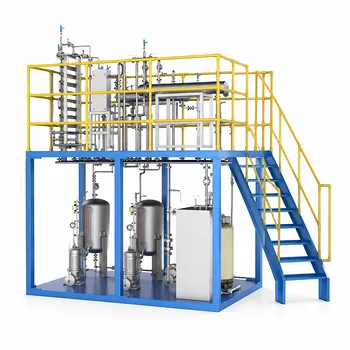
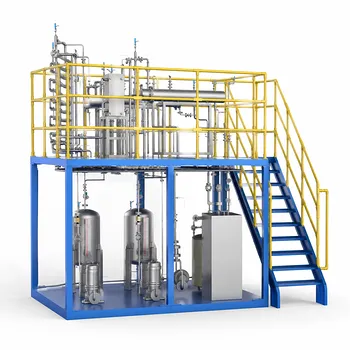
The journey from a balanced chemical equation to a sustainable industrial process begins in the pilot plant. By scaling up reactions in unit operations pilot plants, you can directly observe how the choice of synthesis route transforms raw materials into products—and, crucially, into waste. The concept of atom economy becomes tangible when you compare a traditional multi-step synthesis with a high-efficiency catalytic alternative, physically measure inputs and outputs, and calculate exactly how many reactant atoms end up in your desired molecule versus the waste stream.
Atom economy isn't just a theoretical percentage on a whiteboard. In a pilot plant, it becomes a measurable driver of material cost, waste treatment burden, and process viability. The facility transforms a green chemistry metric into an operational reality, allowing students and researchers to see, touch, and quantify the consequences of molecular design.
Bridging the Gap Between Theory and Tangible Results
A textbook definition of atom economy (AE = molecular weight of target product / sum of molecular weights of all reactants × 100%) feels abstract until you’re standing next to a reactor, loading kilograms of starting material. Pilot-scale unit operations turn that abstraction into a hands-on experimental campaign.
Running Comparative Synthesis Campaigns
The most direct demonstration is a side-by-side evaluation of two synthetic routes to the same product. Run a traditional route that generates significant byproducts (low AE) and a modern catalytic route that incorporates nearly all reactant mass into the final molecule (high AE). Weigh the actual raw materials fed, collect and weigh the purified product, and measure the waste streams. The difference in waste generation between the two runs makes atom economy visceral.
Calculating AE from Real Plant Data
In a pilot plant, you don't guess at yields—you measure them. Students can sample streams, perform mass balances, and calculate the experimental atom economy. Discrepancies between the theoretical AE and the measured performance highlight real-world losses like incomplete conversion, side reactions, or separation inefficiencies. This teaches that a high conceptual AE must be paired with excellent process control to deliver on its promise.
Visualizing Waste Minimization
When a catalytic route achieves a 95% AE versus 60% for a traditional method, the difference isn't just numbers. It translates into fewer drums of spent solvent, lower volumes of hazardous byproducts to treat, and a visibly cleaner process. Pilot plants equipped with downstream separation units make this connection concrete: a high-AE process dramatically reduces the load on distillation columns and extraction vessels, a lesson that stays with learners long after the run ends.
Key Performance Indicators in a Pilot Plant Evaluation
Atom economy is rarely assessed in isolation. The pilot plant allows you to layer in complementary metrics that reveal the full sustainability picture.
Linking AE to Economic Feasibility
A higher atom economy directly lowers raw material cost per kilogram of product. By tracking material consumption across multiple runs, students can calculate cost savings and even perform simple payback analyses. For example, if switching to a high-AE catalyst reduces raw material expenses by $X annually, that saving can be weighed against the incremental cost of the catalyst and any new equipment. This embeds atom economy in a real-world business decision framework.
Monitoring Energy Consumption in High-AE Processes
Superior atom economy often emerges from catalytic routes that operate under milder conditions. Pilot plants instrumented to record steam, electricity, and cooling water usage allow you to overlay energy intensity onto the AE calculation. A process that doubles atom economy but requires extreme temperatures might not be a net green win. The pilot plant reveals the full performance envelope, teaching that green chemistry is a multi-parameter optimization.
Connecting Separation Requirements to AE
Low atom economy means a messy reaction mixture, and pilot-scale separation units—distillation columns, extraction setups, filtration systems—feel that pain immediately. Running a low-AE reaction forces you to use these unit operations extensively, consuming additional energy and generating secondary wastes. Observing this chain reaction helps researchers internalize why minimizing byproducts at the molecular level is the most elegant way to simplify the entire downstream process.
Optimizing Reaction Conditions to Improve Atom Economy
The pilot plant is not just a measurement device; it’s a test bed for improvement. You can systematically adjust parameters and watch the AE climb.
Tuning Temperature and Pressure
By manipulating reaction temperature and pressure, students can shift equilibrium, suppress side reactions, and boost selectivity toward the target product. A pilot reactor with precise control loops allows you to find the sweet spot where atom economy is maximized—often at surprisingly mild conditions that also reduce energy cost.
Catalyst Screening and Loading Studies
Heterogeneous and homogeneous catalysts are the workhorses of high-atom-economy synthesis. A pilot plant can run consecutive experiments varying catalyst type, loading, and support. Measuring the resulting AE and catalyst lifetime provides the kind of engineering data that bench-scale studies cannot fully capture, including catalyst deactivation under realistic fluid dynamics and thermal conditions.
Solvent and Reagent Selection
Sometimes the biggest atom economy gains come from simplifying the recipe. The pilot plant lets you test solvent-free conditions, switch to a more selective reagent, or eliminate a protective-group step entirely. Each modification is evaluated not in a 50-mL flask but in a kilogram-scale, continuous or semi-batch setup where the practicalities of handling and safety become obvious.
Understanding the Trade-offs and Practical Limitations
Honest evaluation means acknowledging that chasing the highest possible atom economy can introduce its own challenges.
The Cost of Selective Catalysts
Catalysts that deliver near-perfect atom economy often rely on scarce or expensive metals. A pilot-scale campaign may demonstrate that the raw material savings are partially offset by high catalyst cost or the need for complex recovery and recycling loops. This trade-off is a critical lesson in holistic process design.
Yield vs. Atom Economy
A reaction with 100% AE can still have a low yield if it proceeds slowly or reversibly under practical conditions. Pilot plant data reveals the true space-time yield: a process that requires impractically long residence times to achieve high AE may be commercially unattractive. Balancing atom economy with productivity is a nuanced decision best taught with real equipment.
By-product Separation Complexity
In some cases, a moderate AE route produces a single, easily removable byproduct, while a high-AE route generates a hard-to-separate impurity at trace levels. Pilot-scale separation studies expose these hidden purification costs, preventing the assumption that higher AE always means simpler downstream processing.
Making the Right Choice for Your Educational or Research Goal
The best way to utilize a pilot plant depends on what you aim to teach or discover. Here are targeted pathways:
- If your primary focus is teaching green chemistry fundamentals: Run a pair of contrasting reactions—traditional vs. catalytic—guide students through mass balances, and have them calculate atom economy alongside waste generation. Let them physically see the waste difference to create a lasting mental model.
- If your primary focus is demonstrating economic viability of a green route: Use the pilot plant to gather accurate material and energy consumption data, then complete a simple payback analysis comparing the current industrial method to the proposed high-AE process. Include separation costs and catalyst life.
- If your primary focus is process optimization and scale-up: Leverage the pilot plant's flexibility to screen catalysts, temperatures, and solvent systems, systematically tracking atom economy and selectivity. Combine this with downstream separations testing to ensure the optimized reaction doesn't create a purification nightmare.
- If your primary focus is linking atom economy to broader sustainability metrics: Expand your pilot plant campaign to record energy use, water consumption, and E-factor. Use these data sets to construct a multi-dimensional sustainability profile, showing that atom economy is a pivotal but not solitary green metric.
The true power of a unit operations pilot plant lies in its ability to transform a conceptual metric like atom economy into a multi-sensory experience of measurement, optimization, and consequence. When you step away from the control panel, you carry forward an engineer's instinct for designing value out of every atom.
Summary Table:
| Evaluation Focus | Practical Action in Pilot Plant | Key Metric / KPI |
|---|---|---|
| Waste Minimization | Compare traditional vs. catalytic routes, weighing outputs | Waste volume & E-factor |
| Economic Feasibility | Track raw material consumption across multiple runs | Raw material cost per kg |
| Energy & Downstream | Monitor steam, power, and separation column loads | Energy intensity & purification cost |
| Process Optimization | Adjust temp/pressure, screen catalysts at scale | Space-time yield & selectivity |
Bring Green Chemistry to Life in Your Lab
LABPARK provides state-of-the-art Educational and Vocational Unit Operations Pilot Plants across chemical engineering, bioprocess & biotech, and environmental & water treatment. Designed specifically for universities, research institutes, and enterprises, our modular pilot plants empower your students and researchers to transition from theoretical calculations to hands-on, measurable process optimization.
Ready to elevate your engineering training and research capabilities? Contact us today to explore our customizable solutions!
Related Products
- Carbon Dioxide Hydrogen Methanol Synthesis Educational Unit Operations Pilot Plant
- Multi Pump Fluid Transport Process Piping Unit Operations Training Pilot Plant
- Natural Product Extraction Unit Operations Training Pilot Plant
- Multi-Modal Distillation Unit Operations Training Pilot Plant
- Multi-Reactor Educational Pilot Plant for Reaction Engineering Unit Operations
People Also Ask
- How do temp & pressure affect methanol synthesis pilot plants? Optimize equilibrium and catalyst performance.
- Why is a purge system necessary when operating a gas recirculation loop in a methanol synthesis pilot plant? (Guide)
- Why do modern methanol pilot plants operate at lower pressures? Catalyst & Feed Requirements Explained
- What are the operational requirements for catalyst activation? Safe Methanol Pilot Plant Operation
- Why is the chemical plant startup schedule crucial? De-risk scale-up with pilot plants.