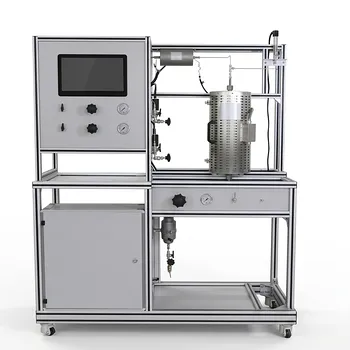
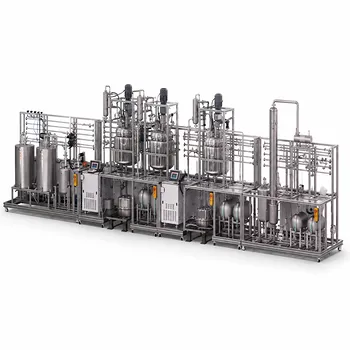
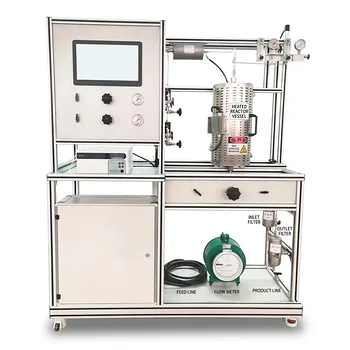
Pilot plants demystify economic optimization by turning a theoretical equilibrium shift into a measurable balance sheet. By systematically increasing the concentration of a cheaper reactant in a continuous stirred-tank reactor (CSTR) or batch reactor, you drive the conversion of more expensive raw materials. Directly analyzing the output then reveals the exact cost-to-benefit ratio, giving you the data to pinpoint the feed mix that maximizes profit, not just yield.
The real power of adjusting reactant concentrations lies in economic leverage. A chemical engineering pilot plant provides the controlled environment to quantify that leverage—showing exactly how many dollars of expensive feedstock are saved for every extra dollar of cheap reactant fed into the reactor, and where the point of diminishing returns actually sets in.
The Economic Logic of Equilibrium Manipulation
Every reversible reaction reaches a dynamic balance—but industrial profit margins depend on pushing that balance far to the product side. Adjusting reactant concentrations is one of the most direct ways to do it.
Le Chatelier’s Principle as a Cost-Cutting Lever
The principle is simple: a system at equilibrium, when disturbed, shifts to relieve the stress. Flooding the reactor with an excess of one reactant creates that deliberate stress.
The equilibrium responds by consuming the added species, forcing the reaction forward and converting more of the other limiting reactant. This is not just a chemistry demonstration; it is a daily practice in cost-conscious manufacturing.
The Industrial Playbook: Sacrifice a Cheap Input to Save an Expensive One
In practice, the cheaper reactant is often a commodity like excess air, water, or a bulk solvent, while the expensive reactant is a high-value intermediate or catalyst-sensitive molecule. The goal is to maximize the conversion of that precious component.
By running the reaction with a stoichiometric excess of the cheap material, you effectively use a low-cost "reagent" to boost the conversion rate of a high-cost raw material. This reduces waste, cuts raw material costs, and increases the yield of the target product per unit of expensive feedstock.
From Reactor to Spreadsheet: How Pilot Plants Validate the Economics
A pilot plant doesn't just prove the chemistry works—it generates the hard numbers needed to make a business case. It bridges the gap between a thermodynamic equation and a manager's profit-and-loss statement.
Setting Up the Experiment: Varying Molar Ratios in CSTRs and Batch Reactors
The experiment starts with a clear matrix of reactant feed ratios. In a CSTR, you can precisely control continuous feed streams; in a batch reactor, you charge specific initial concentrations.
You might run the same reaction at 1:1, 1:2, 1:5, and 1:10 molar ratios of expensive-to-cheap reactant. Each run provides a new steady-state or endpoint for analysis, directly simulating an industrial tweak.
Data Collection: Inline Sensors and Composition Analysis
Pilot plants equipped with inline sensors (for pH, conductivity, or spectroscopy) allow real-time monitoring of the equilibrium shift. This hands-on data stream reinforces Le Chatelier's principle by letting you watch the system re-equilibrate after a disturbance.
For the economic analysis, you rely on offline analytical instruments like gas chromatography or titration to get precise output concentrations. These measured values are the foundation of your cost calculations.
The Crucial Metric: Calculating the Cost-to-Benefit Ratio
The raw data transforms directly into economic insight. For each run, you calculate:
- Conversion of the expensive reactant (moles consumed / moles fed)
- Cost of the cheap reactant fed (price per mole × total moles)
- Value of the expensive reactant saved compared to a baseline run
This yields a cost-to-benefit ratio. A ratio greater than 1.0 means you save more money on the expensive raw material than you spend on the extra cheap reactant—clearly marking a profitable operating point.
Connecting the Dots to Payback Period and ROI
The pilot plant data becomes the engine for a full economic feasibility analysis. You can calculate the annual savings from running a full-scale plant at the optimized molar ratio (e.g., saving a specific tonnage of expensive feedstock per year).
Divide the capital cost of any required process modification (like a larger feed system for the cheap reactant) by this annual saving to get the simple payback period. This teaches engineers that a yield improvement of just a few percent, proven on a pilot scale, can translate into a rapid return on investment.
Understanding the Trade-offs: The True Economic Optimum
A higher conversion is not always the best economic outcome. The pilot plant also reveals the hidden costs that can erode the apparent savings.
The Separation Penalty: Recovering Excess Reactant Isn't Free
Injection of a huge excess of cheap reactant shifts the equilibrium forward, but that unreacted flow must go somewhere. In many processes, it ends up in the product stream and must be separated through distillation, extraction, or another unit operation.
The energy, capital, and operating costs of that extra separation stage can quickly outweigh the raw material savings. A pilot plant running coupled reaction-separation experiments (like a reactor with a distillation column) makes this integrated cost visible.
When Maximizing Conversion Erodes Profit Margins
The law of diminishing returns applies ruthlessly. The first doubling of a cheap reactant might drive conversion from 70% to 85%, offering a huge economic win. The next doubling might only push it to 90%, with a much smaller marginal gain.
If that gain requires triple the separation effort, you have crossed a profit threshold. The economic optimum is the point where the incremental cost of the cheap reactant and its recovery equals the incremental value of the extra product, not where the conversion is highest.
The Real Goal: Minimizing Total Process Cost, Not Just Feed Cost
The pilot plant teaches a systems-level view. By running the full series of experiments and calculating the total cost per kilogram of product for each molar ratio, you can plot a clear curve.
That curve typically has a minimum—the true economic sweet spot. This lesson in holistic optimization, balancing a reaction gain against a separation cost, is one of the most valuable a future chemical engineer can learn.
Making the Right Choice for Your Learning or Development Goal
Whether you are designing a curriculum, a plant modification, or a new catalyst screen, the pilot plant's approach should be tailored to your objective.
- If your primary focus is teaching core thermodynamics: Use a simple batch reactor with a fast, reversible esterification. Let students manually vary the alcohol concentration, measure conversion, and verify Le Chatelier's principle with both quantitative data and direct cost calculations.
- If your primary focus is a profitability analysis for a process upgrade: Run a designed experiment in a CSTR that precisely mimics your full-scale plant's conditions, capturing not just conversion but also the downstream separation costs associated with each molar ratio to identify the true total-cost minimum.
- If your primary focus is commercializing a new high-value molecule: Use the pilot plant to generate the data needed for a payback analysis, comparing the cost of the cheap reactant excess against the value of the expensive precise precursor saved, thereby building a solid investment case for a dedicated plant.
The most enduring lesson a pilot plant can offer is that the "optimum" setting on a process control dial is not a theoretical number but a financial one—and it is yours to discover.
Summary Table:
| Optimization Factor | Process Adjustment | Economic Benefit | Key Trade-off / Cost |
|---|---|---|---|
| Reactant Ratio | Increase concentration of cheaper reactant | Lowers consumption of expensive feedstock | Higher separation & recycling costs |
| Conversion Rate | Drive reaction forward via equilibrium shift | Maximizes product yield per unit of raw material | Law of diminishing returns at high excess |
| Separation Effort | Post-reaction purification & recycling | Recovers unreacted excess materials | High energy consumption & capital cost |
Bring Industrial Economics to Your Lab with LABPARK
Ready to bridge the gap between chemical thermodynamics and real-world process economics? LABPARK provides state-of-the-art Educational and Vocational Unit Operations Pilot Plants in chemical engineering, bioprocess & biotech, and environmental & water treatment.
Designed for universities, research institutes, and enterprises, our pilot plants empower your students and researchers to master equilibrium shifts, optimize yields, and run accurate cost-to-benefit analyses.
Contact LABPARK today to explore our customizable pilot plant solutions and request a technical consultation!
Related Products
- Carbon Dioxide Hydrogen Methanol Synthesis Educational Unit Operations Pilot Plant
- Multi Pump Fluid Transport Process Piping Unit Operations Training Pilot Plant
- Natural Product Extraction Unit Operations Training Pilot Plant
- Multi-Modal Distillation Unit Operations Training Pilot Plant
- Multi-Reactor Educational Pilot Plant for Reaction Engineering Unit Operations
People Also Ask
- How do temp & pressure affect methanol synthesis pilot plants? Optimize equilibrium and catalyst performance.
- Why is a purge system necessary when operating a gas recirculation loop in a methanol synthesis pilot plant? (Guide)
- Why do modern methanol pilot plants operate at lower pressures? Catalyst & Feed Requirements Explained
- What are the operational requirements for catalyst activation? Safe Methanol Pilot Plant Operation
- Why is the chemical plant startup schedule crucial? De-risk scale-up with pilot plants.