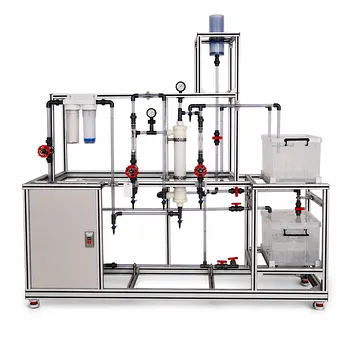
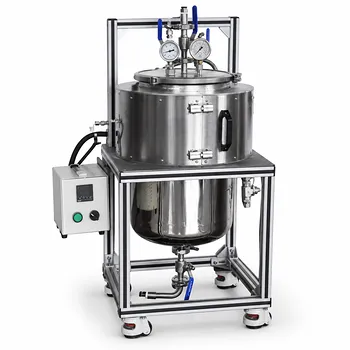
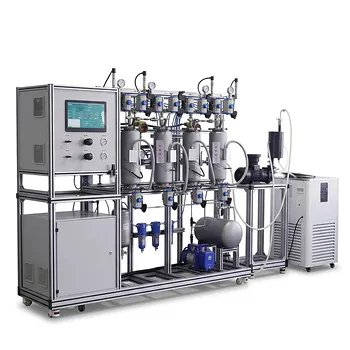
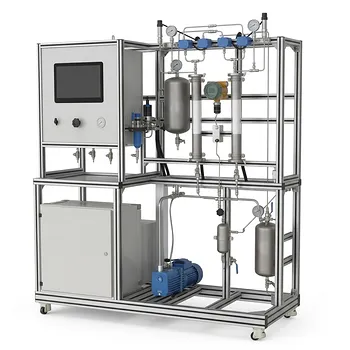
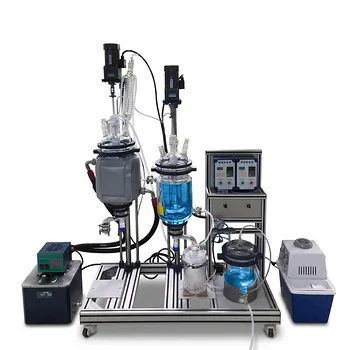
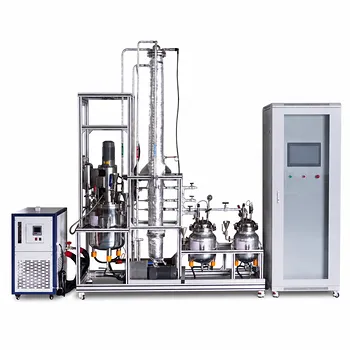
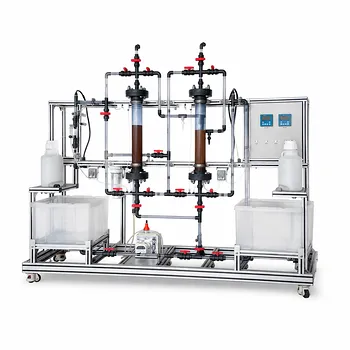
The direct answer lies in an integrated, two-stage configuration. A chemical engineering pilot plant configured to study this synergy will pair a fixed-bed adsorber column, packed with a sulfonated microporous polymer (often a PolyHIPE polymer), with a high-voltage electro‑coalescence cell. The emulsion flows first through the polymer bed, where interfacial active agents (surfactants) are selectively stripped from the droplet surfaces. This chemically destabilizes the emulsion. The pre-treated mixture then enters the electrostatic separator, where the applied field effortlessly coalesces the now‑unprotected water droplets, achieving immediate, high‑efficiency separation even at flow rates that would overwhelm a purely electrical system.
The core takeaway: The polymer acts as a chemical pre‑conditioner that removes the emulsion’s stabilizers. By thinning the surfactant film before the electric field is applied, the system decouples the limits of physical coalescence, enabling continuous, high‑throughput demulsification while simultaneously adsorbing dissolved metal impurities from the oil and water phases.
Core Components of a Synergistic Pilot Plant
The Front‑End: Microporous Polymer Bed
The heart of the chemical assist is a packed‑bed column filled with a sulfonated, microporous polymer—typically a PolyHIPE (Polymerised High Internal Phase Emulsion) foam.
Its dual function is critical.
- Demulsification via surfactant adsorption: The polymer’s high internal surface area boasts both hydrophilic and hydrophobic domains. Surfactants that stabilize the water‑oil interface adsorb onto these matched moieties, breaking the interfacial film.
- Metal and contaminant scavenging: The same porous structure actively adsorbs dissolved metals such as sodium, magnesium, calcium, aluminum, and even silica from the crude oil, as confirmed by EDAX analysis.
Students and researchers can vary polymer mass, pore size, and degree of sulfonation to map the rate of surfactant depletion and its subsequent effect on coalescence.
The Back‑End: Electro‑Coalescence Cell
Downstream of the polymer adsorber sits a coaxial or parallel‑plate electrode vessel capable of applying a controllable high‑voltage field.
This is not a standard gravity settler.
- The electric field induces dipolar forces on the pre‑destabilized droplets, causing them to agglomerate into millimeter‑size drops almost instantaneously.
- The enlarged droplets then settle rapidly under gravity or in a subsequent separation zone, producing a clean aqueous phase and a dry organic phase.
The key is that the polymer shifts the droplet population from a stable, highly‑emulsified state to one that is electrically responsive. Without the polymer, many droplets remain too small or too protected to coalesce even under high voltages.
Downstream Monitoring and Sampling
A robust pilot plant will include multiple sampling ports immediately before and after each unit, as well as on the separated phases.
This enables the direct measurement of:
- Surfactant concentration and the formation of stable surfactant gel‑phases inside the polymer pores.
- Metal content in the oil and water, quantifying the polymer’s ion‑exchange performance.
- Separation efficiency (water content in the oil outlet) under varying conditions using Karl Fischer titration or inline capacitance probes.
The Mechanism: How the Polymer Amplifies Electric Field Performance
Selective Adsorption Destabilizes the Droplet Interface
The primary reference highlights surfactant adsorption on the polymer’s hydrophilic and hydrophobic moieties.
When the emulsion contacts the polymer, the surface‑active molecules that lower interfacial tension and prevent droplet contact are sequestered into the polymer’s micro‑pores.
- The remaining droplet surface becomes bare and energetically favorable for coalescence.
- This is why the electric field now works so effectively—the physical barrier to coalescence is gone.
Formation of Surfactant Gel‑Phases and Metal Extraction
The supplementary references note that the polymer can create stable surfactant gel‑phases within its pores, effectively locking the surfactants away.
Simultaneously, dissolved metal ions (Na, Mg, Ca) are extracted from the aqueous phase by the sulfonated groups on the polymer backbone. This dual action improves not only separation but also oil quality, reducing downstream corrosion and catalyst poisoning in refining.
Synergistic Performance that Defeats Inherent Limits
Experiments show a dramatic behavioral threshold.
- At a flow rate of 90 mL/min, a standalone electrostatic separator might deliver zero immediate separation—the emulsion remains stable even after the electrodes.
- By pre‑treating the same emulsion through the polymer adsorber, complete, immediate phase separation is achieved at that same flow rate.
The synergy is rooted in the fact that coalescence rate is a product of collision frequency and coalescence efficiency. The polymer maximizes the latter to near‑unity, so only a modest electric field is needed to create the collisions.
Key Operating Parameters to Study
Electric Field Strength and Frequency
Start with a baseline voltage that is known to fail on the raw emulsion, then ramp upwards after polymer pre‑treatment.
Students can observe the threshold voltage drop significantly once the surfactant load is reduced, confirming the polymer’s role.
Emulsion Flow Rate and Residence Time
Use a dual‑path configuration: one path bypasses the polymer bed, the other passes through it.
By gradually increasing the total flow rate, researchers establish the maximum throughput for each path. The polymer path will sustain high separation efficiencies where the non‑polymer path collapses, vividly illustrating the process‑intensification concept.
Temperature and Feed Contaminant Loading
Elevating the temperature reduces oil viscosity and increases the density difference, accelerating settling.
But the synergy adds another dimension: a hot emulsion may strip surfactants from the polymer more rapidly or alter ion‑exchange kinetics. A pilot plant should include a heat exchanger upstream of the polymer bed to decouple thermal effects from the chemical destabilization.
Polymer Regeneration Cycles
The pilot plant should be designed for continuous adsorption‑desorption cycles.
Monitoring when separation efficiency begins to fade reveals the polymer’s capacity limit. Subsequent regeneration with mild solvents or pH adjustments can then be demonstrated, linking laboratory research directly to industrial process economics.
Understanding the Trade‑offs
While the synergy is powerful, a pilot plant design must reflect real‑world compromises.
- Pressure drop and fouling: A packed bed of microporous polymer introduces a resistance to flow. High‑viscosity emulsions or waxy crudes may cause clogging. Pilot‑scale experiments are essential to measure pressure drop and identify feed pre‑treatment requirements (e.g., filtration, dilution).
- Polymer durability and swelling: Continuous contact with hot crude and washing cycles can cause polymer swelling or mechanical degradation. Long‑duration runs must monitor changes in polymer bed porosity and demulsification efficiency.
- Chemical cost and regeneration: The adsorbent’s finite capacity means a regeneration step is necessary. The pilot plant must help quantify both the direct cost of the polymer replace/regenerate cycle and the economic trade‑off against the reduced electric power consumption and higher throughput.
- Scalability of the electric field: While the polymer makes low‑voltage operation possible, the electrode geometry must still be designed to handle a variable water cut. A high‑water‑cut emulsion may short‑circuit the electrodes if not properly managed, a failure mode that the pilot plant can reveal.
How to Configure Your Pilot Plant for Specific Research Goals
After sizing the two core units, the final configuration depends on your primary learning objective.
- If your primary focus is mechanistic understanding: Build the plant with multiple, transparent observation ports and sample valves between the polymer bed and the coalescer. Add the ability to bypass the polymer, and install a microscope or high‑speed camera to record droplet size distributions before and after each stage. This directly links surfactant depletion to coalescence kinetics.
- If your primary focus is process intensification and scale‑up: Instrument the plant heavily with flow meters, pressure transducers, and inline water‑cut analyzers. Design the polymer adsorber as a modular, replaceable cartridge and run identical tests with and without it at escalating flow rates. The data will generate the correlations you need for industrial sizing equations.
- If your primary focus is water purification and metal removal: Add an ion‑chromatography or ICP‑OES sampling line to the separated aqueous outlet. Cycle the polymer through multiple adsorption‑desorption rounds and correlate the breakthrough of specific metal ions with the loss of demulsification efficiency, demonstrating the polymer’s dual role as a simultaneous water purifier.
This integrated, two‑stage approach transforms an ordinary electrostatic separator into a responsive, high‑rate, multi‑functional system, giving you a complete picture of how chemical and electrical forces truly work together.
Summary Table:
| Stage | Key Component | Primary Function | Key Parameters to Study |
|---|---|---|---|
| Front-End | Microporous Polymer Bed | Removes surfactants & adsorbs metal impurities | Polymer mass, pore size, regeneration cycles |
| Back-End | Electro-Coalescence Cell | Induces dipolar forces for rapid droplet settling | Voltage strength, frequency, flow rate |
Ready to advance your research in advanced separation technologies? LABPARK provides state-of-the-art Educational and Vocational Unit Operations Pilot Plants in chemical engineering, bioprocess & biotech, and environmental & water treatment. Specially designed for universities, research institutes, and enterprises, our systems enable you to easily configure and study complex processes like electro-coalescence and polymer demulsification. Contact us today to customize your pilot plant and accelerate your research!
Related Products
- Multifunctional Membrane Separation Educational Pilot Plant with Ultrafiltration, Nanofiltration, Reverse Osmosis
- Ultrafiltration Membrane Separation Educational Pilot Plant
- Hot Filtration Educational Unit Operations Pilot Plant Laboratory System
- Multi-Functional Membrane Separation Educational Pilot Plant for Unit Operations Lab
- Bio-fermentation Ethanol Production Practical Training Unit Operations Pilot Plant
People Also Ask
- How do PEI, PVDF, and PSU membranes compare in pilot plants? Find the best fit.
- Pervaporation vs. Vapor Permeation: Handling Suspended Solids in Membrane Pilot Plants
- What are the trade-offs of polymer vs inorganic membranes in teaching pilot plants? Key laboratory comparison.
- How can operators optimize operating conditions and cleaning protocols in membrane separation pilot plants to mitigate fouling?
- What are the advantages of membrane separation in pilot plants? Efficient Organic Vapor Recovery