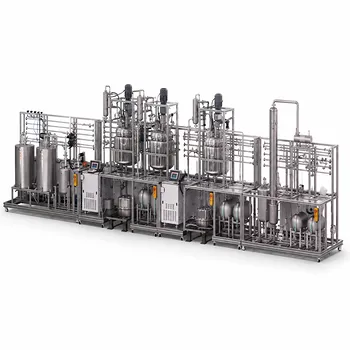
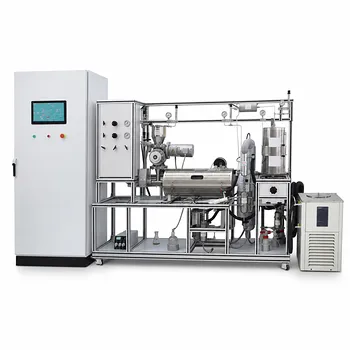
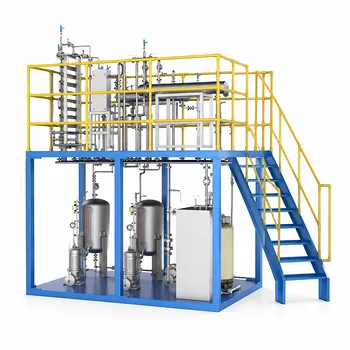
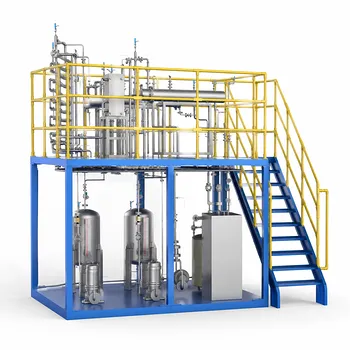
At its core, a chemical engineering pilot plant is a kineticist’s most powerful tool, transforming abstract rate equations into tangible experimental evidence. By operating a jacketed batch or continuous reactor under strictly controlled, isothermal conditions, students and researchers can collect reliable concentration–time data. This empirical dataset then becomes the canvas for applying the integral method—plotting integrated rate laws to find a linear correlation and extract the rate constant $k$—or the differential method, which estimates the instantaneous reaction rate $\frac{dC_A}{dt}$ at multiple concentrations to directly verify the hypothesized reaction mechanism.
Pilot plants empower students and researchers to move beyond idealized textbook problems by providing the precise physical infrastructure—temperature control, sampling ports, and defined reactor hydrodynamics—needed to produce the trustworthy concentration–time data that make integral and differential kinetic analysis possible. This bridge between theory and real process behavior is the key to mastering kinetics and preparing for industrial reactor design.
The Critical Role of Controlled Experimentation
Kinetic parameters are only as good as the data behind them. A pilot plant transforms a hypothesis into a reproducible, safe experiment.
Precisely Controlling the Reaction Environment
Chemical reactions are exquisitely sensitive to temperature. The jacketed reactors and heat exchangers in a pilot plant maintain isothermal operation, eliminating one of the most significant sources of error in kinetic studies. Without this control, the rate constant itself would vary during the experiment, making any analysis ambiguous.
Generating a Reliable Concentration–Time Dataset
Pilot plants are equipped with sampling ports and often online analytical sensors (spectroscopy, conductivity, etc.). This infrastructure allows researchers to withdraw small aliquots at defined time intervals or continuously monitor reactant concentration. For the integral and differential methods, the quality of this time-series data—its frequency and accuracy—determines the precision of the final kinetic parameters.
Applying the Integral Method: From Data Plots to Rate Constants
Once the concentration–time data is collected, students can immediately test proposed rate laws by integrating them and looking for a straight line.
How the Integral Method Works
The integral method assumes a reaction order. The corresponding integrated rate equation is then plotted against time. If the assumption is correct, the plot yields a linear relationship, and the slope directly gives the rate constant $k$. For example:
- First-order: Plotting $\ln(C_A)$ vs. $t$ produces a straight line with slope $-k$.
- Second-order (equal initial concentrations): Plotting $1/C_A$ vs. $t$ produces a straight line with slope $k$.
Why Pilot Plant Data Makes This Method Powerful
Pilot-scale reactors generate real-world, non-ideal data. Students quickly learn to distinguish a truly linear trend from experimental noise, a skill that textbook problems cannot teach. The ability to run reactions for extended durations and at multiple temperatures also allows them to collect enough data points to confidently judge the goodness of fit for different reaction orders.
Probing the Mechanism with the Differential Method
While the integral method assumes a mechanism to test $k$, the differential method directly measures the reaction rate to deduce the mechanism.
Direct Rate Estimation from Concentration Profiles
The differential method requires finding the instantaneous rate $-\frac{dC_A}{dt}$ at various concentrations $C_A$. On a pilot plant, frequent sampling or a continuous online analyzer can generate a smooth concentration–time curve. This curve enables numerical differentiation (e.g., graphical tangents or finite differences) to estimate the rate. By then plotting $\ln(\text{rate})$ vs. $\ln(C_A)$, you can read the reaction order $n$ from the slope without any prior assumption about the mechanism.
Exposure to Real Process Behavior
Direct rate measurement highlights the impact of mass transfer limitations or imperfect mixing—phenomena inherent in real pilot-scale equipment. When the differential plot deviates from ideal behavior, it forces a critical discussion about whether the true kinetics are being observed or whether a transport limitation is interfering, a lesson rarely gleaned from theoretical data.
Advanced Kinetic Studies Enabled by Pilot Plants
Beyond the basic parameter calculations, pilot plants unlock deeper investigations.
Decoupling Kinetics from Reactor Hydrodynamics
A pilot plant with interchangeable reactors—a batch reactor for isothermal integral analysis, a CSTR for steady-state differential rate measurement, a plug flow reactor (PFR) for spatial concentration profiles—allows users to isolate the true chemical kinetics from the mixing pattern. The same reaction run in all three configurations should yield the same intrinsic kinetic parameters; any discrepancy teaches the profound difference between intrinsic kinetics and observed reactor performance.
Determining Activation Energy Through Temperature Variation
With precise temperature control, operators can repeat a kinetic experiment at several temperatures. For each run, the integral or differential method gives a $k$. Plotting $\ln(k)$ vs. $1/T$ (Arrhenius plot) then yields the activation energy $E_a$ from the slope. This directly connects the laboratory-scale pilot plant to molecular collision theory and provides the essential thermal parameter for industrial reactor design.
Bridging Theory and Industrial Practice
Unit operations pilot plants serve as the physical mesoscale bridge between the microscale (molecular kinetics and catalysis) and the macroscale (process design and control). By observing how carefully determined kinetic parameters translate into real conversion, yield, and heat evolution, students and researchers internalize the discipline of scale-up. They learn to identify Critical Process Parameters (CPPs) and to anticipate how a seemingly perfect reaction mechanism can behave differently inside a full-scale industrial vessel.
Understanding the Trade-offs and Common Pitfalls
Pilot plants are not magic black boxes; they demand critical interpretation.
Data Quality vs. Sampling Frequency
The differential method is highly sensitive to noise in the concentration–time data. Infrequent sampling or inconsistent manual withdrawal can create apparent rate fluctuations that overwhelm the kinetic signal. While online analyzers solve this, they introduce their own lag and calibration challenges.
Non-Isothermal Drift and Mixing Effects
Even with a jacketed reactor, highly exothermic reactions can create hot spots or temperature gradients. This means the calculated $k$ may reflect an average temperature, not a single isothermal value. Similarly, mixing time in a large batch pilot plant can be comparable to the reaction half-life, causing concentration gradients that violate the ideal reactor model and corrupt kinetic analysis.
Scale-Down Limitations
Pilot plants are a compromise. Surfaces-to-volume ratios differ from benchtop-scale, affecting catalyst contact and wall effects. Data collected at one scale must be validated across scales before being used for final reactor design. Recognizing these limitations is just as crucial as collecting the data.
Making the Right Choice for Your Goal
To get the most from a pilot plant for kinetic studies, align your experimental approach with your objective.
- If your primary focus is mastering the integral method as a student: Use a batch reactor with precise temperature control. Collect concentration data at regular intervals and manually fit integrated rate laws to experience how data quality affects the linearity test.
- If your primary focus is verifying a complex reaction mechanism with the differential method: Utilize a CSTR or a PFR with an online analytical sensor to capture high-density, steady-state or spatial concentration data, minimizing the error in rate estimation.
- If your primary focus is generating robust kinetic parameters for scale-up: Run the same reaction in multiple reactor configurations (batch, CSTR, PFR) at the pilot scale. The consistency of the derived $k$ and $E_a$ across these systems builds the confidence needed for industrial design.
- If your primary focus is teaching the connection between kinetics and process control: Deliberately introduce a CPP variation (e.g., a temperature ramp or a deliberate mixing deficiency) and use the pilot plant to demonstrate how the observed rate deviates from the intrinsic kinetics, turning a potential pitfall into a powerful lesson.
By strategically leveraging the controlled environment of a unit operations pilot plant, you do not just calculate a rate constant—you develop an engineer’s intuition for how molecules interact at scale, an ability that no simulation or textbook can fully instill.
Summary Table:
| Method | Objective | Key Data Needed | Main Advantage |
|---|---|---|---|
| Integral Method | Find rate constant ($k$) by testing assumed orders | Linear concentration-time plots | Simple to fit, filters out experimental noise |
| Differential Method | Deduce reaction order ($n$) and mechanism | High-density or continuous concentration curves | No prior mechanism assumptions needed |
Bring Theory to Life in Your Lab with LABPARK
Are you looking to equip your students and researchers with hands-on kinetics experience? LABPARK provides premium Educational and Vocational Unit Operations Pilot Plants in chemical engineering, bioprocess & biotech, and environmental & water treatment. Designed for universities, research institutes, and enterprises, our pilot plants deliver the precise temperature control, hydrodynamics, and analytical integration needed to master reaction kinetics and scale-up processes.
Ready to elevate your engineering curriculum or research capabilities? Contact LABPARK today to request a quote or custom solution!
Related Products
- Carbon Dioxide Hydrogen Methanol Synthesis Educational Unit Operations Pilot Plant
- Multi Pump Fluid Transport Process Piping Unit Operations Training Pilot Plant
- Natural Product Extraction Unit Operations Training Pilot Plant
- Multi-Modal Distillation Unit Operations Training Pilot Plant
- Multi-Reactor Educational Pilot Plant for Reaction Engineering Unit Operations
People Also Ask
- How do temp & pressure affect methanol synthesis pilot plants? Optimize equilibrium and catalyst performance.
- Why is a purge system necessary when operating a gas recirculation loop in a methanol synthesis pilot plant? (Guide)
- Why do modern methanol pilot plants operate at lower pressures? Catalyst & Feed Requirements Explained
- What are the operational requirements for catalyst activation? Safe Methanol Pilot Plant Operation
- Why is the chemical plant startup schedule crucial? De-risk scale-up with pilot plants.