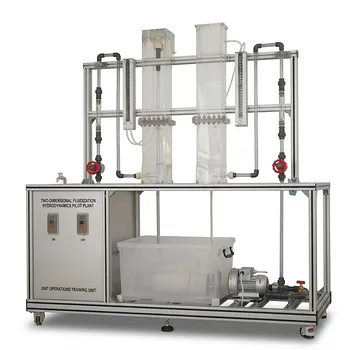
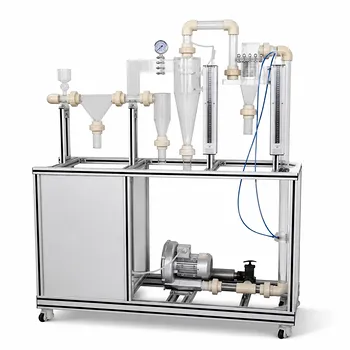
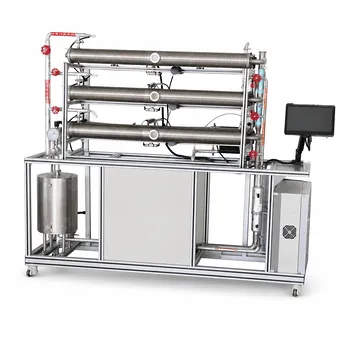
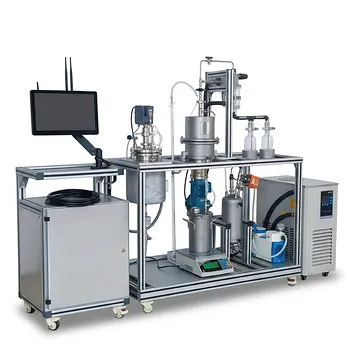
You can immediately evaluate powder flowability in a pilot plant by measuring the angle of repose (AOR).
Students pour the powder through a funnel, measure the height and base radius of the resulting conical heap, and calculate AOR = arctan(h/r). This simple value then classifies the powder from ‘excellent’ flow (25–30°) to ‘poorest’ flow (>66°), letting you quickly judge whether a material will feed smoothly from hoppers, blind a transfer line, or require mechanical aids. More than a single number, AOR teaches why particle size, shape, and moisture control are decisive for every downstream solids handling operation.
The Core Insight:
The angle of repose is not a fundamental material property—it’s an empirical fingerprint of how friction, cohesion, and particle geometry interact under gravity. In a pilot plant, it gives you an immediate, low-cost reality check on powder flowability before you commit to any design change, batch recipe, or troubleshooting step.
Why the Angle of Repose Matters in a Pilot Plant
It Closes the Gap Between Theory and Reality
Chemical engineering curricula teach pressure drop, pump curves, and heat transfer intimately.
Solids handling, however, often feels unpredictable because powders are not simple continuous fluids.
The angle of repose gives you a tangible, visual link between particle-level forces and bulk behavior.
When a powder forms a steep, stable cone, you instantly see that cohesion and friction dominate.
A shallow, flat pile tells you the material is free-flowing.
It’s the Fastest Screening Tool for Flowability
In a pilot plant, you cannot afford to dismantle a feed system or run a full shear test every time a new batch arrives.
AOR measurement requires nothing more than a funnel, a ruler, and a few grams of material.
This speed lets you screen multiple batches, compare suppliers, or check the impact of drying a powder.
If the AOR jumps from 32° to 48° after a humid shift, you know immediately that the hopper is at risk of arching.
How to Measure the Angle of Repose Correctly
The Fixed-Funnel Method
This method is the most reproducible for students because it minimizes operator variability.
Set a funnel at a constant height above a flat, level surface.
Pour the powder gently through the funnel, let it form a self-limiting conical heap, and stop before excess mass slides down the sides.
Measure the heap height (h) from the base to the cone’s apex.
Measure the base radius (r) – this is the distance from the centre to the edge of the pile, not the diameter.
Calculate AOR = arctan (h/r). Use consistent units (e.g., millimetres) and record the result in degrees.
Critical Measurement Details
Keep the funnel height fixed across all tests. A larger drop height can compact the pile and artificially lower the AOR.
Use a split-pour technique if the powder segregates: slowly fill a quarter of the funnel at a time to avoid biasing the centre with fines.
Take a photograph of the heap against a grid or place a protractor behind it. A visual cross-check helps catch errors in h or r.
Single Data Point or Trend?
One AOR measurement gives a snapshot, but a series tells the real story.
Compare the angle of a just‑opened powder with the same powder after 24 hours of storage in humid air.
Compare the angle of a fine, cohesive API with the free‑flowing excipient you intend to blend it with.
By plotting AOR against moisture content or against a process variable like blending time, you transform a single number into a diagnostic tool.
Interpreting the Results: From Angle to Flow Behavior
The Standard Classification
Use the scale directly from your primary reference to translate degrees into operational reality:
- 25–30° – Excellent flow. The powder will discharge from hoppers easily, likely requiring minimal slope.
- 31–35° – Good flow. Still reliable, but slight stickiness may appear with fine particles.
- 36–40° – Fair flow. Often borderline; watch for intermittent ratholing in narrow outlet hoppers.
- 41–45° – Passable, but needs attention. You may need steep walls or vibration.
- 46–55° – Poor flow. Cohesive forces clearly dominate; mass flow design and flow aids become necessary.
- 56–65° – Very poor flow. Almost certain bridging unless hopper walls are extremely steep or the outlet is large.
- >66° – Poorest flow. The powder behaves almost like a semi-solid. Mechanical agitation or forced extraction is essential.
Why the Number Isn’t Enough
A single AOR doesn’t distinguish between two powders that both measure 40° but for completely different reasons.
One might be coarse, dry sand with high interlocking friction. The other might be a fine, cohesive powder with strong inter-particle forces.
That distinction matters: the sand can be made to flow with a steep hopper, while the cohesive powder may still bridge because its issue is tensile strength, not just friction.
This is where you must bring in the deeper science.
The Science Behind the Number: Factors That Change the Angle
Particle Size and Cohesion
The AOR is inversely related to particle size up to a point.
As the supplementary reference explains, flow rate is directly proportional to particle size because gravity’s effect increases with the cube of diameter, while surface forces (Van der Waals, electrostatics) scale with area.
Fine particles (<100 µm) often show AOR above 45° because cohesion dominates.
Larger, granular particles (>500 µm) typically flow with angles below 35°, unless moisture or shape intervenes.
Particle Shape and Interlocking
Spherical, smooth particles pack loosely but slide over each other easily, yielding low AOR.
Needle-like, angular, or highly irregular particles interlock mechanically, increasing the angle dramatically.
In a pilot plant, this explains why a crystallized product might flow beautifully while the milled version of the same substance clogs the feed line. The chemistry hasn’t changed, but the particle geometry has.
Moisture: The Hidden Flow Killer
Even a small increase in moisture content can spike the AOR.
Water forms liquid bridges between particles, adding capillary cohesion and adhesive forces that stick particles to walls.
If your AOR jumps by 10°–15° after exposing the powder to ambient air, the root cause is almost certainly moisture uptake.
The fix is often simpler than re‑engineering the hopper: dry the powder or condition the environment.
Porosity, Density, and Compaction State
High‑density particles with low porosity tend to flow better because their weight overcomes cohesive forces.
Conversely, a highly porous, low‑density powder can exhibit a deceptively high AOR even when dry.
Also, note that the AOR is measured on a “poured” heap.
In a real hopper, consolidation pressure can lock particles together, producing a higher effective angle than the poured AOR suggests. This is why some powders flow easily at the heap but arch under the modest head of a feed bin.
From Measurement to Action: Applying AOR in a Pilot Plant
Predicting and Preventing Flow Obstructions
Arching: If your AOR exceeds 45°, the powder is capable of forming a stable arch across the hopper outlet.
Increase the outlet diameter, steepen the hopper walls, or introduce a mechanical agitator. A practical rule: the hopper half‑angle from the vertical should be at least 5°–10° less than (90° – AOR) to approach mass flow.
Ratholing: Purely cohesive powders with high AOR often develop a central flow channel while the bulk material remains stagnant.
The same design remedies apply, but you may also need to actively monitor stored inventory because visual checks are unreliable.
Designing Reliable Feeding Systems
Students can use the AOR to choose between a simple conical hopper and a more expensive mass‑flow design.
A powder with an AOR of 30° might feed reliably from a flat‑bottomed bin with a small cone insert.
A powder with an AOR of 50° almost certainly requires a steep‑cone mass‑flow hopper and possibly a screw feeder to break any bridges.
The measurement also tells you whether you can rely on gravity alone or need to add vibration, aeration pads, or a mechanical stirrer to the feed hopper.
Connecting AOR to Process Troubleshooting
Suppose your fluidized‑bed reactor suddenly shows poor circulation.
Measure the AOR of the bed material. If it has risen by 10°, you might have fines accumulation or moisture ingress. Correct those upstream issues instead of blindly adjusting the air flow.
Similarly, if a tableting press starts exhibiting weight variation, check the AOR of the granulate. A higher angle than the norm signals that poor flow into the die cavity is the real culprit, not the press settings.
Understanding the Limitations of the Angle of Repose
It’s Not a Rheological Property
The AOR is not the same as the angle of internal friction (α) derived from shear cell tests.
The Coulomb yield locus describes the relationship between shear stress and normal stress, giving you τ = c + σ tan α.
While AOR often correlates with α for free‑flowing, cohesionless materials, it confounds cohesion and friction in a single number.
Do not use AOR as a direct input for hopper structural design—that requires a proper flow function test. The AOR is for screening, ranking, and diagnosing, not for engineering the steel thickness.
Operator Sensitivity and Reproducibility
The method is deceptively simple but sensitive to the pour rate, drop height, and even the cleanliness of the funnel.
Different students in the same laboratory can easily obtain values several degrees apart if they are not consistent.
Always document the exact procedure (funnel type, orifice diameter, distance, pour speed).
Compare relative trends rather than absolute numbers across different groups, and use a standard reference powder for calibration.
Single‑Point vs. Dynamic Behavior
A static heap tells you nothing about how the powder flows under consolidation or shear.
Some powders that form a steep AOR heap can actually flow more easily in a hopper because they are not very compressible.
Conversely, some free‑flowing powders may gain strength over time due to caking or compaction.
Supplement AOR with tap density, flow‑through‑orifice time, or Schulze shear cell tests when you need a complete picture.
Making the Right Choice for Your Pilot Plant Goal
Use the angle of repose as a strategic tool, but always pair it with an understanding of your specific process requirements.
- If your primary focus is rapid screening of material suppliers: Measure the AOR of incoming batches immediately. Flag any deviation greater than 5° from the validated standard and hold the batch for further testing.
- If your primary focus is hopper design education: Let students calculate the required hopper half‑angle from the AOR, then compare that with published mass‑flow design charts. Show them when the simple AOR rule works and when a shear cell test is inevitable.
- If your primary focus is troubleshooting erratic feed in an existing pilot line: Measure the AOR of the troublesome powder and compare it with the historical data from when the system ran well. If the angle increased, look for particle attrition, moisture uptake, or segregation.
- If your primary focus is teaching the link between particle properties and flowability: Have students deliberately alter particle size, shape, or moisture and map the resulting AOR. The visual impact of a steep, stubborn heap makes the science unforgettable.
Ultimately, the angle of repose empowers chemical engineering students to see powders not as mysterious, unruly solids but as materials whose behavior can be measured, predicted, and controlled with just a funnel and a ruler—and a solid grasp of the physics behind the pile.
Summary Table:
| AOR Range | Flowability | Operational Impact & Action |
|---|---|---|
| 25°–30° | Excellent | Flows easily; minimal hopper slope required. |
| 31°–35° | Good | Reliable flow; minor stickiness with fine particles. |
| 36°–45° | Fair to Passable | Borderline flow; may require steep hopper walls or vibration. |
| 46°–65° | Poor to Very Poor | Cohesive behavior; requires mass flow design or flow aids. |
| >66° | Poorest | Semi-solid behavior; mechanical agitation is mandatory. |
Enhance Practical Engineering Education with LABPARK
Ready to bring real-world solids handling and chemical process concepts to life? LABPARK provides premium Educational and Vocational Unit Operations Pilot Plants in chemical engineering, bioprocess & biotech, and environmental & water treatment. Designed specifically for universities, research institutes, and enterprises, our systems offer hands-on training that bridges the gap between classroom theory and industrial reality.
Contact LABPARK today to find the perfect pilot plant solution for your lab!
Related Products
- Solid Waste Pyrolysis and Refining Educational Pilot Plant for Unit Operations
- Two-Dimensional Fluidization Hydrodynamics Educational Pilot Plant for Unit Operations Training
- Gas-Solid Heterogeneous Separation Demonstration Educational Unit Operations Pilot Plant
- Educational Unit Operations Pilot Plant for Intraparticle Diffusion Effective Factor Measurement
- Hot Filtration Educational Unit Operations Pilot Plant Laboratory System
People Also Ask
- How do educational unit operations pilot plants bridge theory and design? Bridge the Engineering Gap
- How do educational unit operations pilot plants address safety and waste management when scaling up?
- When to transition from PID to adaptive control in pilot plants? Key process indicators.
- Why is the chemical plant startup schedule crucial? De-risk scale-up with pilot plants.
- Why Use PTFE & Hastelloy in Chemical Pilot Plants? Prevent Corrosion & Ensure Safety