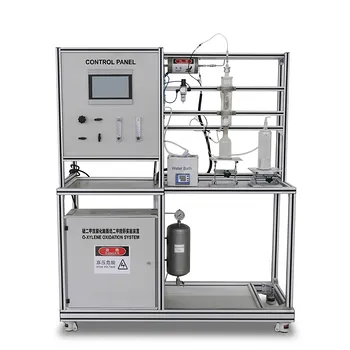
The power of a chemical engineering reactor pilot plant lies in its ability to turn a fascinating color change into a rigorous, quantitative investigation of reaction engineering. By integrating precise temperature control, variable-speed agitation, and real-time analytical sensors, these scaled-down industrial units allow you to systematically observe the thermochromic and solvatochromic transitions of coordination compounds. You can accurately ramp temperature to pinpoint transition thresholds, dose solvents to measure solvation kinetics, and directly apply core chemical engineering principles—like the van’t Hoff equation, heat transfer, and mass transfer—to a visually engaging system. This transforms an abstract benchtop synthesis into a hands-on training platform for industrial reactor operation and process optimization.
The true value of using a reactor pilot plant for these compounds is not just in making them. It’s in creating a controllable, instrumented system where you can quantitatively link temperature and solvent changes to molecular structure, measure the kinetics of those transitions, and deliberately balance thermodynamics, mixing, and heat management—exactly as you would in a production-scale reactor.
Why These Compounds Are an Ideal Pilot Plant Challenge
Thermochromic and solvatochromic coordination compounds, such as nickel-based complexes, change their molecular geometry in response to temperature or solvent environment. For example, a nickel complex can shift from a square planar (often yellow/orange) to an octahedral (often blue/green) configuration as the solvent coordinates or temperature drops. This change is reversible and immediately visible.
At the benchtop scale, you may simply watch the color shift. In a pilot plant, you can engineer that shift, controlling every variable that influences it. The compound becomes a sensitive probe for how well you manage heat, mixing, and material dosing. This makes it an outstanding vehicle for teaching industrial reactor principles—because the feedback is instantaneous, visual, and quantitative when paired with the right instrumentation.
How a Pilot Plant Transforms the Study of Thermochromic Behavior
Precise Temperature Control and Equilibrium Mapping
A jacketed reactor equipped with a programmable thermostatic bath allows you to ramp, hold, and step the temperature with high accuracy. For a thermochromic complex, you can slowly increase the temperature and record the exact temperature at which the color transition begins and completes. This is far more reliable than a hotplate and thermometer.
More importantly, you can treat the structural change as an equilibrium between the low-temperature (often octahedral) and high-temperature (often square planar) forms. By holding the reactor at a series of steady-state temperatures and quantifying the concentration of each species—via in-line UV‑Vis absorbance at a characteristic wavelength—you can calculate an equilibrium constant ($K$) at each temperature. A van’t Hoff plot of $\ln(K)$ versus $1/T$ then yields the enthalpy of the transition ($\Delta H^\circ$). This directly links the color change to thermodynamic theory, teaching students how equilibrium constants shift with temperature for exothermic or endothermic structural rearrangements.
Uncovering Reaction Engineering Principles Through Temperature Profiling
In a pilot plant, you are not limited to a single uniform temperature. With programmable PID controllers and a multi-point temperature sensor array, you can create a temperature profile along a tubular reactor or within the jacket itself. For thermochromic systems that exhibit relatively fast equilibration, you can study how the temperature gradient influences the spatial distribution of colors. This elevates the exercise from simple chemistry to an exercise in reactor design: you see how heat transfer rates, coolant choice, and flow configuration directly impact the product “quality” (color uniformity and transition completeness).
Engineering Solvatochromic Transitions with Controlled Dosing and Mass Transfer
Analyzing Solvation Kinetics Through Precision Dosing
A solvatochromic compound changes color when solvent molecules coordinate to the metal center. In a pilot plant, this becomes a kinetics experiment. A dosing pump can deliver a coordinating solvent (e.g., water, acetonitrile) into the reactor at a precisely controlled rate. Simultaneously, an in-line spectrophotometer records the absorbance change over time, yielding a real-time kinetic curve.
Because the reactor also provides variable-speed agitation, you can deliberately study how mixing intensity affects the observed rate. If the transition is mass-transfer limited, increasing agitator speed will accelerate the color change up to a certain point. This teaches the crucial distinction between kinetic control and diffusion control, a foundation of heterogeneous reaction engineering. Students can calculate the Damköhler number and see visually when the reaction shifts from being reaction-rate-limited to mixing-limited.
Demonstrating Safe Handling of Exothermic Dilution
Many solvatochromic shifts occur with a heat effect, particularly when a coordinating solvent is added, mixing can release heat. The pilot plant’s jacket and safety interlocks allow you to study this thermal response at a scale where it matters. You can measure the temperature rise in real time, calculate the heat of mixing, and design a dosing strategy (slow addition, jacket pre-cooling) that maintains the target temperature. This ingrains industrial safety protocols for exothermic dosing—a lesson far more powerful than a benchtop beaker can deliver.
Integrating Real-Time Analytics to Bridge Theory and Practice
A modern chemical engineering pilot plant for these studies integrates online analytical instruments directly into the process loop. For thermochromic and solvatochromic systems, a flow-through UV‑Vis spectrophotometer or a fiber-optic immersion probe is the most direct sensor. It continuously measures absorbance at the wavelength where the color change is most pronounced. This data, combined with temperature, pressure, and flow rate readings, is fed to a digital data acquisition system.
This setup lets you perform three critical tasks simultaneously:
- Calculate reaction rates from the absorbance–time slope under varying conditions.
- Verify equilibrium models by plotting absorbance vs. temperature at steady state.
- Map hot spots or concentration gradients that might indicate poor mixing or insufficient heat transfer.
The visual feedback of a color change makes abstract chemical engineering concepts—like mass transfer coefficients, activation energies, and equilibrium constants—concrete and immediately observable.
Understanding the Trade-offs and Pitfalls
No experimental setup is without compromise. When deploying a pilot plant for these coordination compound studies, you must navigate several practical challenges:
- Analytical sensor lag: Flow-through spectrophotometers add a time delay and require careful calibration against known concentrations. Fast kinetics can become blurred if the sample loop volume is too large.
- Scale-up discrepancies: The heat transfer and mixing characteristics of a 1‑L jacketed reactor differ from those of a 10‑m³ industrial vessel. A perfectly uniform temperature in the pilot plant can mask gradients that would be catastrophic at production scale.
- Solvent compatibility: Many thermochromic complexes use volatile or aggressive solvents. Gaskets, seals, and pump materials must be selected to prevent leaks or contamination, adding complexity.
- Sensitivity to impurities: A color change is a bulk property. Slight impurities can shift the transition temperature, making it essential to pair the engineering exercise with good chemical synthesis practice.
- Instrumentation cost: Integrating a dedicated in-line spectrophotometer and multi-point temperature sensors increases the capital cost of the pilot plant significantly. Benchtop UV‑Vis may remain a more practical choice for pure chemistry labs.
Making the Right Choice for Your Research or Curriculum
How you design your pilot plant study depends entirely on your primary goal. Use these recommendations to align the setup with your objectives.
- If your primary focus is teaching thermodynamic fundamentals: Prioritize a highly accurate jacketed reactor with a programmable temperature ramp. Focus on steady-state equilibrium measurements and a clear, reproducible van’t Hoff exercise. A single in-line absorbance wavelength is sufficient; avoid complicating the setup with rapid mixing tests.
- If your primary focus is demonstrating mass transfer and mixing effects: Invest in a reactor with a high-performance variable-speed agitator and a torque sensor. Design the solvatochromic kinetics experiment around controlled, incremental increases in stirrer speed, and use a real-time probe to capture the change in apparent rate constant. Emphasize the transition from kinetic to mass-transfer control.
- If your primary focus is process control and safety training: Incorporate a dosing pump with flow totalization and a reaction calorimetry setup that uses jacket heat balance. Let students experience exothermic excursions when dosing is too rapid, and then have them design an interlock sequence and a cascade control loop to maintain the temperature within a safe window.
- If your primary focus is bridging benchtop chemistry and industrial operation: Combine all of the above. Use the pilot plant not only to synthesize the compound, but also to isolate the product, study its thermal stability, and then recycle the solvent—building a complete unit-operation mindset that mirrors real-world production.
The transition from a test tube to a fully instrumented pilot plant transforms a simple color change into a masterclass in chemical engineering. By deliberately controlling heat, flow, and mixing, you gain a deep, quantitative understanding of reaction dynamics that sticks with you long after the color fades.
Summary Table:
| Study Focus | Key Process Variable | Engineering & Scientific Value |
|---|---|---|
| Thermodynamics | Temperature ramp & hold | Determines equilibrium constant ($K$) and transition enthalpy ($\Delta H^\circ$) via van't Hoff plots. |
| Kinetics & Mass Transfer | Agitator speed & solvent dosing rate | Differentiates between kinetic and diffusion control; measures reaction rates in real time. |
| Process Safety & Control | Feed rate & jacket cooling flow | Teaches exothermic mitigation, cascade control loops, and safe industrial dosing protocols. |
Elevate Your Chemical Engineering Lab with LABPARK
Bring abstract thermodynamic and reaction kinetics concepts to life with high-performance instrumentation. LABPARK provides state-of-the-art Educational and Vocational Unit Operations Pilot Plants in chemical engineering, bioprocess & biotech, and environmental & water treatment.
Tailored for universities, research institutes, and enterprises, our pilot plants feature precise temperature control, automated dosing, and seamless analytical integration to bridge the gap between benchtop chemistry and industrial operations.
Contact LABPARK today to discuss how we can customize a pilot plant solution for your curriculum or research facility!
Related Products
- Fixed Bed Gas Solid Catalytic Reaction Educational Pilot Plant
- Multi-Reactor Educational Pilot Plant for Reaction Engineering Unit Operations
- Residence Time Distribution and Reactor Flow Characteristics Determination Educational Pilot Plant
- Fixed-Bed Chemical Reaction and Gas Dust Tar Removal Unit Operations Pilot Plant
- Tubular Reactor Flow Characteristics Determination Educational Unit Operations Pilot Plant
People Also Ask
- Fixed-Bed vs. Fluidized-Bed Reactor: How to Choose the Right Pilot Plant for Gas-Solid Catalytic Reactions
- How to determine catalyst pore radius & porosity? Optimize your chemical engineering pilot plant.
- What reactor configurations study gas-solid reactions? Guide to key types and applications.
- How does identifying the rate-limiting step optimize reaction conditions? Pilot Plant Guide
- How do reactor pilot plants safely study gas-solid reactions? Master kinetics with thermal & flow control.