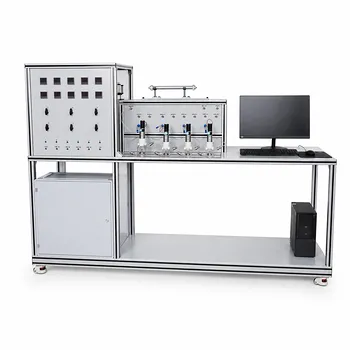
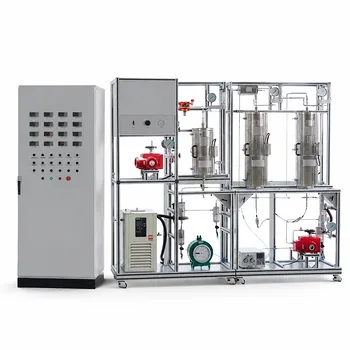
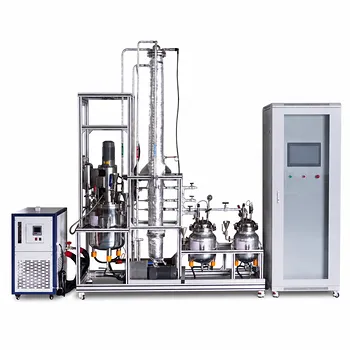
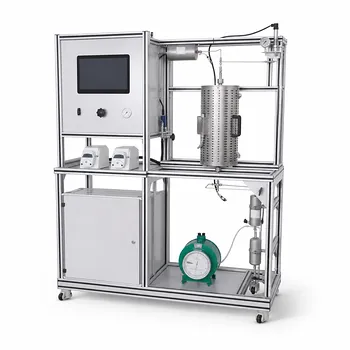
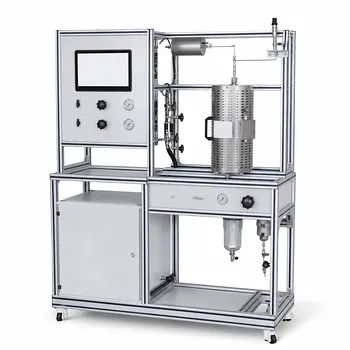
The answer lies in how a pilot-scale CSTR turns an abstract differential equation into a measurable physical outcome. In a steady-state CSTR, you can perform a mass balance on polymer chains of a given length $j$, yielding a difference equation that directly links reactor residence time to the probability of chain growth. This leads to a geometric molecular weight distribution, where the key reaction probability $\alpha$ is simply the ratio of the propagation rate to the total washout rate. By physically adjusting feed flow rates and reactor volume in an educational pilot plant, students see the immediate effect on the polymer’s molecular weight distribution (MWD)—turning mathematical theory into a hands-on, quantitative demonstration.
The pilot-scale CSTR is not just a piece of hardware; it is a physical embodiment of a mass balance. It forces the mathematical model to surface in real time, showing that the washout rate competes directly with chain propagation to define the entire distribution. This makes it the definitive tool for teaching polymerization kinetics and reactor design.
The CSTR as a Solved Mass Balance
Building the Model from First Principles
In a steady-state CSTR, the continuous inflow of monomer and outflow of polymer create a mathematical playground. A mass balance on chains of length $j$ produces a simple difference equation. This balance equates the rate of formation (from growth of shorter chains and propagation) with the rate of removal (by washout).
The solution is a geometric distribution. The probability $\alpha$ that a growing chain adds one more monomer unit before it leaves the reactor is set by the ratio $k_p M / (k_p M + 1/\theta)$, where $k_p M$ is the propagation rate and $1/\theta$ is the washout rate. The average residence time $\theta$ (volume divided by volumetric flow rate) therefore becomes the single most influential knob for shaping the MWD.
Why the Pilot Plant Matters
Solving these equations on paper is one thing. But when students physically turn a pump knob and see the distribution shift in real-time samples, the theory solidifies. The pilot-scale CSTR makes the mathematical function $F(j) = (1-\alpha) \alpha^{j-1}$ a tangible, measurable result.
This direct feedback loop—adjusting a process parameter and recalculating the MWD from GPC data—crystallizes the relationship between unit operations and polymer structure. It removes the abstraction and reveals that residence time is the practical currency of molecular weight control.
From Equations to Experiment: Validating the Model
Collecting Data That Speaks Back
Educational pilot plants equipped with precise dosing pumps and sampling ports let students collect concentration and molecular weight data at steady state. They can then compare the predicted geometric MWD against gel permeation chromatography (GPC) results. Any deviation—say, a broader tail—immediately points to non-idealities like imperfect mixing or hold-up volume, turning the experiment into a lesson on model refinement.
This is where the pilot plant shines as a bridging tool. It sits between bench-scale trivialities and full-scale complexity. Students learn to adjust model parameters (like an effective $\theta$ or a lumped heat transfer coefficient) to reconcile theory with measurement, a skill directly transferable to industrial scale-up.
Demonstrating Denbigh’s Rule in Action
For many step-growth and living polymerizations, the chain lifetime is long relative to the mean residence time. In a CSTR, this yields a broader MWD than in a batch reactor (Denbigh’s rule). The pilot plant lets students test this directly by running the same recipe in a batch and in a continuous mode, then comparing the dispersity indices.
For free-radical polymerizations, however, chain lifetimes are extremely short. Moving to a CSTR can actually narrow the MWD by eliminating the concentration drift that occurs in batch. The pilot plant becomes a platform to challenge intuition, proving that reactor choice is governed by kinetics, not just volume.
Approximating Plug Flow with a CSTR Cascade
When a physical plug-flow reactor is impractical, a series of CSTRs in series approximates its behavior. By connecting 3–5 pilot-scale CSTRs, students measure the residence-time distribution (RTD) via a tracer test and observe how the MWD narrows as the number of stages increases. This reinforces the link between RTD, conversion, and polymer structure—and shows how mathematical modeling can guide reactor configuration to hit a target product quality.
Understanding the Trade-offs and Limitations
The Limits of the Simple Geometric Model
The steady-state CSTR model assumes perfect, instantaneous mixing and time-invariant conditions. In reality, mixing is never perfect, and concentration gradients can exist, especially in larger units. This causes the experimental MWD to deviate from the clean geometric prediction. Students must learn to recognize these discrepancies and not treat the ideal model as absolute truth.
Scale-Up Effects Are Not Captured
A benchtop pilot-scale CSTR operates well away from industrial dimensions. Heat transfer coefficients, wall effects, and flow maldistribution differ significantly. The mathematical model validated on the pilot plant will need further parameter recalibration for full-scale design. The pilot plant teaches the methodology, but it cannot replace the need for larger-scale pilot runs if heat and mass transfer are rate-limiting.
Data Quality Depends on Sensor Precision
Pilot plants rely on accurate flow meters, temperature sensors, and online analytics. Poor calibration or signal noise can obscure the MWD trends. The demonstration must emphasize that a mathematical model is only as good as the data feeding it. Students need to appreciate the role of measurement uncertainty in model validation.
Making the Most of the Pilot Plant Demonstration
The pilot-scale CSTR is a profoundly flexible teaching tool, but its impact depends on how you structure the learning experience. Here’s how to align the equipment to your specific objective:
- If your primary focus is teaching the fundament of MWD control: Run the CSTR at multiple steady-state flow rates and let students use difference equations to predict the geometric distribution. Compare predictions with GPC data. Show that $\theta$ is the dominant lever.
- If your primary focus is validating kinetic models for scale-up: Use the pilot plant to collect concentration and temperature profiles under non-isothermal conditions, then fit a kinetic model. Adjust activation energies and heat transfer coefficients until simulation matches experiment. This exact workflow is what engineers use when moving from lab to plant.
- If your primary focus is exploring reactor configuration effects: Add chain-transfer agent dosing pumps or connect multiple CSTRs in series. Measure how modifier feed rates or cascade stages shift the dispersity and average molecular weight, directly linking process design to product properties.
- If your primary focus is bridging the gap between simulation and reality: Have students first simulate the CSTR using software, then replicate the run on the physical pilot plant. Force them to reconcile discrepancies, adjusting model parameters like effective volume or backmixing coefficients—this is the essence of modern pilot plant methodology.
The power of the pilot-scale CSTR lies in its ability to make a mathematical abstraction physically undeniable. When the geometric distribution appears on a GPC trace because you turned a valve, the lesson lasts a lifetime.
Summary Table:
| Operational Lever | Mathematical Target | Validation & Verification Method |
|---|---|---|
| Adjusting Flow Rates | Geometric MWD shifting | GPC analysis of effluent polymer samples |
| Batch vs. Continuous | Dispersity index analysis | Comparing molecular weight curves (Denbigh's Rule) |
| CSTR Cascade Setup | RTD & plug-flow approximation | Tracer tests & monitoring of MWD narrowing |
Bring Polymerization Theory to Life with LABPARK
Equip your lab with advanced hands-on learning systems. LABPARK provides premium Educational and Vocational Unit Operations Pilot Plants in chemical engineering, bioprocess & biotech, and environmental & water treatment for universities, research institutes, and enterprises. Our pilot-scale CSTRs and reactor systems bridge the gap between abstract mathematical models and industrial reality.
Ready to elevate your engineering curriculum or research capabilities? Contact us today to discuss your laboratory needs!
Related Products
- Multi-Stage Stirred Tanks in Series Residence Time Distribution and Mixing Performance Determination Educational Pilot Plant
- Residence Time Distribution and Reactor Flow Characteristics Determination Educational Pilot Plant
- Gas Phase Mixing and Residence Time Distribution Determination Educational Unit Operations Pilot Plant
- Multi Functional Catalytic Reaction and Reactor Evaluation Educational Unit Operations Pilot Plant
- Multi-Reactor Educational Pilot Plant for Reaction Engineering Unit Operations
People Also Ask
- How does MRF model impeller rotation in CFD? Key Boundary Conditions Explained
- How can a CSTR pilot plant demonstrate reactor staging? Visualize volume savings.
- How does steady-state multiplicity affect the operation and safety of exothermic reactions within a CSTR pilot plant? - Guide
- What parameters to monitor transitioning from Batch to CSTR? Master Pilot Plant Setup
- Why is temperature regulation via a cooling jacket a critical feature in CSTR pilot plants used for laboratory training?