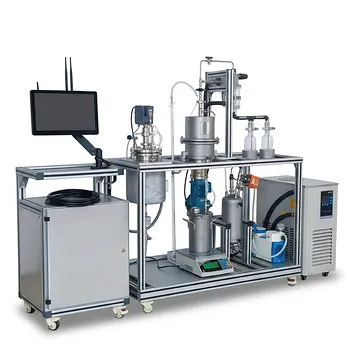
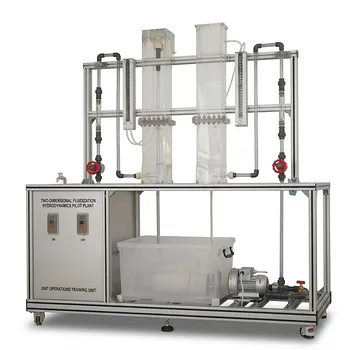
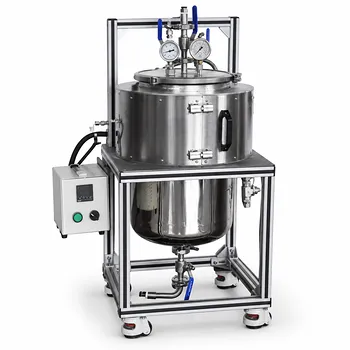
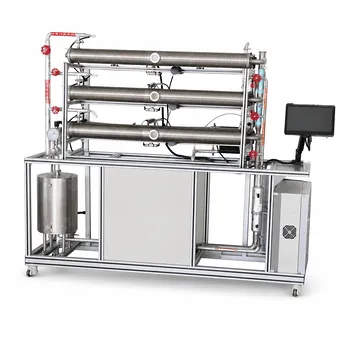
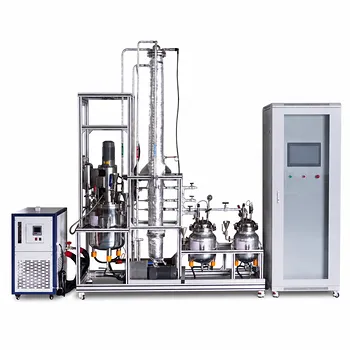
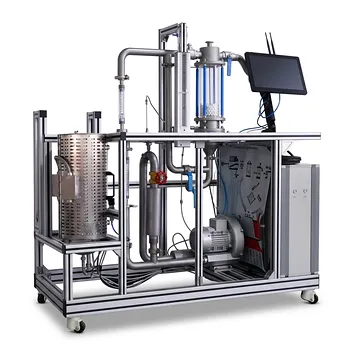
A laboratory-scale unit operations pilot plant can safely demonstrate the multi-stage thermal reduction and gas-solid transport phenomena of a blast furnace by using a high-temperature packed-bed or fluidized-bed reactor with precise multi-zone temperature control, metered flows of CO and CO₂, and integrated real-time sensors. This configuration allows students to replicate the counter-current reduction of hematite through magnetite and wüstite to metallic iron—all without the extreme safety hazards of an industrial ironmaking facility. The result is an authentic, hands-on environment where reaction kinetics, mass transfer limitations, and thermodynamic gradients become directly observable and measurable.
The fundamental challenge is not simply heating iron ore, but recreating the progressive temperature-dependent reduction sequence and the interplay between gas convection, pore diffusion, and surface kinetics that define blast furnace performance. A well-designed pilot plant solves this by combining multi-zone heating, controlled reactive gas atmospheres, and real-time analytical feedback within a safety-first framework, turning a dangerous industrial process into a transparent teaching platform.
Replicating the Blast Furnace’s Multi-Stage Thermal Profile
Industrial blast furnaces are defined by a sharp vertical temperature gradient, where each reduction stage occurs in a specific thermal zone. A laboratory pilot plant must first reproduce this spatial distribution of heat to make the chemistry truthful.
How the Reactor Mimics Zonal Reduction
A single-zone furnace would smear the distinct reactions together, obscuring the transition from hematite (Fe₂O₃) to magnetite (Fe₃O₄) around 450 °C, to wüstite (FeO) near 600 °C, and finally to metallic iron at 800 °C. Instead, pilot plants employ a tubular or fixed-bed reactor fitted with multiple independently controlled PID heating segments.
This design creates a stable axial temperature staircase. Students can sample solids or gases at each zone to confirm that reduction chemistry changes exactly where thermodynamics predicts. The ability to hold a segment at a precise temperature—even as gas flows carry heat away—ensures reproducibility and safety.
The Role of Counter-Current Gas Flow in the Lab
In a true blast furnace, hot reducing gases rise while the solid burden descends. Most educational pilot plants simplify this to a co-current or single-pass gas flow for control and safety, but still allow investigation of the same principles. By flowing a CO/CO₂ mixture over a static bed of iron oxide pellets, students can mimic the gas composition experienced by a descending element of ore.
Varying the CO/CO₂ ratio from stage to stage lets them demonstrate how the equilibrium gas composition shifts with temperature. The system becomes a thermodynamic and kinetic model of the counter-current process, even without the mechanical complexity of a moving bed.
Controlling Gas-Solid Contact and Transport Phenomena
Teaching transport phenomena requires more than just heat; it demands observable shifts in the controlling mechanism. The pilot plant’s instrumentation makes this possible.
Shifting from Chemical Control to Diffusion Control
Gas-solid reactions are not always dominated by the same step. At low temperatures, surface reaction kinetics (the intrinsic rate) often govern the overall conversion. As temperature rises, the reaction becomes faster, and pore diffusion inside the solid pellet becomes the bottleneck. In the most rapid, high-temperature scenarios, transport through the stagnant gas film around the particle can take over.
The pilot plant allows students to deliberately induce these regime shifts. By incrementally increasing the bed temperature while monitoring conversion rates and gas composition, they see the point where further heating no longer boosts conversion linearly—a classic signature of pore diffusion limitation. Similarly, by varying the gas flow velocity across the bed, they can probe the thickness of the external film and its effect on mass transfer. This directly connects theoretical dimensionless numbers (Sherwood, Nusselt) to real process behaviour.
Instrumentation That Makes Phenomena Visible
The reactor is equipped with mass flow controllers for CO and CO₂, pressure transmitters, and multi-point thermocouples. Crucially, an online analysis system—typically gas chromatography or a mass spectrometer—samples the outlet gas continuously.
This setup replaces guesswork with data. Students can plot the disappearance of CO or the appearance of CO₂ in real time, calculate instantaneous reaction rates, and perform an instantaneous mass balance. They can also introduce inert tracer gases to measure residence time distributions, revealing deviations from ideal plug flow. The whole gas-solid transport story becomes a quantitative, visual narrative.
Safety by Design: Mitigating Risks at Pilot Scale
The most critical challenge with blast furnace chemistry is the use of carbon monoxide—a toxic, flammable gas. The pilot plant’s safety architecture must be as robust as its educational value.
Engineering Multiple Layers of Protection
Modern pilot plants incorporate integrated safety interlocks that go far beyond a simple fume hood. CO and hydrogen (if present) are always kept at sub-atmospheric or low positive pressure inside a sealed, double-walled piping system. Continuous gas leak detectors are installed at every joint and valve, and they automatically trigger emergency shut-off valves and purge sequences if any concentration above a safe threshold is detected.
The reactor itself sits within a transparent blast shield or containment enclosure rated for overpressure scenarios. Overpressure relief lines vent to a safe location, never into the laboratory. These measures do not rely on operator vigilance alone; they are hardwired. The result is that even during an accidental runaway or gas leak, the physical consequences are fully contained.
Operating Conditions That Minimize Severity
The pilot plant intentionally operates at lower temperatures and atmospheric pressure compared to industrial systems. While a real blast furnace can exceed 1500 °C in the raceway, the educational pilot rarely goes above 900 °C, and the gas volumes are small (millilitres to litres per minute). This deliberate scaling down reduces the stored chemical and thermal energy, making any deviation inherently less severe. It also aligns with the principle that the key phenomena—reduction stages, kinetic control shifts—are observable at moderate conditions, while extreme conditions add only risk.
From Data to Understanding: Kinetic Analysis and Model Validation
The ultimate goal is not to run a miniature smelter, but to enable rigorous chemical engineering analysis. The pilot plant turns abstract rate laws into fitted models.
Building a Kinetic Model from Real Measurements
With temperature, pressure, and gas composition logged every second, students can calculate the rate of iron oxide reduction as a function of time and position. They can then fit classic rate equations—such as the shrinking-core model—to their data. By comparing experimental conversion curves with predictions for film diffusion control, ash-layer diffusion control, or chemical reaction control, they identify which step limits the process at a given temperature.
This exercise directly mirrors the work of industrial process development: determining rate constants, activation energies, and optimal operating windows. The only difference is that the errors do not cost millions or endanger lives.
Bridging Theory and Industrial Practice
Le Chatelier’s principle and Arrhenius kinetics often feel abstract when presented as textbook equations. In the pilot plant, a student can raise the setpoint of a heating zone and watch the outlet CO₂ concentration rise, realizing that the endothermic shift for FeO reduction has consumed more CO. They can increase the total gas flow and observe a change in conversion, linking it to the reduced residence time and altered external mass transfer. The gap between theoretical thermodynamics and operational reality closes.
Understanding the Trade-offs and Limitations
An honest assessment requires acknowledging where a lab-scale pilot plant diverges from an industrial blast furnace.
The lab system typically uses a static bed rather than a moving, shrinking burden. It lacks the complex aerodynamics of a counter-current stock column, the formation of cohesive zones, and the mechanical degradation that pellets undergo in a real furnace. Furthermore, the gas volumes and thermal gradients, while representative, are scaled down, which can underplay certain inertial or hydrostatic effects.
The use of CO, even at small scale, demands rigorous safety protocols and proper ventilation that some academic settings may find resource-intensive. Most importantly, the pilot plant focuses on the core reduction chemistry and gas-solid transfer, deliberately omitting slag chemistry, hot metal carbon pickup, and raceway combustion—all of which define true smelting. Treating the pilot plant as a kinetic and transport teaching aid, rather than a mini‐blast furnace, is essential.
Making the Right Choice for Your Educational Goal
The way you configure and use the pilot plant depends on what you aim to teach. Specific recommendations follow:
- If your primary focus is reaction kinetics and rate law determination: Design experiments with a fixed bed of uniform pellets and carefully stepped temperature ramps. Equip the outlet with a gas chromatograph, and have students fit shrinking-core models to identify the controlling regime at each temperature stage.
- If your primary focus is transport phenomena and mass transfer limitations: Vary the gas flow velocity systematically at constant temperature while monitoring conversion. Use the resulting Sherwood number correlations to demonstrate the transition from kinetic to film‐diffusion control, and incorporate a tracer study to measure residence time distribution.
- If your primary focus is process safety and industrial safeguards: Include the pilot plant’s safety interlocks, leak detection, and containment as an integral part of the curriculum. Have students perform a HAZOP study on the unit before operation, and make emergency shutdown procedures a graded skill. This turns the setup into a process safety learning tool as much as a reactor.
- If your primary focus is bridging thermodynamics and industrial realit y: Schedule runs where students deliberately shift the CO/CO₂ ratio and bed temperature, then predict conversion using equilibrium constants and Le Chatelier’s principle. Compare predictions to measured gas compositions, highlighting the difference between equilibrium-limited and kinetically controlled yields.
You can teach the heart of ironmaking science without a single ton of molten metal. The well-instrumented pilot plant takes a vast, dangerous industrial process and compresses it into a safe, controllable, and deeply educational experience.
Summary Table:
| Blast Furnace Phenomenon | Pilot Plant Solution | Key Safety Control |
|---|---|---|
| Multi-stage thermal reduction | Multi-zone PID-controlled heating | Low-pressure & lower temp operation |
| Gas-solid transport / kinetics | Metered CO/CO₂ flows & online gas analysis | Double-walled piping & leak detection |
| Reaction regime shifts | Variable gas velocity & step temperature ramps | Automatic shutdown & nitrogen purge |
Bring Industrial Chemistry Safely into Your Lab
Looking to upgrade your chemical engineering curriculum or research capabilities? LABPARK provides premium Educational and Vocational Unit Operations Pilot Plants in chemical engineering, bioprocess & biotech, and environmental & water treatment for universities, research institutes, and enterprises.
Our custom-engineered pilot plants feature advanced multi-zone control and multi-layered safety containment, enabling your students to safely explore gas-solid transport phenomena and reaction kinetics without industrial hazards.
Contact LABPARK today to consult with our engineers and find the ideal unit operations solution for your laboratory!
Related Products
- Rising and Falling Film Evaporation Educational Unit Operations Pilot Plant
- Multi Functional Catalytic Reaction and Reactor Evaluation Educational Unit Operations Pilot Plant
- Constant Pressure Filtration Educational Unit Operations Pilot Plant
- Supercritical High-Gravity Flash Evaporation Educational Unit Operations Pilot Plant
- Two-Dimensional Fluidization Hydrodynamics Educational Pilot Plant for Unit Operations Training
People Also Ask
- How do educational unit operations pilot plants bridge theory and design? Bridge the Engineering Gap
- How do educational unit operations pilot plants address safety and waste management when scaling up?
- How is the heat transfer area calculated for an evaporation unit operations pilot plant during experimental design? Guide
- How to select educational evaporator pilot plants for thermal & scaling solutions? Complete Guide
- What are the structural characteristics & applications of rising-falling film evaporators in unit operations training?