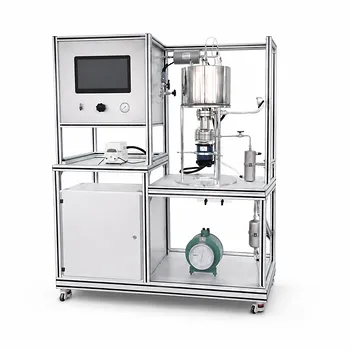
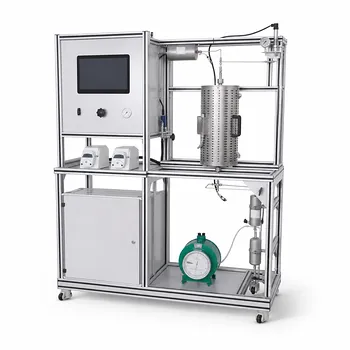
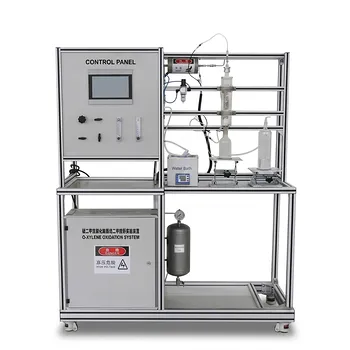
Pilot plants are the definitive empirical bridge between a novel catalyst's potential and a commercially viable industrial process. They allow you to transform syngas (CO + H₂) into valuable products like methane under tightly controlled, scalable conditions. This is achieved by using integrated packed-bed reactor systems to introduce controlled gas mixtures over a stationary catalyst bed while continuously monitoring reaction kinetics, thermal profiles, and product selectivity via online gas chromatography.
While a small lab reactor proves a catalyst works, a pilot plant proves it can survive and perform under the intense thermal and mechanical stresses of industrial operation. It’s the essential tool for de-risking scale-up, generating kinetic models from real-world gradients, and training engineers on the safe handling of high-pressure, exothermic, and toxic gas systems before a single pipe is laid at a commercial facility.
Deconstructing the Pilot-Scale Syngas Reactor
Simulating the Industrial Core
A syngas conversion pilot plant doesn't just mix gases; it recreates the extreme conditions inside a commercial reactor. The primary reference specifies using tubular or packed-bed reactors, which are the industry standard for fixed-bed processes like methanation. These are loaded with industrial-formulated catalysts, often supported nickel or palladium.
This setup allows you to precisely control the feed, typically a mixture of carbon monoxide and hydrogen. Supplementary sources clarify that this demands precise mass flow controllers and high-temperature furnace controls that can faithfully replicate the thermal stresses seen in a full-scale plant.
The Criticality of Heat Transfer Analysis
Methanation (CO + 3H₂ → CH₄ + H₂O) is a highly exothermic reaction. On an industrial scale, poor heat management leads to thermal runaway, catalyst sintering, and catastrophic failure. In a pilot plant, you can embed multiple thermocouples along the reactor bed's length to measure axial temperature profiles. This data is invaluable. It shows you exactly where the "hot spot" forms, allowing you to validate computational heat transfer models and explore mitigation strategies—like catalyst dilution with inert packing or multi-stage cooling—that are impossible to study accurately in micro-reactors.
Decoding Reaction Kinetics Under Mass Transfer
Academic kinetic studies often strive for differential conditions, free from heat and mass transfer limitations. A pilot plant intentionally introduces them. By operating at industrial Gas Hourly Space Velocities (GHSV) , you can observe the interplay between intrinsic kinetics, pore diffusion, and film mass transfer. As supplementary information points out, online analysis via gas chromatography is non-negotiable. It connects the measured temperature profile to actual conversion and yield, allowing you to calculate the real-world effectiveness factor of your catalyst pellet, not just the powdered form.
Mapping the Reaction and Process Control Landscape
Validating Alternative Reaction Pathways
Syngas conversion isn't limited to methanation. A capable pilot plant is a versatile platform for exploring a family of reactions. Supplementary references detail how the same core setup is used for Fischer-Tropsch synthesis to produce hydrocarbons and alcohols, or the water-gas shift reaction (CO + H₂O → H₂ + CO₂) to adjust the H₂/CO ratio. This flexibility is crucial for studying integrated processes, such as a biorefinery concept where you might first shift the syngas, then methanate the resulting stream.
Translating Transient Operations to Process Control
Steady-state performance is just one data point. The real industrial challenge is handling transients: start-up, shut-down, and feedstock composition changes. A pilot plant equipped with PID temperature controls and online analytical sensors becomes a process control laboratory. You can deliberately introduce a step change in the CO flow and watch how the reactor's thermal inertia and control system respond. This directly informs the programming of safety interlocks and control logic for a commercial distributed control system (DCS).
Understanding the Trade-offs and Pitfalls
The Scale-Down Fidelity Challenge
A pilot-scale packed bed can never perfectly replicate industrial-scale fluid dynamics. The reactor-to-particle diameter ratio is smaller, which often means higher wall-to-bed heat transfer coefficients and less back-mixing than a massive commercial reactor. Data from a pilot plant that ignores this radial heat transfer advantage can be dangerously optimistic about hotspot severity. You must use the pilot data not as a perfect mirror, but as a powerful validation point for a scale-up model that accounts for these geometric differences.
Catalyst Deactivation and Material Integrity
Running a pilot plant for hundreds of hours reveals the brutal truth of catalyst deactivation. Supplementary information on steam reforming notes the need for alumina or spinel carriers to withstand high-temperature steam. For methanation, you will observe poisoning from sulfur slips or coking from improper H₂/CO ratios—problems invisible in short-term lab tests. The pilot plant’s metallurgy itself becomes a variable; you can detect metal dusting corrosion, ensuring material selection is done before scaling up.
The Non-Negotiable Safety Imperative
You are handling toxic, flammable gases under pressure. The leap from a bench-scale glass rig to a pilot plant is a leap in hazard level. Following the safety philosophy described for other high-pressure processes like the Haber-Bosch pilot unit, your syngas plant must be engineered with overpressure relief valves, blast shields, gas leak detectors, and automated emergency shut-off interlocks. These aren't just add-ons; they represent the standard operating culture that pilot-scale research instills in future engineers.
Making the Right Choice for Your Goal
The specific configuration and operational strategy of your pilot plant must be dictated solely by your deep need. The hardware is just a tool; your experimental design is what extracts its value.
- If your primary focus is validating a new catalyst's industrial lifetime: Operate continuously for thousands of hours, monitoring slow performance decay and correlating it with post-mortem catalyst characterization to understand sintering or poisoning mechanisms.
- If your primary focus is generating high-fidelity data for a kinetic model: Run a systematic test matrix varying temperature, pressure, and space velocity, ensuring you accurately measure axial temperature profiles to separate kinetics from heat transfer.
- If your primary focus is dynamic process optimization and control: Experiment with load-following operations and feedstock ramp rates, using the integrated control system to develop strategies that maximize yield and minimize thermal stress during transients.
The pilot plant’s ultimate value is not as a miniature factory, but as a crucible where theoretical chemical engineering confronts physical reality, forcing you to solve the heat, mass, and safety challenges that define industrial success.
Summary Table:
| Study Area | Key Pilot Plant Activity | Industrial Scale-Up Benefit |
|---|---|---|
| Heat Transfer | Measure axial temperature profiles | Prevents thermal runaway and catalyst sintering |
| Kinetics & Mass Transfer | Analyze GHSV & online gas chromatography | Determines real-world catalyst effectiveness |
| Process Control | Test transient operations & PID loops | Establishes safety interlocks for commercial DCS |
| Catalyst Lifetime | Conduct long-term continuous runs | Identifies poisoning, coking, and metallurgy limits |
Accelerate Your Scale-Up with LABPARK
Transitioning from lab-scale catalyst testing to industrial syngas conversion requires robust, reliable data. LABPARK provides state-of-the-art Educational and Vocational Unit Operations Pilot Plants in chemical engineering, bioprocess & biotech, and environmental & water treatment for universities, research institutes, and enterprises.
By partnering with LABPARK, you can:
- Safely study high-pressure, exothermic reactions like methanation.
- Generate precise thermal and kinetic data to validate scale-up models.
- Train future engineers on industry-standard process control and safety systems.
Ready to elevate your research and training capabilities? Contact LABPARK today to request a customized quote!
Related Products
- Fixed Bed Gas Solid Catalytic Reaction Educational Pilot Plant
- Fluidized Bed Gas Solid Catalytic Reaction Educational Pilot Plant
- Multi Functional Catalytic Reaction and Reactor Evaluation Educational Unit Operations Pilot Plant
- Internal Circulation Gradient Free Catalytic Reaction Educational Pilot Plant
- Micro-Scale Gas-Solid Catalytic Reaction Educational Pilot Plant
People Also Ask
- How do reactor pilot plants safely study gas-solid reactions? Master kinetics with thermal & flow control.
- How does the Mears criterion evaluate transport resistance? Key Guide to Intrinsic Kinetics
- Fluidized vs. Fixed Bed Reactors: Comparing Heat & Complexity in Pilot Plants
- Why is a multibed configuration necessary for exothermic reactions? Optimize your pilot plant trajectory.
- What are the differences between pseudohomogeneous and heterogeneous models in pilot plants?