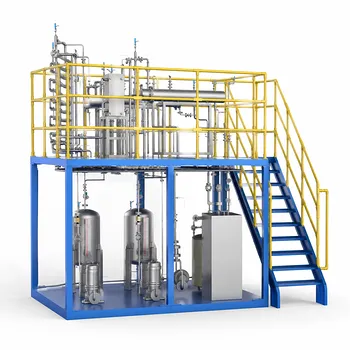
The key to preventing unplanned shutdowns with acoustic chemometric monitoring lies in listening to the process before it fails.
By mounting non‑intrusive acoustic sensors on critical vessel walls, pipelines, or orifice plates, a pilot plant can continuously capture the vibration signature of ongoing processes. Chemometric analysis of these acoustic spectra can predict vital variables—like crystallization temperature, granule moisture, or fluidization airflow—in real time. The moment a deviation pattern emerges, operators receive an early warning, giving them the time to adjust process parameters and avoid a work‑intensive shutdown.
Core Takeaway: Acoustic chemometrics gives you a non‑intrusive, predictive sense of your process. By replacing blind spots where traditional sensors lag, it can flag conditions like bed lump formation or nozzle clogging up to 30 minutes before a failure, turning reactive shutdowns into proactive adjustments.
The Core Principle: Listening Where Traditional Sensors Fail
Chemical engineering pilot plants are often loaded with temperature, pressure, and flow transmitters, but these devices have significant delay times and cannot directly detect mechanical changes like particle accumulation or wall layering.
Acoustic chemometrics fills this gap by capturing the broad‑spectrum vibration patterns that naturally arise from fluid flow, turbulence, cavitation, and particle collisions.
From Process Noise to Process Knowledge
Every unit operation has a unique acoustic fingerprint.
When fluid flows through an orifice plate, or granules bounce in a fluidized bed, the resulting vibrations carry information about density, velocity, composition, and physical state.
By mounting accelerometers externally, you can record this “passive” noise without ever penetrating the equipment—no contamination risk, no flow disturbance.
Why Pilot Plants Need a Predictive Ear
In a pilot plant, experiments and trainee operations often push equipment to its limits; unplanned shutdowns waste valuable research time and can compromise fragile catalysts or continuous runs.
Early warning is the difference between a simple nozzle unblocking and a full reactor teardown.
Traditional measurements might only alert you 10 minutes before a shut‑down trigger is tripped, leaving insufficient time to intervene.
Practical Integration: Clamping the Sensor to the Process
Integration starts with selecting the right mounting point.
The sensor listens where the process “speaks” loudest—downstream of an orifice plate for flow analysis, on the reactor wall for fluidized bed dynamics, or on chamber walls for crystallization.
Because the entire system is clamp‑on, you install it without welding, cutting, or halting operations.
Mounting Methods: Glue Stud vs. Screw Tap
For temporary, rapidly changing experimental setups, a glue stud is the most common choice—it fixes the sensor quickly and can be removed without damaging the equipment.
For long‑term stability, a screw tap is the preferred method, providing a permanent, robust mechanical bond that withstands vibration and thermal cycling.
The Cable Rule: Fix It or Lose Signal
One often‑overlooked detail is cable management.
The sensor cable must be firmly fixed to the same surface as the sensor using tape, plastic strips, or clamps.
If the cable is left loose, the process vibrations will cause it to bounce against the equipment, injecting impact noise that corrupts the acoustic signature and degrades chemometric predictions.
From Raw Signal to Actionable Insight: The Chemometric Engine
A single accelerometer captures a complex spectrum of frequencies.
To extract meaning, we apply chemometric techniques like Principal Component Analysis (PCA) for early fault detection or Partial Least Squares (PLS) regression for quantitative predictions.
This approach allows a single sensor to simultaneously predict multiple properties—moisture, chemical concentration, temperature, and flow state—without dedicated probes.
Early Warning: 30 Minutes vs. 10 Minutes
In a fluidized bed granulation pilot plant, lump formation or a cake on the perforated bottom plate is a common shutdown cause.
Acoustic monitoring with PCA can detect the change in bed dynamics 30 minutes or more before a failure occurs—simply by recognizing a shift in the power spectrum—compared to traditional differential pressure or temperature readings that may only give a 10‑minute warning.
That extra time lets operators adjust binder spray rate or fluidization airflow and keep the bed stable.
Indirect Multivariate Calibration for Hard‑to‑Measure Parameters
Pipeline‑mounted sensors downstream of an orifice plate can predict trace oil‑in‑water concentration or monitor chemical composition without any invasive sampling.
PLS models learn the relationship between the acoustic spectrum and the target property, turning the sensor into a virtual analyzer that needs no physical contact with the fluid.
Common Pitfalls and Trade‑offs to Avoid
Acoustic chemometrics is powerful but not magic. A few pitfalls can undermine your integration.
Signal Integrity: Mounting Decay and Noise
Glue studs can degrade over time under temperature swings, loosening the coupling and introducing signal drift.
Scheduled inspection of the sensor attachment and cable fixings is essential to maintain data quality.
Model Maintenance: The Chemometric Cost
Initial setup requires a calibration phase where you collect acoustic spectra alongside reference measurements.
If the process formulation changes significantly, the multivariate model may need to be re‑calibrated. This upfront effort is the price you pay for a no‑moving‑parts, non‑intrusive monitoring system.
Not Every Deviation Has an Acoustic Voice
Acoustic monitoring excels at detecting physical changes like clogging, cavitation, or bed collapse, but it will not replace a thermocouple for pure static temperature measurement.
The key is to integrate it as a complement to your existing instrument suite, layered into a multivariate statistical process control (MSPC) strategy.
Making Acoustic Monitoring Work for Your Pilot Plant
Acoustic chemometrics can be adapted to any unit operation where vibration patterns reflect the process condition. The best approach depends on your primary goal.
- If your primary focus is fluidized bed stability: Place clamp‑on sensors on the reactor wall near the bed, use PCA detection, and react to early warnings 30+ minutes before lump formation forces a shutdown.
- If your primary focus is pipeline flow assurance and composition: Mount a sensor downstream of an orifice plate, employ PLS models to predict trace concentrations or contaminants, and monitor continuously without intrusive probes.
- If your primary focus is rapid experimentation with temporary setups: Use glue studs and secure the cables thoroughly to get reliable data fast, then transition to screw tap mounts for long‑running campaigns.
- If your primary focus is training students on industrial predictive maintenance: Integrate acoustic monitoring alongside traditional instruments, demonstrating how MSPC catches anomalies that single‑variable alarms miss.
By giving your pilot plant a non‑intrusive voice, you transform an unplanned shutdown from a disruptive surprise into a manageable, preventable event.
Summary Table:
| Aspect | Details & Methods | Key Benefits |
|---|---|---|
| Sensor Mounting | Non-intrusive (Glue stud or screw tap) | No process interruption or contamination risk |
| Data Analysis | PCA (anomaly detection) & PLS (regression) | Predicts moisture, concentration, and flow status |
| Early Warning | Detects shifts in acoustic power spectrum | Flags failure up to 30 mins early (vs. 10 mins traditional) |
| Key Target Areas | Fluidized beds, pipelines, crystallization | Prevents nozzle clogging, bed lump formation, and line blocks |
Maximize Uptime with LABPARK Pilot Plants
Unplanned shutdowns and sensor lag can disrupt critical research and training. LABPARK provides state-of-the-art Educational and Vocational Unit Operations Pilot Plants in chemical engineering, bioprocess & biotech, and environmental & water treatment. Designed specifically for universities, research institutes, and enterprises, our systems support advanced process control and monitoring technologies to ensure seamless, reliable operations.
Ready to elevate your lab's capabilities and prevent process failures? Contact LABPARK today to find the perfect pilot plant solution for your institution.
Related Products
- Carbon Dioxide Hydrogen Methanol Synthesis Educational Unit Operations Pilot Plant
- Multi Pump Fluid Transport Process Piping Unit Operations Training Pilot Plant
- Natural Product Extraction Unit Operations Training Pilot Plant
- Multi-Modal Distillation Unit Operations Training Pilot Plant
- Multi-Reactor Educational Pilot Plant for Reaction Engineering Unit Operations
People Also Ask
- How do temp & pressure affect methanol synthesis pilot plants? Optimize equilibrium and catalyst performance.
- Why is a purge system necessary when operating a gas recirculation loop in a methanol synthesis pilot plant? (Guide)
- Why do modern methanol pilot plants operate at lower pressures? Catalyst & Feed Requirements Explained
- What are the operational requirements for catalyst activation? Safe Methanol Pilot Plant Operation
- Why is the chemical plant startup schedule crucial? De-risk scale-up with pilot plants.