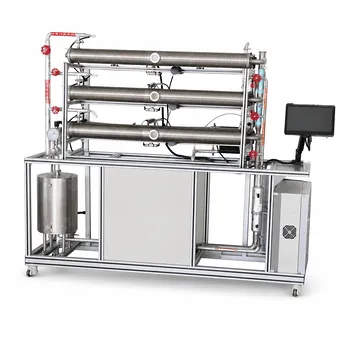
A pilot plant turns textbook neutralization theory into a tangible, control-loop experiment. Academic laboratories demonstrate the neutralization of acidic and alkaline industrial wastewater by operating a bench‑to‑pilot scale reactor that treats simulated effluent with real‑time pH monitoring and automated chemical dosing. Students feed a waste stream—such as dilute sulfuric acid—into a neutralization vessel, add a selected base, and observe how the system stabilises pH while generating precipitates. This hands‑on setup reveals not just the chemistry, but the process‑control dynamics and economic choices that define real‑world wastewater treatment.
Neutralisation is never simply “add a chemical until pH 7.” A well‑designed pilot plant makes visible the hidden variables—reaction kinetics, precipitate formation, control‑loop stability, and by‑product value—turning an environmental obligation into an engineering optimisation problem.
What a Neutralisation Pilot Plant Looks Like
At its core, the pilot plant mirrors an industrial neutralisation loop, scaled down for teaching and research. It equips students to move from theory to measurable, repeatable results.
The Core Components: Reactor, Dosing, and Sensing
A typical setup consists of a stirred neutralisation reactor, a feed pump delivering simulated acidic or alkaline wastewater, and a dosing pump delivering the neutralising agent. Real‑time pH sensors immersed in the reactor provide continuous feedback, while automated control loops modulate the dosing rate to keep effluent within a tight pH band.
Simulating Industrial Effluents Safely
Dilute sulfuric acid often serves as the model acidic waste because it is representative and manageable at lab scale. For alkaline demonstrations, a weak base such as sodium hydroxide can be fed, and the system counteracts it with dilute acid or dissolved carbon dioxide—mirroring industrial use of acid waste or CO₂ injection.
Demonstrating Acidic Wastewater Neutralisation
The primary reference design starts with an acidic stream, allowing students to explore agent selection, precipitation, and the interplay between chemistry and process control.
Choosing the Neutralising Agent
Lime (calcium oxide, CaO) and sodium hydroxide are classic alkaline agents. The pilot plant allows students to swap between them, observing that lime reacts with sulfate to form gypsum (calcium sulfate), an insoluble precipitate that reduces the total dissolved solids (TDS) load on downstream facilities. Using ammonia produces ammonium sulfate, a potential commercial‑grade fertiliser by‑product—transforming a cost centre into a revenue possibility.
Following Precipitation Kinetics
As the base mixes with the acidic waste, pH rises and dissolved ions start forming solid particles. Students measure how quickly precipitation occurs under different stirring rates and dosing strategies. This bridges the gap between equilibrium calculations and the real‑time mass transfer limitations that dictate reactor sizing.
Evaluating Control Loop Configurations
The automated dosing loop is a teaching tool in itself. Researchers can impose step changes in influent pH or flowrate and study how proportional‑integral‑derivative (PID) tuning affects effluent stability. The pilot plant makes control‑loop performance directly observable—oscillations, overshoot, and steady‑state error become concrete concepts rather than abstract models.
Demonstrating Alkaline Wastewater Neutralisation
While the primary reference emphasises acidic feed, the same platform can easily reverse the chemistry to treat alkaline effluents.
Switching to an Alkaline Feed
By pumping a sodium hydroxide solution into the reactor, the pilot plant simulates high‑pH industrial discharge. Acidic waste streams (or CO₂ gas) are then dosed to consume hydroxide ions. The same pH sensors and control loops apply, but the precipitation products differ—often forming carbonates or simple salts.
Linking to Industrial CO₂ Utilisation
Injecting carbon dioxide not only neutralises alkalinity but also demonstrates how greenhouse gas can be repurposed. The reaction forms bicarbonate/carbonate, lowering pH while providing a conversation around carbon capture and utilisation in water treatment.
Beyond the pH Meter: Economic and By‑Product Analysis
A well‑structured pilot plant exercise doesn’t stop at achieving pH 7; it forces students to think like plant engineers.
Calculating Operating and Chemical Costs
Students log the amount of neutralising agent consumed per litre of wastewater. Multiplying by industrial‑scale consumption reveals why cheaper reagents like lime often win over caustic soda, despite handling challenges. The pilot plant makes cost a quantifiable design parameter.
Assessing By‑Product Value and Disposal
When ammonia neutralises sulfuric acid, the resulting ammonium sulfate can be crystallised and potentially sold. Gypsum from lime may find use in construction. The pilot plant allows students to harvest these solids and debate whether the purity and quantity justify a side‑stream recovery process—illustrating the circular‑economy principles embedded in modern water treatment.
Understanding the Trade‑offs in Pilot‑Scale Neutralisation
Transparency about limitations builds credibility. A pilot plant is a powerful learning tool, but it cannot replicate every industrial nuance.
Chemical Handling and Safety
Even dilute acids and bases require proper personal protective equipment (PPE) and ventilation. Lime slurries can clog dosing lines; ammonia requires fume control. The pilot plant must be operated with the same respect as a full‑scale facility, and these operational headaches are themselves a valuable lesson.
Scaling Limitations
Precipitation that appears gentle at pilot scale can generate severe scaling and fouling in full‑sized reactors. Students should be cautioned that lessons about mixing and solids removal do not always scale linearly—but that recognising this gap is a critical engineering insight.
Automation vs. Manual Operation
Relying solely on automated loops can obscure fundamental understanding. Deliberately running the plant in manual mode, where students adjust dosing by feel, teaches the intuition behind control decisions and the true value of feedback systems. The trade‑off is time and reproducibility—so a mixed approach often yields the deepest learning.
How to Tailor the Pilot Plant for Your Educational Goals
The versatility of a neutralisation pilot plant means it can serve multiple teaching objectives. The key is to align the experiment with the core takeaway you want students to gain.
- If your primary focus is process control: Emphasise PID tuning, sensor calibration, and disturbance rejection. Use step‑change tests and charge students with writing the control‑logic algorithm themselves.
- If your goal is resource recovery and circular economy: Let teams experiment with different agents and measure by‑product purity. Task them with a techno‑economic analysis comparing lime, caustic, and ammonia on a cost‑per‑treated‑cubic‑metre basis.
- If you want to simulate plant troubleshooting: Introduce realistic faults—a clogged lime slurry line, a drifting pH electrode, or a sudden spike in influent acidity. Have students diagnose and resolve issues while documenting the impact on effluent quality.
- If the objective is a foundational mass‑transfer experience: Keep automation minimal, run batch neutralisations, and calculate reaction rates and precipitation yields. Couple this with microscopy of the resulting solids to connect kinetics to particle morphology.
A pilot plant transforms wastewater neutralisation from a passive safety step into an active design challenge—and that shift in perspective is exactly what turns students into the problem‑solvers industry needs.
Summary Table:
| Feature | Acidic Wastewater Treatment | Alkaline Wastewater Treatment |
|---|---|---|
| Model Waste | Dilute sulfuric acid ($H_2SO_4$) | Sodium hydroxide ($NaOH$) / high-pH waste |
| Reagents Used | Lime, sodium hydroxide, ammonia | Acidic waste streams, Carbon dioxide ($CO_2$) |
| Key By-products | Gypsum (construction), Ammonium sulfate (fertilizer) | Carbonates, soluble salts |
| Learning Focus | Precipitation kinetics, reagent economics | Carbon capture/utilization, pH control loops |
Bring textbook theory to life in your laboratory. LABPARK provides state-of-the-art Educational and Vocational Unit Operations Pilot Plants in chemical engineering, bioprocess & biotech, and environmental & water treatment. Designed specifically for universities, research institutes, and enterprises, our pilot plants empower students and researchers to master real-world process control, precipitation kinetics, and wastewater treatment dynamics. Ready to upgrade your engineering lab? Contact us today to discover the perfect pilot plant solution for your curriculum!
Related Products
- Solid Waste Pyrolysis and Refining Educational Pilot Plant for Unit Operations
- Fixed-Bed Chemical Reaction and Gas Dust Tar Removal Unit Operations Pilot Plant
- Rising and Falling Film Evaporation Educational Unit Operations Pilot Plant
- Three-Tube Heat Transfer Educational Pilot Plant for Unit Operations Training
- Carbon Dioxide Hydrogen Methanol Synthesis Educational Unit Operations Pilot Plant
People Also Ask
- How do educational unit operations pilot plants bridge theory and design? Bridge the Engineering Gap
- How do educational unit operations pilot plants address safety and waste management when scaling up?
- When to transition from PID to adaptive control in pilot plants? Key process indicators.
- Why is the chemical plant startup schedule crucial? De-risk scale-up with pilot plants.
- How do deviations in estimating latent heat impact pilot plant thermal systems? Avoid hardware mis-sizing.