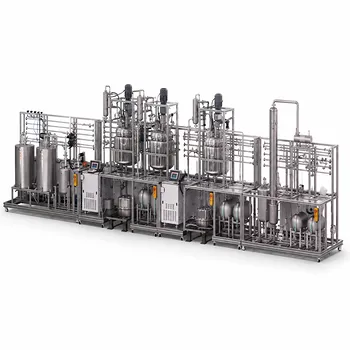
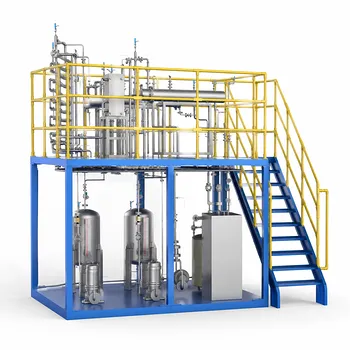
HAZOP isn’t just an industry requirement—it’s the most powerful teaching tool an academic laboratory can deploy. Academic labs apply HAZOP to educational unit operations pilot plants by dividing the process into distinct nodes (such as vessels or lines), then systematically analyzing deviations using standard guide words. The key parameters that must be evaluated are temperature, pressure, flow rate, pH, volume (liquid level), agitation, concentration, viscosity, and phase state (solid, liquid, or gas). This structured approach uncovers hidden risks before students ever touch a valve, turning a routine lab session into a professional safety audit.
HAZOP transforms a pilot plant from a simple demonstration rig into a dynamic risk-awareness simulator. By forcing students to ask “what if” about every critical parameter, it bridges the gap between textbook safety theory and the real-world discipline of operational hazard identification.
Why HAZOP Belongs in the Academic Lab
Integrating HAZOP into your unit operations curriculum solves a deep educational problem: chemical engineering graduates often enter industry with strong theory but weak instinct for process hazard analysis. A pilot plant without a HAZOP exercise is a missed opportunity to build that instinct safely.
Vocational Training That Mirrors Industry
Before operating pilot-scale reactors or distillation columns, students and instructors who perform a HAZOP replicate the exact same risk-assessment workflow used on billion-dollar industrial plants. This teaches them how safety interlocks, alarm limits, and emergency shutdown procedures are justified in the real world. The pilot plant becomes a living laboratory for professional practice, not just chemical phenomena.
From Passive Observation to Active Risk Analysis
Traditional pilot plant exercises often focus on meeting performance targets. A HAZOP flips the script. Students must actively interrogate the equipment, using guide words like “No,” “More,” or “Reverse” on parameters such as flow or pressure. For example, analyzing a “No heating steam flow” deviation on a vaporizer forces them to trace a valve failure through to the consequence of liquid reactant accumulation. This active inquiry cements understanding far better than a pre-written safety checklist.
Building a Culture of Systematic Inquiry
The collaborative, structured nature of HAZOP teaches students how to think, not just what to check. They learn to evaluate multiple situations involving specific equipment, assess the likelihood and consequences of hazards, and propose corrective actions. This systematic mindset becomes the foundation of a lifelong safety culture.
How to Implement HAZOP in Your Unit Ops Lab
A successful academic HAZOP follows a repeatable, step-by-step procedure that any student team can learn. The process is identical in principle to an industrial study but scaled to the educational environment.
Step 1: Divide the Pilot Plant into Logical Nodes
Start by selecting a specific piece of equipment, like a reactor or a steam-heated vaporizer, and clearly define its design intent. Then, identify the connecting process lines using the P&ID. Each line and vessel becomes a separate node for analysis, ensuring full coverage of the pilot plant’s process flow.
Step 2: Select the Critical Parameters to Evaluate
For each node, students must evaluate a core set of process variables. The parameters to scrutinize are:
- Temperature
- Pressure
- Flow Rate
- pH
- Volume (Liquid Level)
- Agitation
- Concentration
- Viscosity
- Phase State (solid, liquid, gas)
Choosing the right parameter for the right node is critical. On a feed line, flow rate is the primary concern. Inside a reactor, temperature, pressure, agitation, and level dominate the risk profile.
Step 3: Apply Guide Words to Reveal Deviations
With a parameter selected, students apply standard HAZOP guide words to imagine deviations from the design intent. Key guide words include None (No), More, Less, Reverse, and others.
- On a steam line to a vaporizer, the guide word “More” (More Steam Flow) reveals a deviation caused by a control valve failure, leading to low liquid level and high vapor velocity.
- On a feed line, the guide word “Reverse” uncovers the risk of hot acidic gases backflowing and corroding upstream equipment, immediately justifying the need for a non-return valve.
- Combining “No” with flow rate on a cooling water line exposes the consequences of pump failure.
This pairing of guide word and parameter transforms an abstract P&ID symbol into a vivid, consequential scenario.
Step 4: Document Findings and Verify Safeguards
For every identified deviation, students must record the cause, the consequence, and the existing safeguards. They then determine if the current instrumentation—alarms, interlocks, relief valves—is sufficient or if additional protections are needed. Marking the analyzed lines on the P&ID as they proceed ensures no part of the system is overlooked. This documentation mirrors industrial HAZOP worksheets and builds habits of rigorous, auditable safety analysis.
Understanding the Trade-offs and Common Pitfalls
While the benefits are clear, forcing a full HAZOP into an academic setting without adaptation can backfire. Instructors must navigate several inherent tensions.
Time Constraints vs. Depth of Analysis
A full HAZOP on every node and every parameter is time-consuming and can overwhelm students. The risk is that the exercise becomes a rushed chore rather than a deep learning experience. You will likely need to pre-select a limited set of nodes and guide words for a single lab session, deliberately sacrificing exhaustive coverage for educational impact.
The Danger of a Checklist Mentality
If not facilitated carefully, students can fall into a mechanical box-ticking exercise. They may simply go through the motions of applying guide words without truly visualizing the physical consequences. The facilitator must constantly push students to connect deviations to real outcomes—like liquid carryover or exothermic runaway—to maintain engagement.
Instructor Preparedness as a Limiting Factor
A HAZOP is only as good as the facilitator guiding the team. In an academic lab, this means instructors must themselves be comfortable with HAZOP methodology and process safety fundamentals. Without adequate training, the discussion can miss subtle but critical hazards, giving students a false sense of security.
Tailoring the HAZOP Exercise to Your Educational Goals
The way you scope a HAZOP should directly reflect what you want students to learn. Use these goal-driven strategies to calibrate the exercise.
- If your primary focus is introducing safety concepts: Start with a single, non-reactive node (like a simple feed line) and only three parameters (flow, pressure, level). Ensure every student can articulate the logic of cause-consequence-safeguard before moving to more complex equipment.
- If your primary focus is advanced process control design: Challenge students to not only identify hazards but to specify the trip setpoints, alarm logic, and interlocks (e.g., a low-level alarm on a vaporizer linked to an automatic steam shutoff) that would mitigate their identified deviations.
- If your primary focus is preparing students for industrial placements: Combine the HAZOP study with a standard operating procedure (SOP) writing workshop. Each identified hazard in the HAZOP worksheet should directly translate into a specific warning, an emergency step, or a control verification in the SOP.
When you embed HAZOP into your pilot plant curriculum, you are not simply teaching a hazard analysis technique. You are engineering a mindset that questions deviations, respects exothermic potential, and instinctively looks for the safeguard—a mindset that will protect processes and lives from the very first day of your students’ professional careers.
Summary Table:
| Parameter | Guide Word | Example Deviation & Cause | Key Safeguard |
|---|---|---|---|
| Temperature | More | Steam control valve stuck open | High-temperature cutoff / Alarm |
| Flow Rate | Reverse | Feed pump failure / Backflow | Install check/non-return valve |
| Volume (Level) | Less | Supply tank empties / Pump trip | Low-level interlock / Pump shutdown |
| Pressure | More | Blocked outlet valve | Safety relief valve (PRV) / Rupture disc |
Integrate Industrial-Grade Safety Into Your Curriculum with LABPARK
Ensure your students graduate with the practical risk-analysis skills today's industries demand. LABPARK designs and manufactures premium Educational and Vocational Unit Operations Pilot Plants across chemical engineering, bioprocess & biotech, and environmental & water treatment.
Our systems are tailored for universities, research institutes, and enterprises to bridge the gap between process theory and real-world safety compliance. Ready to upgrade your lab's training capabilities? Contact LABPARK today to discuss your customized pilot plant solutions!
Related Products
- Carbon Dioxide Hydrogen Methanol Synthesis Educational Unit Operations Pilot Plant
- Multi Pump Fluid Transport Process Piping Unit Operations Training Pilot Plant
- Natural Product Extraction Unit Operations Training Pilot Plant
- Multi-Modal Distillation Unit Operations Training Pilot Plant
- Multi-Reactor Educational Pilot Plant for Reaction Engineering Unit Operations
People Also Ask
- How do temp & pressure affect methanol synthesis pilot plants? Optimize equilibrium and catalyst performance.
- Why is a purge system necessary when operating a gas recirculation loop in a methanol synthesis pilot plant? (Guide)
- Why do modern methanol pilot plants operate at lower pressures? Catalyst & Feed Requirements Explained
- What are the operational requirements for catalyst activation? Safe Methanol Pilot Plant Operation
- Why is the chemical plant startup schedule crucial? De-risk scale-up with pilot plants.