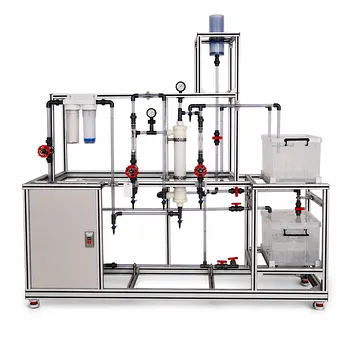
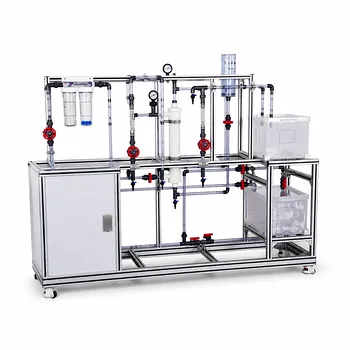
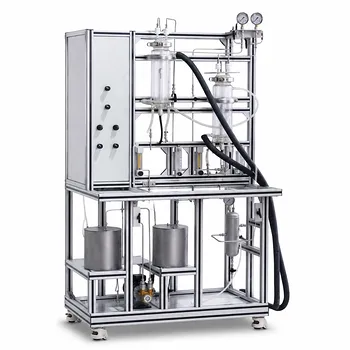
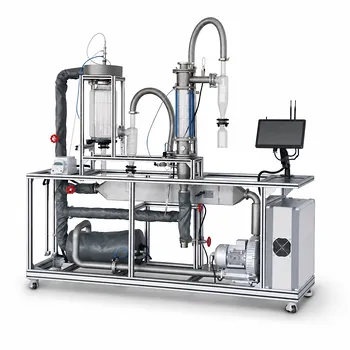
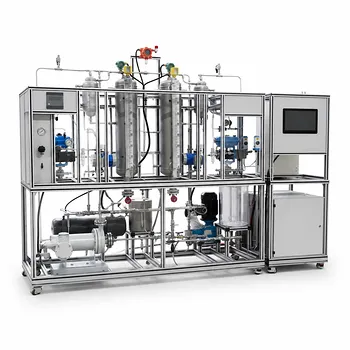
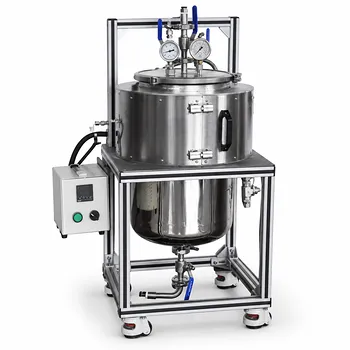
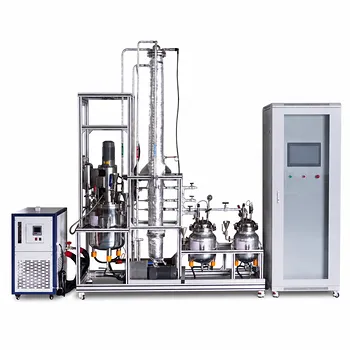
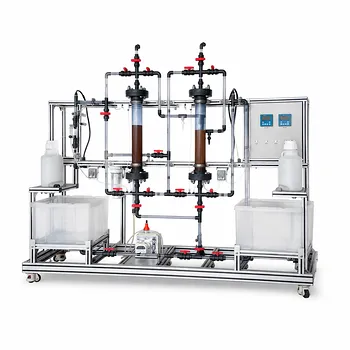
A multi-functional membrane filtration pilot plant demonstrates industrial NF applications by making invisible separation principles visible and quantifiable. For the food sector, it physically shows how juice can be concentrated at low temperatures, preserving heat-sensitive flavors and nutrients while removing water. For the textile sector, it provides a closed-loop simulation where you can see deeply colored dye wastewater become clear permeate water ready for reuse, directly illustrating a circular economy.
The true educational value of an NF pilot plant lies not just in showing that separation happens, but in revealing why—by manipulating pressure, flow, and chemistry to expose the membrane's unique selective boundary between concentrating valuable food components and purifying challenging industrial wastewater.
Simulating High-Value Food Concentration
Beyond just removing water, an NF pilot plant allows you to demonstrate how to selectively retain the molecular components that define a product's quality and nutritional value. This moves the lesson from simple dewatering to advanced product engineering.
The Juice Concentration Benchmark
A core experiment involves concentrating a fruit juice simulant. Unlike thermal evaporation, which can degrade color and aroma, the pilot plant demonstrates a non-destructive, isothermal process.
By tracking the volume reduction factor and measuring the sugar content (degrees Brix) of the retained stream, users directly observe how low-molecular-weight sugars are concentrated. At the same time, the permeate line shows clear water being removed, validating the membrane’s role in retaining flavor compounds with a molecular weight above the 200 Da threshold without a phase change.
Mastering Dairy Fractionation
The same pilot plant can be re-configured to unlock value from dairy streams, demonstrating the precise separation of proteins from lactose and salts. This is a far more complex demonstration of the membrane's selective power.
The primary reference highlights fractionating milk to produce protein-rich and lactose-free products. In the pilot plant, you physically prove charge-dependent rejection: the NF membrane strongly retains the larger, partially charged whey proteins, while allowing smaller, neutral lactose molecules and monovalent salts to pass into the permeate. This single demonstration teaches the fundamental principle behind producing high-value milk protein concentrates and specialty nutritional ingredients.
Engineering Circular Water Economies for Textiles
Here, the pilot plant’s focus shifts from product valorization to resource recovery. It becomes a miniaturized water treatment facility, directly tackling one of the industry’s most significant environmental challenges: highly visible and persistent dye pollution.
Demonstrating Zero-Liquid Discharge Principles
The primary reference directly states the NF unit can simulate textile wastewater treatment to teach zero-liquid discharge (ZLD) . The pilot plant makes this abstract concept tangible.
A synthetic feed of water spiked with a large reactive dye molecule visually demonstrates near-total pollutant rejection. The dark feed contrasts starkly with the clear permeate, giving an immediate, intuitive understanding of purification. Quantitative measurements of dye concentration, chemical oxygen demand, and conductivity reinforce the lesson, showing how NF enables treated water to be recycled back into the dyeing process, closing the industrial loop.
Revealing the Selective Salt-Dye Barrier
The most critical industrial lesson comes from analyzing both the permeate and the concentrate streams simultaneously. This reveals the unique economic niche of NF between ultrafiltration (UF) and reverse osmosis (RO).
The supplementary references specify that NF rejects organic compounds with a molecular weight of 200–400 Da and divalent salts at 90–98%, while allowing monovalent salts to pass at a much lower rate. In a textile context, this means the pilot plant shows how NF can let the process-enabling monovalent salt (e.g., NaCl) pass through, while almost perfectly capturing the heavy dye molecules and larger process chemicals. This selective barrier allows for the recovery of both clean water and a reusable brine that UF cannot achieve and RO would over-engineer.
Understanding the Trade-offs and Operational Levers
The pilot plant’s greatest lesson is that membrane filtration is never a static, perfect solution. It is a dynamic equilibrium defined by trade-offs that an operator must navigate.
The Concentration-Fouling Paradox
A hands-on experiment deliberately pushing for a high concentration factor will inevitably demonstrate the onset of flux decline. This teaches the critical concept of concentration polarization, where retained solutes build up on the membrane surface.
Participants directly observe that higher concentration efficiency comes at the cost of a rapidly decreasing permeate flow rate due to this gel-layer formation and potential protein or dye fouling. The lesson is that 100% water recovery is physically and economically impossible; the process must stop at an optimal point.
Managing the Mechanical Levers
The pilot plant allows for the manipulation of the key control variables to counteract fouling: trans-membrane pressure (TMP) and cross-flow velocity. Users learn that increasing the shear rate across the membrane surface is often more effective for controlling fouling than simply increasing pressure, which can compact the fouling layer. This exploration uncovers the non-linear relationship between pressure, flow, and energy consumption, a crucial economic insight for any industrial process.
The Inevitable Reality of Cleaning-in-Place (CIP)
Finally, the pilot plant demonstrates that membranes are consumable tools requiring maintenance. After running a concentrated food or textile product, users must develop and execute a cleaning-in-place (CIP) regimen. This involves selecting cleaning chemicals (alkaline, acidic, enzymatic), controlling temperature, and measuring the restoration of clean water flux. This practical step teaches that operational lifetime and effective CIP protocols are just as important as initial separation performance.
Making the Right Choice for Your Goal
The specific experimental design and the conclusions you draw will depend entirely on whether you are optimizing a product or processing a waste stream.
- If your primary focus is product development in food science: Use the pilot plant to quantify the "retention factor" of key quality attributes. Your experiment should center on how operating parameters influence the final concentration and purity of a target biomolecule, like a flavor peptide or a protein, while assessing the energy cost per kilogram of water removed.
- If your primary focus is sustainability and water treatment: Design your experiment around the "recovery rate" and "rejection efficiency" of a model pollutant. Compare the permeate quality against industrial water reuse standards and measure the volume of concentrated waste generated, directly quantifying the economics of a circular water economy.
- If your primary focus is process engineering and operations: Concentrate on mapping the performance envelope of the specific NF membrane. Systematically vary TMP and cross-flow velocity to find the critical flux window, then design an accelerated fouling test to benchmark different CIP strategy effectiveness.
The multi-functional pilot plant transforms nanofiltration from a textbook concept into a tangible decision-making tool, empowering you to bridge the gap between molecular selectivity and industrial-scale sustainability.
Summary Table:
| Sector | Key Application | Filtration Mechanism | Target Outcome |
|---|---|---|---|
| Food | Juice & dairy concentration | Isothermal separation & charge-dependent rejection | Retain nutrients/proteins; remove water/lactose |
| Textile | Wastewater reuse & ZLD | Selective salt-dye barrier (200-400 Da cutoff) | Recover clean water & reusable brine |
Bring Industrial Nanofiltration to Life with LABPARK
Are you looking to bridge the gap between classroom theory and industrial reality? LABPARK provides state-of-the-art Educational and Vocational Unit Operations Pilot Plants in chemical engineering, bioprocess & biotech, and environmental & water treatment. Designed specifically for universities, research institutes, and enterprises, our pilot systems empower students and researchers to master membrane separation, fouling control, and circular economy principles hands-on.
Ready to elevate your engineering curriculum or research capabilities? Contact LABPARK today to find the perfect pilot plant solution for your lab!
Related Products
- Multifunctional Membrane Separation Educational Pilot Plant with Ultrafiltration, Nanofiltration, Reverse Osmosis
- Multi-Functional Membrane Separation Educational Pilot Plant for Unit Operations Lab
- Multi Functional Membrane Crystallization Educational Unit Operations Pilot Plant
- Ultrafiltration Membrane Separation Educational Pilot Plant
- Hollow Fiber Ultrafiltration Membrane Separation Educational Pilot Plant
People Also Ask
- How do PEI, PVDF, and PSU membranes compare in pilot plants? Find the best fit.
- Pervaporation vs. Vapor Permeation: Handling Suspended Solids in Membrane Pilot Plants
- What are the trade-offs of polymer vs inorganic membranes in teaching pilot plants? Key laboratory comparison.
- How can operators optimize operating conditions and cleaning protocols in membrane separation pilot plants to mitigate fouling?
- What are the advantages of membrane separation in pilot plants? Efficient Organic Vapor Recovery