Knowledge Chemical Engineering Education How can a filtration pilot plant demonstrate wet process phosphoric acid production? Learn Key Optimization Steps
Author avatar

Tech Team · LABPARK

Updated 1 month ago

How can a filtration pilot plant demonstrate wet process phosphoric acid production? Learn Key Optimization Steps


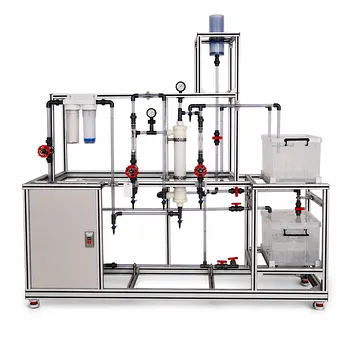
A filtration pilot plant turns a messy, corrosive chemical reaction into a quantifiable separation science.
It allows you to take the slurry produced from reacting phosphate rock with sulfuric acid and use equipment like a rotary vacuum filter or a plate and frame filter press to precisely study the solid-liquid separation. You measure filtration resistance, optimize cake washing to recover trapped phosphoric acid, and evaluate filtrate clarity before the acid is concentrated in a downstream evaporator. This directly demonstrates the step that makes or breaks the entire wet process.

The core value of a filtration pilot plant is that it isolates the most troublesome part of phosphoric acid production—separating hot, corrosive acid from calcium sulfate crystals—and gives you the data to control it. By manipulating reactor conditions that feed the filter, you can see exactly how crystal formation, slurry properties, and operating parameters translate into filtration speed, acid recovery, and waste gypsum quality.

What a Filtration Pilot Plant Actually Demonstrates

The wet process is a cascade of interconnected unit operations. The filtration step sits right at the point where the reaction’s success is turned into a usable product. Here is what the pilot plant lets you directly observe and quantify.

Measuring Filtration Resistance to Predict Full-Scale Performance

The slurry’s filtration resistance is the ultimate report card for the reaction and crystallization steps upstream.
By running the pilot filter under controlled vacuum or pressure, you can log the time required to form a cake at a given thickness. This data correlates with the particle size distribution of the gypsum crystals—the very thing determined by reactor temperature (typically 80–85°C), sulfate concentration, and solid-to-liquid ratio.
A pilot plant lets you change those reactor variables and then measure the resulting filtration resistance, giving you a direct link between chemistry and filter throughput.

Optimizing Cake Washing to Maximize Phosphoric Acid Recovery

The gypsum filter cake traps valuable phosphoric acid. Without washing, you lose product—and create a sticky, acidic waste stream.
In the pilot plant, you can apply multiple displacement washing stages and measure the concentration of phosphorus in the wash filtrate. This tells you exactly how much water is needed to displace the acid without over-diluting the main product stream.
Students and researchers quickly see that every extra liter of wash water recovers more acid, but also increases the load on the downstream vacuum evaporator pilot plant.

Ensuring Filtrate Clarity for Downstream Concentration

Cloudy filtrate means fine gypsum particles have passed through the filter medium, which will foul heat exchangers and evaporators.
The pilot plant provides a direct visual and analytical check: you can measure turbidity or suspended solids content of the filtrate immediately.
By adjusting filter cloth selection, precoat techniques, or even upstream crystallization conditions, the pilot plant demonstrates how to safeguard the entire phosphoric acid concentration train.

Handling Corrosive Slurries and Gypsum By-Product

The wet process produces a slurry of phosphoric acid (around 30% P₂O₅) and calcium sulfate at high temperature. This is aggressively corrosive.
Running the filtration pilot plant with realistic materials of construction—such as stainless steel or reinforced plastics—teaches proper selection of wetted parts and safe handling protocols.
The collected gypsum cake is a direct industrial waste product. The pilot plant lets you measure its moisture content and residual phosphorus, both critical for environmental compliance and potential reuse (e.g., in construction materials).

Understanding the Trade-offs in Filtration Optimization

No single setting maximizes every desirable outcome. The pilot plant’s greatest teaching moment is revealing these inherent tensions.

Cake Washing Efficiency vs. Product Dilution

Aggressive washing recovers more phosphoric acid, but the wash water dilutes the product acid.
In a closed-loop system, that extra water must be evaporated later, costing energy. The pilot plant allows you to chart the recovery-vs-concentration curve and find the economic sweet spot.

Filter Speed vs. Clarity—The Balancing Act

Higher filtration rates usually mean a thinner, more permeable cake—often from larger gypsum crystals formed under carefully controlled sulfate levels.
But pushing speed too far can push fine particles into the filtrate, muddying the clarity. The pilot plant’s instrumentation shows where that trade-off lies for each unique slurry.

Dihydrate Crystal Morphology and Filtration Behavior

The wet process typically targets dihydrate gypsum (CaSO₄·2H₂O), which forms wide, tabular crystals that filter and wash relatively well.
However, slight shifts in temperature or sulfate concentration can produce needle-like or fine crystals that drastically increase filtration resistance. The pilot plant lets you recreate these excursions and see how a 2–3°C deviation can double your filter cycle time.

Making the Right Choice for Your Pilot Plant Demonstration

How you configure and run the filtration unit depends on your primary goal. Below are the most common starting points, along with what they teach.

  • If your primary focus is teaching fundamental unit operations: Integrate the filtration pilot plant with multi-stage stirred reactors and a vacuum evaporator. Run the full sequence so learners grasp how reaction kinetics, crystal seeding, and filtration pressure drop all interconnect.
  • If your primary focus is process optimization and scale-up: Systematically vary the solid-to-liquid ratio, sulfate concentration, and temperature. Record filtration resistance and washing efficiency for each condition to build a dataset that directly informs industrial filter sizing.
  • If your primary focus is waste minimization and environmental compliance: Concentrate on cake washing studies and final gypsum quality. Measure phosphorus losses in the cake and explore the minimal wash ratio that still meets discharge or reuse specifications.

A filtration pilot plant is not just a piece of demonstration hardware—it’s the analytical engine that reveals exactly how to turn phosphate rock into pure phosphoric acid while taming the enormous volumes of gypsum the wet process inevitably creates.

Summary Table:

Key Demonstration Focus Area Practical Outcome
Filtration Resistance Crystal morphology & slurry viscosity Predicts full-scale filter throughput and sizing
Cake Washing Acid recovery vs. filtrate dilution Optimizes washing stages to minimize product loss
Filtrate Clarity Solid breakthrough & turbidity control Safeguards downstream evaporators from fouling
By-Product Management Gypsum cake moisture & residual acid Ensures environmental compliance and waste reuse

Bring Industrial Chemistry to Life with LABPARK

Are you looking to bridge the gap between classroom theory and industrial application? LABPARK provides premium Educational and Vocational Unit Operations Pilot Plants in chemical engineering, bioprocess & biotech, and environmental & water treatment.

Specifically engineered for universities, research institutes, and progressive enterprises, our pilot plants empower students and researchers to master complex separation and filtration processes.

Contact LABPARK today to discuss your laboratory configuration and take your chemical engineering programs to the next level!

Related Products

People Also Ask

Related Products

Hot Filtration Educational Unit Operations Pilot Plant Laboratory System

Hot Filtration Educational Unit Operations Pilot Plant Laboratory System

This integrated laboratory bench-scale hot filtration pilot plant enables students to study solid-liquid separation under thermal conditions, featuring a stainless steel vessel, removable heating jacket, and multi-layer filter plates for unit operations education, ideal for chemical engineering laboratory curriculum.

Constant Pressure Filtration Educational Unit Operations Pilot Plant

Constant Pressure Filtration Educational Unit Operations Pilot Plant

Hands-on educational pilot plant for constant pressure filtration. Classic plate and frame filter press allows students to study kinetics, determine specific cake resistance, perform cake washing and evaluate washing rates. Ideal for chemical engineering curriculum. Mobile, customizable, safety-compliant design.

Multi-Modal Distillation Unit Operations Training Pilot Plant

Multi-Modal Distillation Unit Operations Training Pilot Plant

Multi-modal distillation pilot plant for practical unit operations training in chemical engineering education. Features real, analog, and semi-physical simulation modes, industrial construction, customizable for university labs. Hands-on fractionation columns, SCADA control, safety systems. Includes sight glasses, sampling ports, closed-loop recycling.

Dual-Mode Rectification Pilot Plant for Practical Training Unit Operations

Dual-Mode Rectification Pilot Plant for Practical Training Unit Operations

Industrial-scale dual-mode rectification pilot plant for chemical engineering practical training. Features real-material and simulated-material operation modes, sieve-plate column with sight glasses for visual observation of hydrodynamics, and customizable SCADA control for safe, hands-on learning of unit operations and mass transfer.

Multi-Reactor Educational Pilot Plant for Reaction Engineering Unit Operations

Multi-Reactor Educational Pilot Plant for Reaction Engineering Unit Operations

Integrated bench-scale educational pilot plant for chemical engineering teaching featuring fixed bed fluidized bed and stirred tank reactors with web-based digital twin controls and safety interlocks for hands-on unit operations and reaction engineering comparative studies in one compact system.

Educational Pressure Swing Adsorption Ethylene Capture Unit Operations Pilot Plant

Educational Pressure Swing Adsorption Ethylene Capture Unit Operations Pilot Plant

Advanced educational pilot plant for pressure swing adsorption ethylene capture provides comprehensive hands-on training in industrial gas separation processes, featuring an eight-column PSA system, real-time data acquisition, and fully customizable design for chemical engineering unit operations laboratories and research.

Multi-Functional Membrane Separation Educational Pilot Plant for Unit Operations Lab

Multi-Functional Membrane Separation Educational Pilot Plant for Unit Operations Lab

The Multi-functional Membrane Separation Educational Unit Operations Pilot Plant is an integrated bench-scale laboratory system designed for teaching undergraduate engineering education. It features Ultrafiltration, Nanofiltration, and Reverse Osmosis modules in a compact, mobile unit for practical hands-on learning.

Gas-Solid Heterogeneous Separation Demonstration Educational Unit Operations Pilot Plant

Gas-Solid Heterogeneous Separation Demonstration Educational Unit Operations Pilot Plant

Comprehensive visual transparent gas-solid separation pilot plant for chemical engineering labs. Demonstrates gravity settling inertial settling cyclone and bag filter technologies. Enables real-time analysis of fluid-particle mechanics pressure drop and collection efficiency. Ideal for undergraduate unit operations courses.

Dual-Mode Gas Absorption and Desorption Unit Operations Training Pilot Plant

Dual-Mode Gas Absorption and Desorption Unit Operations Training Pilot Plant

Industrial-scale pilot plant for gas absorption and desorption training in chemical engineering. Features dual-mode operation with real and simulated materials, transparent columns for flow visualization, and customizable design. Supports independent or combined loops for hands-on unit operations experiments.

Absorption and Desorption Educational Unit Operations Pilot Plant

Absorption and Desorption Educational Unit Operations Pilot Plant

Dual packed column absorption and desorption pilot plant for chemical engineering education, offering real-time mass transfer coefficient measurement, durable mobile frame, industrial touch-screen interface, and customizable design for varied laboratory curricula, enabling hands-on study of gas absorption and stripping.

Solid Waste Pyrolysis and Refining Educational Pilot Plant for Unit Operations

Solid Waste Pyrolysis and Refining Educational Pilot Plant for Unit Operations

This pilot plant for solid waste pyrolysis and refining integrates pyrolysis, separation, distillation, and catalytic hydrogenation into one educational unit. It provides visual process observation, smart data logging, and industrial safety for hands-on learning of engineering unit operations.

Natural Product Extraction Unit Operations Training Pilot Plant

Natural Product Extraction Unit Operations Training Pilot Plant

Integrated natural product extraction pilot plant for chemical engineering training bridges theory and industrial practice with modular extraction and evaporation/concentration units, hybrid touchscreen and manual control, realistic process simulation, and self-contained softened water and vacuum utilities.

Ion Exchange Water Purification Educational Pilot Plant for Engineering Unit Operations

Ion Exchange Water Purification Educational Pilot Plant for Engineering Unit Operations

This bench-scale ion exchange pilot plant trains engineering students in water purification. Dual transparent columns simulate industrial softening and demineralization. Students observe fluid dynamics, perform resin regeneration, and analyze breakthrough curves. The corrosion-resistant frame ensures durability in unit operations experiments.

Photocatalytic Membrane Separation and Degradation Unit Operations Pilot Plant

Photocatalytic Membrane Separation and Degradation Unit Operations Pilot Plant

Bench-scale pilot plant integrating photocatalytic degradation with membrane separation for engineering education. Study advanced oxidation, microfiltration, and hybrid processes using industrial sensors. Features safety light-blocking curtain, low-noise compressor, and durable stainless-steel construction.

Rising and Falling Film Evaporation Educational Unit Operations Pilot Plant

Rising and Falling Film Evaporation Educational Unit Operations Pilot Plant

Hands-on educational pilot plant for studying rising and falling film evaporation, flow regimes, and heat transfer. Customizable for university labs with industrial instrumentation and data acquisition. Enables comparative evaluation of evaporation modes and energy efficiency.

Fixed-Bed Chemical Reaction and Gas Dust Tar Removal Unit Operations Pilot Plant

Fixed-Bed Chemical Reaction and Gas Dust Tar Removal Unit Operations Pilot Plant

Integrated educational pilot plant for studying catalytic gas-solid reactions and downstream gas purification. Features dual fixed-bed reactor, three-stage heating, and touchscreen control for hands-on engineering training. Ideal for chemical and environmental engineering curricula.

Multi-Functional Drying Educational Unit Operations Pilot Plant

Multi-Functional Drying Educational Unit Operations Pilot Plant

Versatile multi-functional drying educational unit operations pilot plant integrating tunnel, fluidized bed, and spray drying. Enables hands-on study of drying curves, psychrometry, and gas-solid separation for chemical engineering curriculum in higher education labs.

Ultrafiltration Membrane Separation Educational Pilot Plant

Ultrafiltration Membrane Separation Educational Pilot Plant

This ultrafiltration membrane separation educational pilot plant enables undergraduate students to process PVA solutions, study hollow fiber membrane dynamics, and perform quantitative analysis with spectrophotometry for hands-on learning of unit operations and industrial maintenance and membrane cleaning protocols.

Ethyl Acetate Synthesis Unit Operations Pilot Plant for Practical Training

Ethyl Acetate Synthesis Unit Operations Pilot Plant for Practical Training

Modular and customizable pilot plant for ethyl acetate synthesis practical training. Integrates esterification reaction, liquid-liquid extraction, neutralization, and sieve-plate distillation unit operations. Bridging theory and real-world industrial processes. Designed for university chemical engineering labs

Multi-Functional Special Distillation Educational Pilot Plant

Multi-Functional Special Distillation Educational Pilot Plant

Versatile multi-functional special distillation pilot plant for chemical engineering education. Supports continuous, vacuum, azeotropic, reactive, extractive distillation. Transparent glass columns enable real-time visual observation of hydrodynamics and separation processes.


Leave Your Message