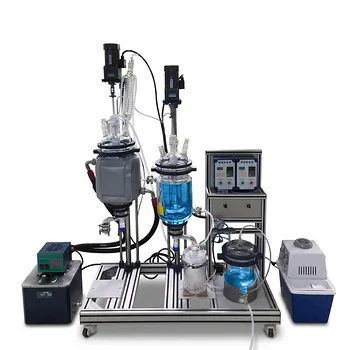
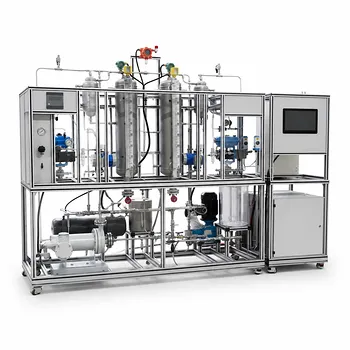
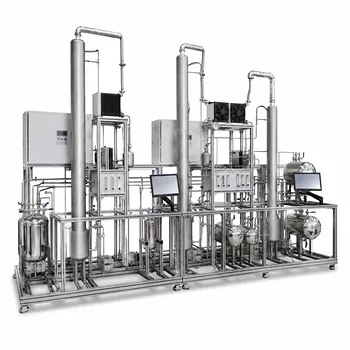
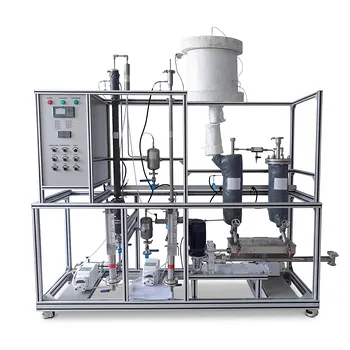
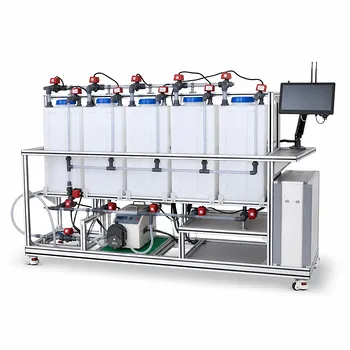
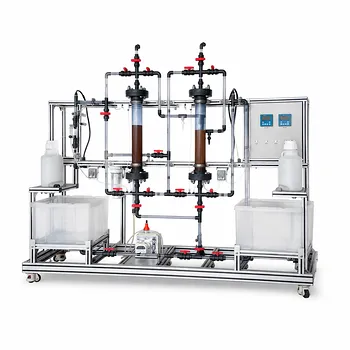
Crystallization pilot plants are not just scaled-down equipment; they are dynamic instruments for mapping the precise boundaries of process control. You can use a crystallization unit operations pilot plant to demonstrate the critical process parameters of ammonium chloride crystallization by controlling and observing the interplay of residence time, fluid dynamics, agitation, temperature, and material compatibility. The plant allows you to directly see how parameters like supersaturation generation, circulation velocity, and cooling rate determine crystal size, purity, and process stability. In essence, it turns theoretical phase diagrams into a tangible, controlled experiment where cause and effect become crystal clear.
A well-designed ammonium chloride crystallization pilot plant reveals that crystal quality is not a single variable problem. It’s the result of a precise orchestration of residence time (over 8 hours), tightly controlled fluid velocities in different vessel zones, and smart material choices—all while navigating the common-ion effect and metastable zone boundaries to produce clean, uniform solids.
Translating Thermodynamic Theory into Operational Leverage
The Temperature-Dependent Solubility Sweet Spot
Ammonium chloride’s solubility drops sharply with decreasing temperature, while sodium chloride’s stays nearly constant. This is the foundation you can explore. By cooling the solution to around 15°C, the pilot plant demonstrates selective precipitation of NH₄Cl, exactly as used in combined soda processes. You can track the crystal yield as a function of the temperature profile, turning abstract solubility curves into a visible mass of solids.
Salting-Out: The Common-Ion Effect in Action
The pilot plant also showcases salting-out crystallization. By adding solid NaCl to the mother liquor, the chloride ion concentration spikes, forcing more NH₄Cl out of solution. Students and researchers directly observe how the common-ion effect pushes the equilibrium. This dual-mode demonstration (cooling plus salting-out) ties phase diagrams to real-world process intensification, teaching you to maximize yield without adding extra energy.
Navigating the Metastable Zone
Precise temperature sensors and stirring speed controls let you operate within the metastable region—the narrow window between the solubility curve and spontaneous nucleation. By varying cooling rates and agitation, the plant reveals how to keep supersaturation low enough to grow existing crystals rather than create fines. You can literally map the supersolubility limit for a given feed composition, a critical industrial design parameter.
Engineering Fluid Dynamics for Optimal Crystal Growth
Zoned Velocities Define the Crystal Bed
The pilot plant crystallizer is designed with distinct hydrodynamic zones. In the clear liquid zone, a rising velocity of 0.015 to 0.02 m/s prevents fine crystals from being carried out. In the suspension zone, a higher velocity of 0.025 to 0.05 m/s keeps larger crystals fluidized and in continuous contact with supersaturated solution. By adjusting circulation pump speeds, you demonstrate the direct link between fluid drag, classification, and the final crystal size distribution.
Internal Draft Tubes and Axial Flow
Using internal draft tubes combined with an axial flow pump, the plant evenly cycles the slurry. This controlled circulation promotes crystal growth by constantly exposing the particle surface to fresh, cooled solution. You can see how varying the pump speed alters the mixing intensity and thus the cooling rate, preventing local cold spots that trigger primary nucleation. It’s a vivid lesson in scaling up from a stirred beaker to an industrial crystallizer.
The Interplay of Residence Time and Circulation
More than 8 Hours of Growth Opportunity
Long residence time is non-negotiable for ammonium chloride. The pilot plant demonstrates that a mean residence time of at least 8 hours is necessary to achieve stable crystal quality. By controlling the feed rate and the working volume, you observe how particle size evolves over time. Short-circuiting the flow or reducing residence time immediately shows up as a wider size distribution and higher fines content.
Solid-Liquid Balance and Circulation Flow Rates
The system constantly balances the solid-to-liquid ratio. A sufficiently low solids percentage (typically achieved by bleed and feed) maintains slurry fluidity and prevents circulation loop blockages. Adjusting the slurry pump speed directly impacts the fluidization of the crystal bed. The pilot plant lets you plot crystal size against circulation flow rate, giving you the data needed to design a full-scale unit that avoids settling lines.
Material Selection: Surviving the Chloride Environment
Corrosion as a Process Variable
Ammonium chloride solutions are aggressively corrosive. The pilot plant uses steel vessels lined with plastic or anti-corrosive coatings. This teaches you that material selection is not an afterthought but a critical process parameter. You can test the integrity of different linings under thermal cycling and abrasion from the slurry, directly connecting equipment protection to product purity and operational safety.
Impurity Entrapment and Crystallizer Material
Rough or corroded surfaces act as nucleation sites and can entrap impurities. By examining the surface finish and coating integrity after runs, students learn how a well-protected vessel directly contributes to lower impurity levels in the final crystals. This hands-on insight is impossible to gain from a textbook.
Demonstrating Advanced Control Strategies
In-Situ Monitoring of Polymorph Conversion
Instruments like focused beam reflectance measurement (FBRM) or Raman spectroscopy can be integrated. They show real-time changes in crystal size and form as cooling rates or solvent composition shift. The pilot plant lets you set precise manufacturing operating limits and alarm conditions, mirroring good manufacturing practice for pharmaceutical or fine chemical production.
Seeding and Cooling Profile Optimization
You can systematically vary the cooling profile—linear, parabolic, or intermittent—and introduce seed crystals at specific temperatures. The pilot plant reveals how seeding dominates over primary nucleation, steering the final crystal size distribution toward large, uniform particles. This is the most direct way to demonstrate kinetic control over thermodynamic potential.
Understanding the Trade-offs and Pitfalls
Productivity versus Quality
Pushing for higher throughput by reducing residence time below 8 hours will impair crystal growth and increase fines. The pilot plant makes this trade-off quantifiable. You must balance the desire for high production rates against the need for product that meets size and purity specifications.
Cooling Rate and Nucleation
Faster cooling generates higher supersaturation faster, which can slip into the labile zone and cause uncontrolled nucleation. You can witness rapid cooling producing a cloudy mass of fine crystals, while a slow, controlled ramp yields large, well-faceted particles. The lesson: the fastest way is rarely the best way for crystal quality.
Salting-Out versus Purity
Adding NaCl boosts yield but introduces the complexity of separating the excess salt from the final ammonium chloride product. The pilot plant shows that the salting-out step must be carefully integrated with washing and solid-liquid separation, or you simply trade one problem for another.
Making the Right Choice for Your Learning or Development Goal
Based on your primary objective, the pilot plant can be focused in these ways:
- If your primary focus is mastering thermodynamic fundamentals: Use cooling and salting-out experiments to map the ternary phase diagram, and verify how yield responds to temperature and common-ion concentration.
- If your primary focus is process design and scale-up: Quantify the relationship between circulation flow rate, residence time, and crystal size distribution, and use that data to define zone velocities for a commercial vessel.
- If your primary focus is material durability and corrosion: Run extended campaigns comparing different vessel linings and coatings, measuring thickness loss and monitoring surface roughness under actual chloride slurry conditions.
- If your primary focus is advanced process control: Integrate in-situ particle size analyzers to establish the metastable zone width for various cooling rates, and design seeding protocols that lock in a target crystal size distribution.
The crystallization unit operations pilot plant for ammonium chloride is more than a teaching tool; it is your laboratory to develop the intuition that turns a precipitation step into a predictable, high-performance unit operation.
Summary Table:
| Parameter | Target Value / Range | Operational Purpose & Effect |
|---|---|---|
| Cooling Temperature | ~15°C | Drives selective precipitation of NH₄Cl |
| Residence Time | > 8 Hours | Achieves stable crystal size & minimizes fines |
| Rise Velocity | 0.015 - 0.02 m/s | Prevents fine crystals from elutriating in the clear zone |
| Suspension Velocity | 0.025 - 0.05 m/s | Keeps larger crystals fluidized in the suspension zone |
| Salting-Out | NaCl addition | Triggers crystallization using the common-ion effect |
Ready to bridge the gap between chemical engineering theory and industrial practice? LABPARK provides high-quality Educational and Vocational Unit Operations Pilot Plants in chemical engineering, bioprocess & biotech, and environmental & water treatment. Specifically designed for universities, research institutes, and enterprises, our systems enable students and researchers to master complex crystallization dynamics first-hand. Contact us today to discover how we can elevate your lab's training and research capabilities!
Related Products
- Multi Functional Membrane Crystallization Educational Unit Operations Pilot Plant
- Methane Cracking Educational Unit Operations Pilot Plant
- Multi-Functional Special Distillation Educational Pilot Plant
- Dual-Mode Rectification Pilot Plant for Practical Training Unit Operations
- Potassium Salt Thermal Dissolution and Crystallization Separation Educational Unit Operations Pilot Plant
People Also Ask
- Why is precise temperature control critical in crystallization pilot plants? Key to Scale-Up Success
- Control Crystallization Pilot Plant Secondary Nucleation: 4 Key Adjustments
- What key factors should be considered when configuring a crystallization unit operations pilot plant?
- What are the benefits of integrating online PAT tools like ATR-FTIR into crystallization unit operations pilot plants?
- How to use crystallization pilot plant agitation speed to identify diffusion vs reaction growth?