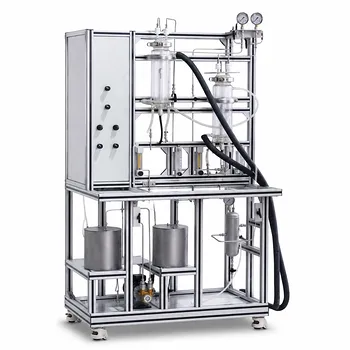
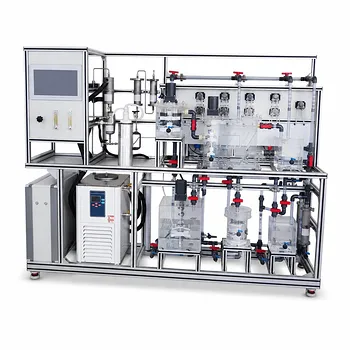
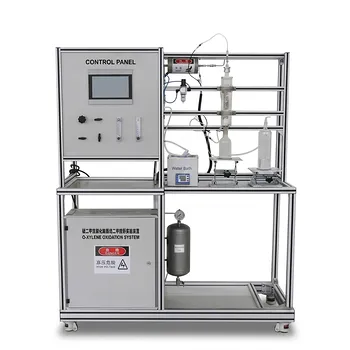
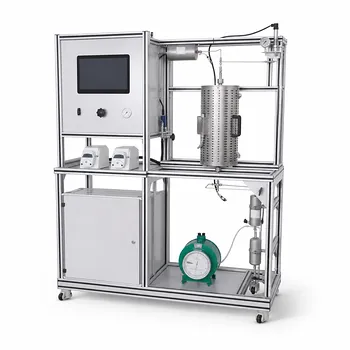
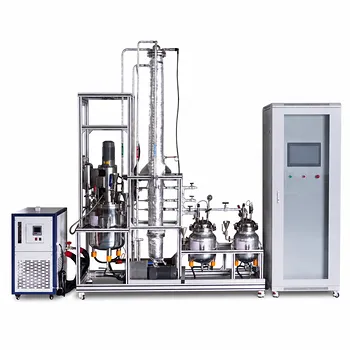
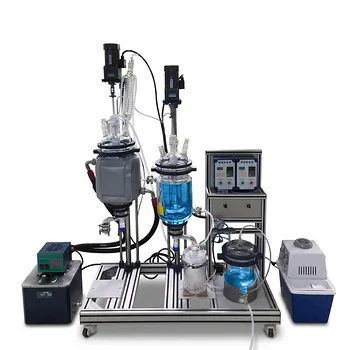
By splitting the reaction across multiple catalyst beds with intermediate cooling, a unit operations pilot plant directly demonstrates the essential temperature control strategy for the exothermic oxidation of SO2 to SO3. In a single adiabatic bed, the heat released quickly raises the gas temperature, limiting conversion to 60–70% because the thermodynamic equilibrium becomes unfavorable. The pilot plant shows how lowering the gas temperature between beds shifts the equilibrium back toward SO3, ultimately achieving an overall conversion of 98–99%. This hands-on setup makes the interplay between kinetics and thermodynamics both visible and quantifiable.
The oxidation of SO2 is a classic reversible, exothermic reaction where temperature is a double-edged tool: you need enough heat to activate the catalyst, but too much heat destroys your final yield. A pilot plant with staged beds and intercooling teaches that the winning strategy is to step the temperature down as conversion increases, following an optimal temperature pathway that balances speed and equilibrium.
The Thermodynamic-Kinetic Dilemma
The core challenge of SO2 oxidation is that the conditions that accelerate the reaction are the very same conditions that limit its completion.
Why a Single Bed Falls Short
The reaction ($SO_2 + 0.5O_2 \rightleftharpoons SO_3$) releases approximately 98 kJ/mol. In a fixed bed with no heat removal, this energy drives a rapid adiabatic temperature rise. Since the equilibrium constant drops as temperature climbs, the reaction reaches a thermodynamic ceiling well before all SO2 is consumed, capping conversion around 60–70%.
The Low-Temperature Bottleneck
While low temperatures (350–400 °C) strongly favor SO3 formation thermodynamically, the reaction rate collapses. The catalyst needs a minimum operating temperature of roughly 680–715 K (about 405–440 °C) to deliver industrially meaningful kinetics. You cannot simply run cold from the start and expect a practical yield—the catalyst would remain virtually dormant.
Demonstrating the Multi-Bed Temperature Strategy
A unit operations pilot plant mirrors the industrial approach: several fixed-bed reactor stages separated by heat exchangers or air quenching loops.
Staged Cooling in Action
The gas flowing into Bed 1 is preheated to the catalyst’s light-off temperature. As the exothermic reaction proceeds, the outlet temperature surges. Instead of sending this hot, equilibrium-hindered stream directly to a second pass, the pilot plant routes it through an interstage cooler. This reduces the gas temperature back toward the bed-inlet target, restoring a strong thermodynamic driving force. Students can sample between beds to track the stepwise jump in conversion, typically observing a climb from 60–70% after the first bed to over 98% after the final bed.
Visualizing the Optimal Temperature Profile
Every conversion level has a theoretical optimum temperature ($T_{opt}$) where the net reaction rate is maximized. The pilot plant allows users to manually or automatically adjust interstage cooling duties to sweep along this $T_{opt}$-conversion curve. By recording inlet and outlet temperatures and calculating the adiabatic temperature rise index ($\lambda = \frac{C_{A0}(-\Delta H_r)}{\rho c_p}$), students can plot the actual temperature trajectory against the ideal profile, directly quantifying the penalty of poorly controlled cooling.
Enhancing Learning with Real-Time Data
Modern pilot plants are instrumented to turn thermal strategy into measurable numbers.
Quantifying Equilibrium and Kinetics
Integrated thermocouples, pressure transducers, and gas analyzers provide live data. Students can calculate the equilibrium constant ($K_p$) at multiple points, observe how the rate constant ($k = A e^{-E/RT}$) changes with temperature, and even assess rate-limiting steps like catalyst adsorption. The data makes abstract textbook concepts—like the exponential sensitivity of reaction rate to temperature—concrete and verifiable.
Validating Kinetic Models Safely
The pilot plant generates empirical datasets under controlled, non-hazardous conditions. These datasets are invaluable for fitting reaction rate equations and determining Arrhenius parameters. Unlike an industrial reactor, the pilot scale allows students to intentionally operate near the limits of stability to study thermal runaway risks, without the catastrophic consequences. This bridges the gap between theory and the safety analysis required for full-scale design.
Pushing Beyond Standard Equilibrium
Advanced pilot configurations illustrate an even more powerful temperature-management lesson.
The Double Absorption Concept
If you remove SO3 from the gas stream after an intermediate stage—simulating an interstage absorption tower—you lower the product concentration. By Le Chatelier’s principle, this drives the reaction beyond its standard thermodynamic ceiling. Pilot plants that incorporate this feature demonstrate how a process can achieve conversions exceeding 99.7%. It reinforces the idea that temperature control and product removal are synergistic levers, both critical for meeting stringent emission limits.
Understanding the Trade-offs and Limitations
No temperature strategy comes without compromises, and the pilot plant is an ideal platform to explore them.
Catalyst Temperature Sensitivity
Vanadium pentoxide ($V_2O_5$) catalysts—the industrial workhorse—must stay above their activation threshold. Cool too much between beds, and you risk extinguishing the reaction. The pilot plant also offers a chance to compare catalyst types: platinum catalysts, for example, are far more active but are easily poisoned by impurities like arsenic, highlighting why upstream purification is non-negotiable.
Complexity and Capital Cost
More beds and intercoolers mean more equipment and piping. While the pilot plant’s flexibility is educational, it also demonstrates why an industrial plant must optimize the number of stages against capital expenditure. Sometimes a four-bed configuration with carefully sized intercoolers is the economic sweet spot, not a five- or six-bed system that achieves marginally higher conversion.
The Constant Threat of Runaway
Exothermic reactions can self-accelerate if cooling fails. The pilot plant is equipped with automated cooling systems—jackets, internal coils, air quenches—to demonstrate active temperature management. By studying the linear relationship between temperature rise and conversion ($T = T_0 + \lambda X_A$) and the exponential nature of the rate constant, students learn to identify the precise conditions that would lead to a runaway, building intuition for industrial safety system design.
Making the Right Choice for Your Educational Goal
How you configure and operate the SO2 oxidation pilot plant depends entirely on what you want the experiment to teach.
- If your primary focus is reaction engineering fundamentals: Map the full conversion-temperature trajectory. Calculate the adiabatic temperature rise for each bed, derive the optimum temperature profile, and verify how closely your cooling stages follow it.
- If your primary focus is process control and safety: Concentrate on the interstage cooling loops. Study the dynamic response of bed temperatures to changes in coolant flow, set up high-temperature alarms, and simulate the failure of a cooling step to observe the resulting temperature excursion.
- If your primary focus is environmental and economic efficiency: Set up the double absorption simulation. Evaluate how intermediate SO3 removal relaxes the temperature constraints and allows a lower final bed temperature, enabling conversion efficiencies that minimize stack emissions.
Mastering temperature control on the pilot scale transforms a theoretical equilibrium limitation into a practical, solvable engineering challenge—one that defines the heart of industrial sulfuric acid production.
Summary Table:
| Stage / Process Step | Temperature Control Action | Conversion Target | Engineering Insight Demonstrated |
|---|---|---|---|
| Bed 1 (Adiabatic) | Heat gas to catalyst light-off (~400°C) | 60–70% | Thermodynamic equilibrium limitation |
| Interstage Cooling | Cool gas stream back to catalyst threshold | - | Driving force restoration |
| Subsequent Beds | Staged reaction with intermediate cooling | 98–99% | Optimal temperature trajectory design |
| Double Absorption | Remove SO3 product + cool gas stream | >99.7% | Le Chatelier's principle in action |
Elevate Process Engineering Education with LABPARK
Hands-on experience with exothermic reactions is crucial for training the next generation of chemical engineers. LABPARK offers state-of-the-art Educational and Vocational Unit Operations Pilot Plants covering chemical engineering, bioprocess & biotech, and environmental & water treatment.
We help universities, research institutes, and enterprises:
- Safely simulate hazardous industrial processes (like SO2/SO3 oxidation).
- Map real-time kinetic and thermodynamic data.
- Train students on advanced process control and safety systems.
Contact LABPARK today to request a quote and discover how our pilot plants can transform your educational or research facility!
Related Products
- Methane Cracking Educational Unit Operations Pilot Plant
- Photocatalytic Membrane Separation and Degradation Unit Operations Pilot Plant
- Thermal Desorption Exhaust Gas and Tail Water Treatment Educational Pilot Plant
- O-Xylene Oxidation to Phthalic Anhydride Educational Unit Operations Pilot Plant
- Fixed-Bed Chemical Reaction and Gas Dust Tar Removal Unit Operations Pilot Plant
People Also Ask
- How do ethane vs naphtha cracking influence teaching pilot plant analytical configurations? Key Design Guide
- How can flow-NMR be integrated with pilot plant reactors to monitor kinetics? A Complete Guide
- How do cracking temperature and residence time affect olefin yield? Pilot Plant Guide
- How are utility consumption rates integrated into chemical pilot plant economic evaluations?
- How should OSBL investments be estimated? Key Steps to Avoid Budget Overruns in Pilot Plant Projects