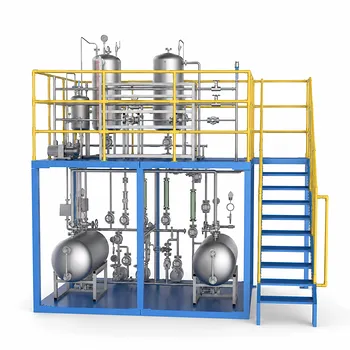
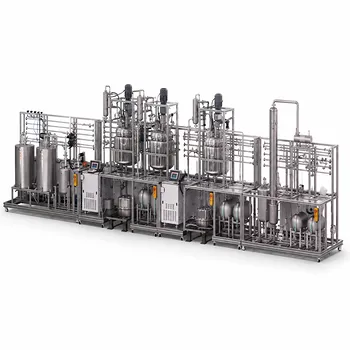
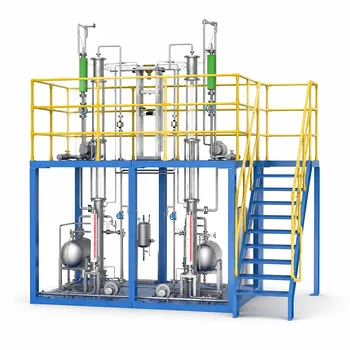
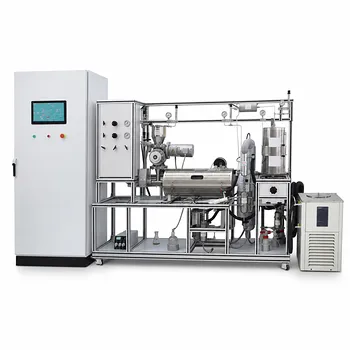
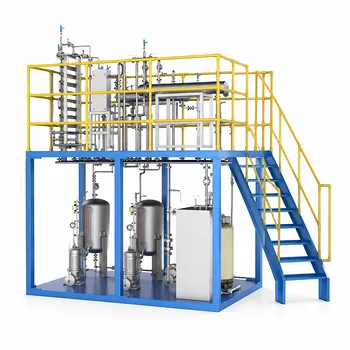
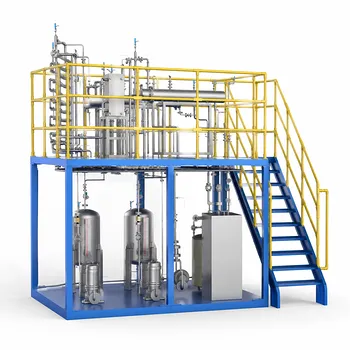
The core of chemical engineering fluid mechanics education isn't just solving equations on paper—it's seeing them govern a real, operating system. In a unit operations pilot plant, students apply the conservation laws of mass, momentum, and energy by measuring actual flow rates, pressure drops, and temperatures, then using those measurements to calculate and validate theoretical balances. They solve for velocities using the continuity equation, predict frictional losses via momentum balances, and quantify heat transfer through energy balances, directly comparing their hand calculations to the live data streaming from sensors. This closed-loop process transforms abstract partial differential equations into a tangible, intuitive understanding of how fluids behave in real process equipment.
The fundamental conservation laws become a working language when students operate pilot-scale heat exchangers, piping networks, and pumps. They move beyond memorization to practical mastery by using mass, momentum, and energy balances to predict, measure, and reconcile the behavior of real fluids under real process conditions—bridging the critical gap between continuum mechanics theory and industrial chemical engineering.
From Theory to Practice: The Role of the Pilot Plant
Pilot plants are the proving ground where mathematical models meet physical reality. They take the conservation laws out of the textbook and force students to confront measurement, assumptions, and the inherent messiness of real fluids.
Making Conservation Laws Tangible
A lecture on the continuity equation can feel like an exercise in algebra. A student standing in front of a Venturi meter watching a pressure gauge respond to a valve change is witnessing the conservation of mass in real time. The equation $\dot{m} = \rho A v$ stops being a formula and becomes a powerful prediction of what that gauge should read.
The Iterative Learning Cycle of Measurement and Calculation
The pedagogical power comes from the loop: measure, calculate, compare, and reconcile. Students use flow meters and pressure sensors to collect real-time data. They then apply the conservation laws to calculate expected values—for example, velocity at a reduced cross-section or temperature change across a heat exchanger. Discrepancies between theory and experiment are not failures; they are the most valuable teaching moments, forcing a deeper analysis of friction factors, non-ideal fluid properties, or sensor calibration.
Applying Mass Conservation: The Continuity Equation in Action
The law of mass conservation is the starting point for any fluid flow analysis. In the pilot plant, it becomes a tool for real-time process monitoring and design validation.
Measuring Flow Rates and Mass Balances
Students use integrated orifice plates, Venturi tubes, and rotameters to directly measure volumetric flow. They then apply the continuity principle to perform a mass balance across the entire system—verifying that what goes into a piping network or a reactor matches what comes out (accounting for any accumulation). This simple act cements the absolute and inviolable nature of the mass balance.
Validating Continuity Across Varying Cross-Sections
When a fluid flows through a constriction, its velocity must increase. Students physically observe this principle: they read the pressure drop across the constriction, use Bernoulli (a form of the mechanical energy balance to which continuity is coupled) to back-calculate the velocity, and confirm that the product of area and velocity remains constant. This direct validation builds an intuition for flow behavior that years of simulation alone cannot provide.
Applying Momentum Conservation: Pressure Drops and Forces
The momentum balance explains why pumps are needed and how flow is driven. It’s the law that connects pressure, friction, and the mechanical forces acting on a fluid.
Calculating Frictional Losses and Selecting Pumps
In a pilot plant’s extended piping network, students measure the pressure drop along a straight run of pipe or through a valve. They then apply the momentum conservation equation, which accounts for conductive (viscous) and convective momentum transport, to calculate the frictional losses. This exercise makes the connection between theory and a critical industrial task: sizing a pump with enough head to overcome those losses.
Measuring Pressure Differential to Validate Bernoulli’s Equation
The Bernoulli equation is a powerful simplification of the mechanical energy balance for steady, inviscid, incompressible flow. By measuring pressure and velocity at two points in a pilot-scale piping system—such as across a venturi—students can directly test this equation. They learn exactly when it holds, and more importantly, when the viscous dissipation term becomes too large to ignore, requiring a full momentum balance.
Applying Energy Conservation: Heat and Work in Fluid Systems
Fluid flow is rarely isothermal in industry. The law of energy conservation connects the thermal and mechanical worlds, and pilot plants with heat exchangers make this connection explicit.
Quantifying Heat Exchange in Heat Exchangers
A shell-and-tube heat exchanger on a pilot skid allows students to measure the hot and cold fluid inlet and outlet temperatures and flow rates. Using the steady-flow energy equation, they calculate the theoretical heat duty and compare it to the experimental value, instantly visualizing the conservation of energy across a control volume. This holistic analysis unifies fluid mechanics with heat transfer.
Accounting for Thermal Losses and Pump Work
The full energy balance forces students to think about non-ideal heat transfer—heat lost to the surroundings through pipe walls—and the conversion of shaft work from a pump into thermal energy (a slight fluid heating). Neglecting these terms often explains why a pilot plant’s energy balance doesn’t close initially, teaching the rigorous discipline of full-scale industrial accounting.
Understanding the Trade-offs and Pitfalls
A pilot plant is not a perfect theoretical world. The true learning comes from confronting the limitations of both the equipment and the simplifying assumptions of the conservation equations.
The Gap Between Ideal and Real Fluids
Textbook problems often assume constant viscosity and no mixing anomalies. In reality, students may encounter non-ideal mixing behaviors—like the viscosity peak in certain alcohol-aldehyde mixtures—that dramatically alter pressure drops and heat transfer coefficients. This experience teaches the crucial lesson that real fluid property measurement is a prerequisite for applying conservation laws correctly to design operations like distillation or complex transport.
Instrumentation Accuracy and Error Analysis
Every sensor in a pilot plant has a finite accuracy. Students quickly learn that a velocity calculated from a pressure differential is only as good as the transducer calibration. The conservation laws become a framework for error propagation analysis, forcing a disciplined evaluation of whether a mismatch between theory and experiment is due to a faulty assumption or simply an imprecise measurement.
Scale-Up Limitations from Pilot Data
While the conservation laws themselves are scale-invariant, the parameters that feed them (like friction factors and heat transfer coefficients) are not. Using pilot plant data directly for energy balances can give a student a dangerously simplified view of scale-up economics if they don't account for changes in surface-to-volume ratios and flow regime. The pilot plant is the starting point for understanding these principles, not the end.
Making the Right Choice for Your Educational Goal
How you integrate conservation laws into pilot plant exercises depends on your primary learning objective. The flexibility of these systems allows you to emphasize different skills.
- If your primary focus is reinforcing theoretical fundamentals: Use the pilot plant as a validation tool. Have students derive mass, momentum, and energy balances, predict the plant’s steady-state outputs, and then run the experiment to confirm their hand calculations, discussing any small deviations.
- If your primary focus is developing practical engineering intuition: Let students operate the plant themselves. Task them with using real-time pressure and flow data to diagnose a problem—like a partially closed valve or a fouled heat exchanger—by applying the conservation laws backwards from effect to cause.
- If your primary focus is illustrating real-world complexities: Design experiments around non-ideal fluids or intentionally introduce heat loss scenarios. Force students to measure fluid properties and update their energy balances in real time, driving home the iterative nature of industrial process design.
Mastering the conservation laws is not an academic exercise; it is the act of learning to read the unseen lifeblood of any chemical process. A pilot plant, with its humming pumps and streaming data, transforms these laws from arcane equations into the fundamental, predictable, and testable language of the physical world.
Summary Table:
| Conservation Law | Physical Application in Pilot Plant | Key Learning Outcome |
|---|---|---|
| Mass (Continuity) | Orifice plates, Venturi tubes, and rotameters | Validating mass balances and velocity changes across changing cross-sections. |
| Momentum | Pressure drops in pipes, valves, and fittings | Calculating frictional losses, testing Bernoulli's equation, and sizing pumps. |
| Energy | Shell-and-tube heat exchangers and pump systems | Quantifying heat transfer, accounting for thermal losses, and calculating shaft work. |
Transform Engineering Education with LABPARK
At LABPARK, we empower universities, research institutes, and enterprises to bridge the gap between textbook equations and industrial reality. We provide high-quality, customizable Educational and Vocational Unit Operations Pilot Plants across key domains:
- Chemical Engineering (Fluid Mechanics, Heat Transfer, and Distillation)
- Bioprocess & Biotech
- Environmental & Water Treatment
Give your students the hands-on tools to validate mass, momentum, and energy balances on real-world systems. Contact LABPARK today to explore our pilot plant solutions and elevate your laboratory capabilities!
Related Products
- Carbon Dioxide Hydrogen Methanol Synthesis Educational Unit Operations Pilot Plant
- Multi Pump Fluid Transport Process Piping Unit Operations Training Pilot Plant
- Natural Product Extraction Unit Operations Training Pilot Plant
- Multi-Modal Distillation Unit Operations Training Pilot Plant
- Multi-Reactor Educational Pilot Plant for Reaction Engineering Unit Operations
People Also Ask
- How do temp & pressure affect methanol synthesis pilot plants? Optimize equilibrium and catalyst performance.
- Why is a purge system necessary when operating a gas recirculation loop in a methanol synthesis pilot plant? (Guide)
- Why do modern methanol pilot plants operate at lower pressures? Catalyst & Feed Requirements Explained
- What are the operational requirements for catalyst activation? Safe Methanol Pilot Plant Operation
- Why is the chemical plant startup schedule crucial? De-risk scale-up with pilot plants.