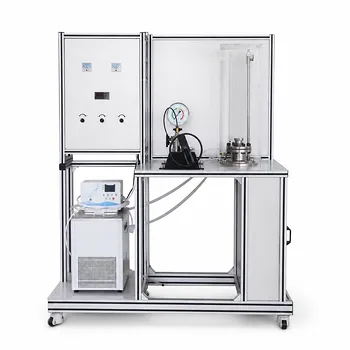
Phase Change Materials (PCMs) are used in thermal unit operations pilot plants as controlled thermal reservoirs that absorb and release heat during melting and solidification. A hot process fluid can flow through a vessel jacket or heat exchanger containing a PCM, such as a specialized wax or organic compound. As the PCM melts, it absorbs energy at nearly constant temperature, allowing students to observe latent heat storage and its ability to stabilize process temperatures longer than ordinary sensible cooling media.
PCMs make latent heat visible in the laboratory: students measure a temperature plateau during melting or solidification, use the resulting cooling curve to estimate stored energy and latent heat of fusion, and assess whether the material can support industrial heat recovery or renewable-energy applications.
How PCMs Demonstrate Latent Heat Storage
The Difference Between Sensible and Latent Heat
Sensible heat changes a material’s temperature without changing its phase. Its energy requirement is commonly represented by the heat-capacity relationship:
[ Q_{\text{sensible}} = m C_p \Delta T ]
Latent heat is absorbed or released during a phase transition, such as melting or solidification, while the material remains close to its phase-change temperature:
[ Q_{\text{latent}} = m \Delta H_{\text{fus}} ]
Here, (m) is the PCM mass and (\Delta H_{\text{fus}}) is its specific enthalpy of fusion.
Creating a Temperature Plateau
During a pilot plant experiment, the PCM is heated until it begins to melt or is exposed to a hotter process stream. Additional energy then goes primarily into the solid-to-liquid transition rather than raising the PCM temperature substantially.
This produces a relatively flat region, or temperature plateau, on a temperature-versus-time plot. The plateau provides direct experimental evidence that energy is being stored as latent heat.
Demonstrating Passive Thermal Regulation
A PCM-jacketed vessel or heat exchanger can moderate the temperature of a process fluid without continuous active control. The PCM absorbs excess heat during melting and later releases heat during solidification as the surrounding process cools.
This behavior helps students distinguish thermal storage from simple cooling. A conventional coolant mainly changes temperature as it absorbs sensible heat, whereas a PCM can absorb substantial energy while remaining near a selected transition temperature.
How the Pilot Plant Experiment Works
Heating or Cooling the Process Stream
The process fluid is circulated through a vessel, jacket, or heat exchanger connected to the PCM zone. Depending on the experiment, the PCM may absorb heat from a hot fluid, release stored heat to a cooler fluid, or cycle between both conditions.
Sensors record the inlet temperature, outlet temperature, PCM temperature, flow rate, and elapsed time. These measurements connect the PCM’s material behavior to an actual unit operation rather than treating latent heat as an isolated textbook property.
Recording Cooling Curves
Students commonly heat the PCM and then monitor its temperature as it cools. The resulting curve typically shows three regions:
- Sensible cooling of the liquid PCM, where temperature decreases relatively quickly.
- Solidification, where temperature changes slowly near the phase-transition temperature.
- Sensible cooling of the solid PCM, where the temperature decreases again after solidification is substantially complete.
The duration and area of the near-constant-temperature region indicate how the PCM stores and releases thermal energy under the experimental conditions.
Comparing PCM and Conventional Media
A useful comparison uses the same vessel, process-fluid volume, and initial temperature with a conventional sensible cooling medium and a PCM-based system. Students can compare temperature stability, cooling time, heat-transfer rate, and the amount of energy absorbed over a defined interval.
The comparison shows why a PCM may maintain a process temperature for longer, even though its temperature does not rise as quickly as that of a purely sensible storage medium.
What Students Calculate
Estimating Latent Heat of Fusion
If the PCM mass and the energy transferred during the phase-change interval are known, students can estimate the latent heat of fusion:
[ \Delta H_{\text{fus}} \approx \frac{Q_{\text{phase change}}}{m_{\text{PCM}}} ]
The transferred energy may be estimated from process-fluid measurements:
[ Q_{\text{fluid}} = m_{\text{fluid}} C_p (T_{\text{out}} - T_{\text{in}}) ]
In a real pilot plant, the two values may differ because of heat losses, incomplete melting, sensor uncertainty, and heat retained by vessel walls and piping.
Performing an Energy Balance
Students can construct an energy balance around the PCM system:
[ Q_{\text{in}} = Q_{\text{stored}} + Q_{\text{loss}} + Q_{\text{equipment}} ]
The stored energy includes both sensible and latent contributions:
[ Q_{\text{stored}} = m C_{p,\text{solid}}\Delta T_{\text{solid}}
- m\Delta H_{\text{fus}}
- m C_{p,\text{liquid}}\Delta T_{\text{liquid}} ]
This calculation reinforces that a PCM does not store energy exclusively as latent heat. Its total storage capacity also includes sensible heating or cooling before and after the phase transition.
Evaluating Thermal Storage Performance
Performance can be assessed using several practical indicators:
- The temperature range over which the PCM operates.
- The time spent near the target transition temperature.
- The measured energy stored and recovered.
- The difference between charging and discharging energy.
- The repeatability of successive thermal cycles.
- The effect of flow rate and heat-transfer area on response time.
These measurements help students connect laboratory observations with the design of thermal utilities, heat-recovery systems, and renewable-energy storage equipment.
Connecting PCMs to Thermal Unit Operations
Evaporators and Boilers
Evaporators and boilers require substantial heat input to drive vaporization. Water, for example, has a latent heat of vaporization of approximately 2257 kJ/kg at 100°C and 1 atm.
A PCM experiment provides a complementary way to study this concept. Students learn that large energy transfers can occur at nearly constant temperature during a phase transition, whether the transition involves boiling process fluid or melting a thermal-storage material.
Condensers and Heat Exchangers
Condensation releases latent heat that must be transferred through a heat exchanger or condenser. A PCM placed on the receiving side can capture part of that energy while remaining near its melting temperature.
This arrangement allows students to examine heat recovery, temperature matching, exchanger duty, and the role of thermal storage in reducing the mismatch between heat supply and heat demand.
Distillation Systems
Distillation depends on repeated vaporization and condensation, making latent heat central to its energy balance. PCM-based storage can be used in an instructional setup to demonstrate how heat recovered from one part of a process might be stored temporarily and supplied to another part later.
The experiment does not replace the distillation column’s vapor-liquid equilibrium analysis. Instead, it adds a controlled thermal-storage layer to the study of reboiler and condenser duties.
Understanding the Trade-offs
Limited Heat-Transfer Rates
PCMs can store significant energy, but many have relatively low thermal conductivity. Melting or solidification may therefore proceed slowly, particularly in larger volumes or when the PCM is poorly mixed.
Pilot plants expose this limitation by showing that storage capacity alone does not determine performance. Heat-transfer surface area, wall construction, flow arrangement, and temperature difference strongly affect charging and discharging rates.
Phase-Change Temperature Constraints
A PCM is most useful when its transition temperature matches the desired operating range. A material that melts too far above or below the process target may provide little temperature regulation.
The selected PCM must also remain chemically stable and compatible with the vessel, jacket, seals, and process environment.
Hysteresis, Supercooling, and Incomplete Cycling
Some PCMs solidify at a temperature different from their melting temperature or remain liquid below the expected freezing point. These effects can distort the idealized temperature plateau and make the charging and discharging curves asymmetric.
Students should therefore treat the measured phase-change temperature and latent heat as operating data, not automatically as perfect material constants.
Heat Losses and Measurement Uncertainty
A pilot plant is not perfectly insulated. Heat may be lost through vessel walls, piping, supports, and instrumentation, while temperature sensors may not represent the PCM’s average temperature.
Accurate analysis requires calibration, consistent initial conditions, adequate insulation, and an explicit estimate of uncertainty. Otherwise, the calculated latent heat may include equipment heat capacity or environmental losses.
Making the Right Choice for Your Goal
PCMs are most valuable when the experiment connects material behavior, heat transfer, and process-level energy balances.
- If your primary focus is teaching latent heat: Use temperature-versus-time curves to identify the melting or solidification plateau and calculate the PCM’s apparent latent heat of fusion.
- If your primary focus is temperature regulation: Select a PCM whose transition temperature matches the process target and compare its temperature stability with a sensible cooling medium.
- If your primary focus is heat recovery: Operate the system through repeated charging and discharging cycles, then compare the energy supplied, stored, recovered, and lost.
- If your primary focus is unit-operation design: Vary flow rate, heat-transfer area, and PCM quantity to show how storage capacity and heat-transfer kinetics jointly determine performance.
By integrating PCMs into vessels, jackets, and heat exchangers, pilot plants turn latent heat storage from an abstract thermodynamic quantity into a measurable process-design tool.
Summary Table:
| Key area | What students learn | Typical measurements |
|---|---|---|
| Latent heat | Energy absorbed or released during melting and solidification | PCM temperature and phase-change plateau |
| Thermal regulation | How PCMs stabilize process temperatures near a transition point | Inlet/outlet temperature and cooling time |
| Energy calculations | How to estimate latent heat and total stored energy | Mass, flow rate, temperature, and heat duty |
| Heat recovery | How stored heat can be transferred between process streams | Charging, discharging, and recovered energy |
| Unit operations | PCM applications in heat exchangers, evaporators, condensers, and distillation systems | Heat-transfer rate and energy balance |
| Performance limits | Effects of conductivity, flow rate, heat-transfer area, losses, and cycling | Repeatability and measurement uncertainty |
Apply Latent Heat Concepts with LABPARK Pilot Plants
Give students and researchers hands-on experience with PCM melting, solidification, temperature regulation, heat recovery, and process energy balances. LABPARK provides Educational and Vocational Unit Operations Pilot Plants for chemical engineering, bioprocess and biotech, and environmental and water treatment applications.
Our pilot-plant systems help universities, research institutes, and enterprises connect thermodynamic theory with measurable process data through vessels, jackets, heat exchangers, sensors, flow control, and repeatable operating experiments. Contact LABPARK to discuss your teaching, research, or workforce-training goals and identify the right pilot-plant configuration for your laboratory.
Contact LABPARK today to plan a practical, industry-relevant unit-operations training solution.
Related Products
- Carbon Material Thermal Pretreatment Multiphase Separation Educational Pilot Plant
- Carbon Dioxide PVT Curve Determination Educational Unit Operations Pilot Plant
- Two Phase Flow Pattern Velocity Resistance Measurement Educational Pilot Plant
- Dual Mode Heat Transfer Pilot Plant for Unit Operations Training
- Natural Product Extraction Unit Operations Training Pilot Plant
People Also Ask
- What challenges do gravity transitions present for pressure control in multiphase separation pilot plants?
- How does steady-state multiplicity affect the operation and safety of exothermic reactions within a CSTR pilot plant? - Guide
- How does CSTR cooling jacket design influence stability? Control reactor oscillations.
- What is the significance of CSTR chaotic behavior? Master Reactor Safety
- Why is temperature regulation via a cooling jacket a critical feature in CSTR pilot plants used for laboratory training?