The precise application of enthalpy models is the linchpin of reliable energy balances in distillation and evaporation pilot plants. By decomposing enthalpy into an ideal-gas contribution plus a departure function from a cubic equation of state for vapor—and for liquid, adding the excess enthalpy of mixing through an activity coefficient model—engineers transform theoretical thermodynamics into exact utility sizing. This two‑layer approach directly dictates the steam, cooling water, and electrical heater loads needed to achieve target reflux ratios, product purities, and scalable design data.
The core challenge is not simply calculating a number; it is selecting a thermodynamic framework that faithfully captures the non‑idealities of the specific mixture—whether that means a modified Redlich‑Kwong equation for a polar vapor, a Wilson coefficient model for a liquid, or a linear interpolation of database values for well‑characterized hydrocarbons. Done right, the enthalpy model becomes a true translation between the pilot plant and the full‑scale unit, preventing under‑ or oversized utilities and giving design teams the confidence that their energy balance is solid.
The Foundation: Why Pilot Plant Energy Balances Demand Accurate Enthalpy
Energy Balance as a Scale‑Up Translator
In distillation and evaporation, phase change dominates the energy landscape. The total energy required to move a kilogram of liquid into the vapor phase is the enthalpy difference between those two states—a value that must be identical in principle for a 20‑liter pilot still and a 20‑meter industrial column. If the pilot plant’s enthalpy model is wrong, the reboiler duty calculated from stream enthalpies will be wrong, and the entire scale‑up exercise loses its footing.
The Direct Link to Equipment Sizing
The condenser duty (Qc) and reboiler duty (RebQ) are computed directly from stream enthalpies and flow rates. A 5‑10% error in the liquid‑vapor enthalpy difference corresponds to an equal error in the required heat exchanger duty. In a pilot plant, that translates into an undersized steam generator that can’t maintain the desired vapor rate, a reflux ratio that drifts off target, and separation purities that never meet specifications. The enthalpy model is therefore not a theoretical luxury; it is the specification sheet for heating and cooling utilities.
Constructing Enthalpy Models for Vapor and Liquid Streams
The Ideal‑Gas + Departure Approach
The workhorse method builds vapor enthalpy from two pieces. The ideal‑gas enthalpy (H⁎) comes from standard temperature‑dependent heat‑capacity polynomials. An enthalpy departure term (H − H⁎) corrects for real‑gas behavior and is derived from a pressure‑volume‑temperature equation of state. Commonly used choices are the Redlich‑Kwong, Soave‑Redlich‑Kwong, or Peng‑Robinson equations. When the vapor mixture contains polar molecules, a modified version such as the Prausnitz‑Chueh Redlich‑Kwong form is often substituted to better handle polar fugacities and non‑ideal vapor‑phase behavior.
Liquid Enthalpy: Mixing In Non‑Idealities
For liquid streams, the total enthalpy is expressed as H = H_ideal + ΔH_mix. The ideal part is obtained from pure‑component liquid heat capacities or temperature polynomials. The excess enthalpy of mixing (ΔH_mix) is where the real complexity—and the model selection—becomes critical. It is calculated through liquid activity coefficient models such as Wilson, NRTL, or UNIQUAC. This term captures the heat released or absorbed when components mix, and for non‑ideal systems like water‑ethanol‑aldehyde mixtures it can be a large fraction of the total enthalpy change.
Connecting to Real Pilot‑Plant Data
For hydrocarbon mixtures, a pragmatic alternative exists: linear interpolation of pure‑component enthalpy values from Maxwell‑type databases, using mixture molecular weight or boiling point as the interpolation key. At the pilot‑plant scale, this method often stays within 2% of a rigorous component‑by‑component thermodynamic model, making it an invaluable teaching tool and a rapid cross‑check for energy balances.
Navigating Model Selection for Non‑Ideal Mixtures
When Polar Compounds Enter the Process
The moment polar species—alcohols, aldehydes, water—appear in the feed, the simple cubic equation of state with standard mixing rules may fail. For the vapor phase, a modified EoS that accounts for polar interactions is required. For the liquid phase, the choice of activity coefficient model becomes the dominant accuracy driver. The Wilson equation is frequently preferred for binary pairs like acetaldehyde‑ethanol, while NRTL or UNIQUAC handle broader multicomponent non‑idealities. Each model brings its own set of binary interaction parameters, and the quality of those parameters directly determines the quality of the enthalpy balance.
The Role of Experimental VLE and Enthalpy Data
Accurate ΔH_mix values cannot be guessed. They must be regressed from experimental vapor‑liquid equilibrium (VLE) or mixing‑calorimetry data. When measured data are unavailable, the UNIFAC group‑contribution method can estimate activity coefficients and thus excess enthalpy. This is a powerful fallback, but pilot‑plant runs then become a validation exercise: the measured condenser and reboiler duties serve to confirm or adjust the predicted enthalpy values, closing the loop between model and reality.
Verifying and Validating the Energy Balance in the Pilot Plant
From Calculated Duty to Measured Input
The ultimate test occurs when the calculated reboiler duty (based on stream enthalpies and flow rates) is compared with the actual electrical power supplied to the pilot‑plant reboiler and the measured heat absorbed by the cooling water in the condenser. Any systematic offset reveals unaccounted heat losses, imperfect model parameters, or even a unit‑conversion error. This direct comparison transforms a theoretical energy balance into a living diagnosis of process efficiency.
Interpolation as a Teaching and Verification Tool
For educational settings, the molecular weight/boiling point interpolation method serves a dual purpose. It provides a quick, manual calculation of enthalpy, and when juxtaposed with rigorous EOS values that agree within 2%, it reinforces thermodynamic principles. In research settings, the same technique acts as an independent sanity check, flagging any gross modeling mistakes before they become equipment failures.
Understanding the Trade‑offs
Accuracy Versus Complexity
Selecting an activity coefficient model like NRTL yields high fidelity for polar mixtures, but it demands reliable binary parameters. A cubic EOS with van der Waals one‑fluid mixing rules is simpler to set up, yet it can systematically underestimate liquid‑phase non‑ideality by 10‑20% for alcohol‑water systems. That magnitude of error directly undermines the pilot plant’s ability to predict full‑scale utility loads. This is not a “better always” choice; it is a trade‑off between model fidelity and the availability of trustworthy parameters.
The Phase‑Change Error Trap
A seemingly minor oversight in the enthalpy of vaporization—using the value at the wrong pressure, neglecting the volume‑change work (pΔV), or simply converting units incorrectly—introduces a constant offset that cascades through every energy balance around the column. The result is a pilot plant that runs cold, never reaches the target reflux ratio, and yields separation data that are impossible to reproduce at larger scale.
The “Black Box” Risk
Modern process simulators can hide the underlying model choices. A user who clicks “SRK” without recognizing that the default mixing rules are inadequate for a polar system will generate beautiful energy balance reports that are physically wrong. The interpolation method, with its transparent ±2% accuracy, is a reminder that every enthalpy number should be manually verifiable against a known benchmark before it is used to specify hardware.
Parameter Availability
For novel, proprietary mixtures, experimental VLE data are often nonexistent. UNIFAC provides a reasonable first estimate, but it introduces an uncertainty that must be quantified during pilot‑plant operation. The safest path is to treat the first pilot runs as a data‑generation campaign: measure actual duties, back‑calculate apparent enthalpy differences, and refine the model before final scale‑up.
Making the Right Choice for Your Pilot Plant Goal
- If your primary focus is educational validation: Use the molecular weight/boiling point interpolation method alongside a rigorous EOS‑based approach. The ±2% agreement teaches the physical meaning of enthalpy departure, gives students a concrete way to verify their energy balances, and demystifies the “black box” of simulation software.
- If your primary focus is process development for non‑ideal polar mixtures: Invest time in selecting an activity coefficient model (Wilson, NRTL, or UNIQUAC) with parameters regressed from reliable VLE data. Pair it with a modified cubic EoS for the vapor phase, and validate the resulting enthalpy predictions against actual pilot‑plant reboiler power and condenser heat pickup. Small adjustments in binary parameters at this stage can prevent costly miscalculations during scale‑up.
- If your primary focus is scaling up a well‑characterized hydrocarbon system: A standard Soave‑Redlich‑Kwong or Peng‑Robinson EOS with classic mixing rules, combined with a temperature‑polynomial liquid enthalpy, is typically sufficient. Use database interpolation as a quick cross‑check; the two‑minute calculation confirms that the model hasn’t drifted into unrealistic territory and adds a layer of confidence before utility lines are sized.
When you ground your pilot‑plant energy balance in an enthalpy model that faithfully reflects the actual fluid behavior, you turn a small‑scale experiment into a reliable blueprint for full‑scale design.
Summary Table:
| Enthalpy Model Type | Target Phase | Ideal Applications | Key Advantages & Considerations |
|---|---|---|---|
| Cubic EoS (e.g., SRK, PR) + Departure | Vapor | Hydrocarbons & non-polar gases | Corrects for real-gas behavior; less accurate for highly polar vapor mixtures. |
| Activity Coefficient (Wilson, NRTL, UNIQUAC) | Liquid | Highly polar mixtures (alcohols, water) | Captures excess enthalpy of mixing; requires precise binary interaction parameters. |
| Database Interpolation (Maxwell-type) | Vapor/Liquid | Well-characterized hydrocarbon systems | Simple, fast cross-check with $\pm2%$ accuracy; excellent for educational verification. |
| UNIFAC Group Contribution | Liquid | Novel mixtures with missing VLE data | Predicts activity coefficients and excess enthalpy; introducing minor estimation uncertainties. |
Scale Up with Confidence—Partner with LABPARK
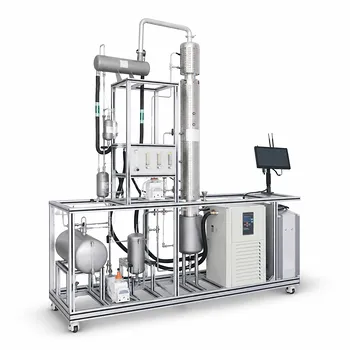
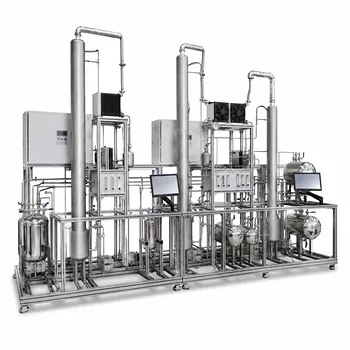
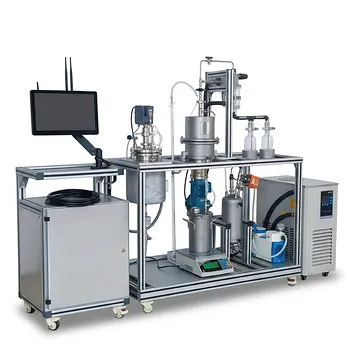
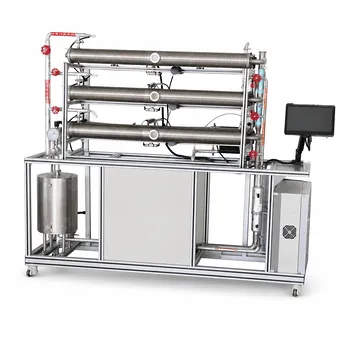
Achieving accurate energy balances in distillation and evaporation requires both thermodynamic rigor and precision-engineered hardware. LABPARK provides premium Educational and Vocational Unit Operations Pilot Plants in chemical engineering, bioprocess & biotech, and environmental & water treatment. Designed specifically for universities, research institutes, and enterprises, our pilot plants bridge the gap between classroom theory and industrial application.
Ready to elevate your engineering training and research capabilities? Contact LABPARK today to discuss your custom pilot plant configuration!
Related Products
- Continuous Sieve-Plate Distillation Pilot Plant for Unit Operations Laboratory Education
- Green Anhydrous Ethanol Purification Extractive Distillation Unit Operations Training Pilot Plant
- Multi-Modal Distillation Unit Operations Training Pilot Plant
- Dual-Mode Rectification Pilot Plant for Practical Training Unit Operations
- Continuous Batch Extractive Distillation Educational Pilot Plant
People Also Ask
- How does catalyst water concentration affect distillation pilot plant design? Key separation train choices.
- Why is vacuum operation capability an essential feature for a distillation unit operations pilot plant? Unlock Efficiency
- How to select the right activity coefficient model (Wilson, NRTL, UNIQUAC) for distillation pilot plants?
- What are the primary reflux ratio control strategies? Master Distillation Unit Operations
- How can real-time carbon number prediction improve distillation pilot plants? Optimize control.