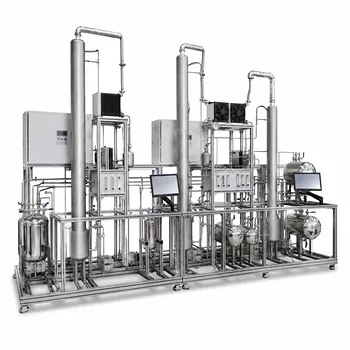
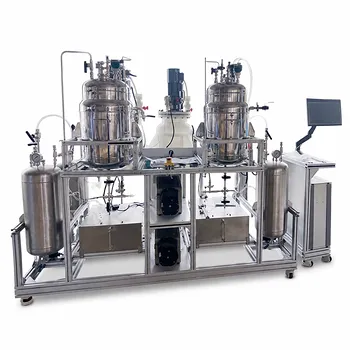
For distillation pilot plants handling highly non-ideal mixtures, robust convergence is not a luxury—it is a prerequisite. The global variable iteration method is preferred because it solves the entire MESH (Material balance, Equilibrium, Summation, Enthalpy) equation matrix simultaneously using a multi-variable Newton‑Raphson approach. This simultaneous correction strategy, exemplified by the Naphtali‑Sandholm method, prevents the severe oscillation and divergence that cripple traditional block‑solving algorithms. To achieve reliable convergence during modeling, a damping factor is initially set below 1.0 to suppress instability, then ramped up to accelerate the solution once key tolerances on temperature and flow rates are approached.
When a distillation pilot plant deals with azeotropic or extractive separations, the thermodynamic non‑ideality makes sequential solvers fail. The global variable iteration method (Naphtali‑Sandholm) replaces fragile step‑by‑step logic with a single Newton‑Raphson correction across all variables—and a carefully managed damping strategy is the engine that drives it to convergence without oscillating.
Why Sequential Methods Fail for Non‑Ideal Systems
The Fragile Assumptions of Bubble Point and Sum Rates Solvers
Sequential block‑solving methods like the bubble point method or sum rates method fixate on one equation group at a time.
They assume that temperatures and flow rates can be reliably updated stage‑by‑stage using decoupled loops.
For highly non‑ideal mixtures, strong composition‑dependent K‑values and heat effects create feedback that shatters this decoupling.
Iteration loops begin to oscillate wildly, and divergence becomes the rule rather than the exception.
The Feedback Problem in Azeotropic and Extractive Pilots
Pilot plants that handle azeotropes or use entrainers exhibit extreme sensitivity in their vapor‑liquid equilibrium.
A small perturbation in a stage temperature cascades into large swings in activity coefficients and flow rates.
Sequential methods lack the mathematical framework to see and compensate for these system‑wide interactions.
The result is a column profile that refuses to settle—an intolerable situation when you must match physical sensor data.
The Global Variable Iteration Method: A Simultaneous Solution
Solving the Full MESH Matrix at Once
The global variable iteration method (often implemented as the Naphtali‑Sandholm algorithm) treats the entire column as one system.
All MESH equations—balances, phase equilibrium relationships, summation constraints, and enthalpy balances—are assembled into a single vector‑valued function.
A Newton‑Raphson correction then updates temperatures, flow rates, and compositions simultaneously in every iteration.
Because the correction accounts for cross‑dependencies, the method remains stable even when local K‑value curvature is severe.
Why This Matters for Pilot Plants
Distillation pilot plants are not just theoretical exercises; they produce physical temperature profiles that must be predicted.
The simultaneous solver generates column profiles that converge to a steady state that can be directly verified against the plant’s installed temperature sensors.
This predictability is critical for extractive distillation experiments, where the location of temperature fronts directly influences entrainer feed positioning and energy use.
Without this robustness, a mismatch between model and pilot data would lead to wasted experimental runs and flawed scale‑up data.
Achieving Convergence: The Damping Strategy
The Oscillation Problem and the Role of the Damping Factor
Even a simultaneous Newton solver can over‑shoot in early iterations when dealing with steep, non‑linear MESH surfaces.
Pure Newton steps can swing the variables beyond the region of attraction, causing temporary divergence or limit‑cycle oscillation.
To counteract this, a damping factor (ε < 1) is applied to the calculated corrections during the initial phase of the simulation.
This artificially shortens each step, keeping the iteration within the basin of convergence while the algorithm “learns” the local curvature.
Accelerating into Convergence
Once the maximum residuals drop and the solution moves into a near‑linear zone, the damping factor can be increased.
Adjusting to ε ≥ 1 (and often to exactly 1.0) allows the solver to take full Newton steps, which delivers quadratic convergence near the root.
The transition is typically triggered by monitoring tolerance checks on temperature and flow rates—for example, when the maximum stage temperature change drops below 01. K and relative flow differences fall below 0.001.
This two‑stage damping strategy marries safety with speed, exactly what a time‑sensitive pilot campaign needs.
Practical Convergence Criteria
Mathematical verification follows the practice of checking two independent measures.
The first is an absolute temperature tolerance: the largest stage‑to‑stage temperature change between iterations must be less than 0.1 K.
The second is a relative flow‑rate tolerance: the normalized difference in liquid flows $L_j^{(r)} - L_j^{(r-1)}$ must be below 0.001 across all stages.
When both conditions are satisfied, the column profile is considered converged and ready for comparison with the pilot plant’s physical readings.
Understanding the Trade‑offs
Computational Demands vs. Robustness
Simultaneous solvers evaluate large Jacobian matrices and solve linear systems at each iteration, making them more computationally expensive per step than sequential methods.
However, the cost is justified because a few damped Newton steps routinely replace hundreds of oscillating sequential loops.
For columns with many stages but a modest number of components (under about 40), the trade‑off is overwhelmingly favorable.
The Critical Role of Initial Estimates
The Newton‑Raphson core is only as powerful as its starting point.
Poor initial guesses for temperature or flow profiles can place the vector outside the domain of attraction, rendering even a damped solver ineffective.
Pilot plant engineers often use shortcut results or a previous similar run to seed the simulation.
If convergence stalls despite damping, refining these initial estimates—especially the reboiler and condenser duties—is the first diagnostic step.
Component List Management
Simulation fidelity requires tracking all components that influence purity or accumulate in recycle loops.
However, inflating the component list beyond roughly 40 species inflates the Jacobian size and degrades convergence speed.
The target is to include all key feed impurities, by‑products that may concentrate, and enough pseudo‑components to match the plant’s distillation curve—no more, no less.
This discipline prevents the solver from drowning in variables that contribute almost nothing to the separation.
Making the Right Choice for Your Goal
- If your primary focus is a fast screening of near‑ideal mixtures: Use a shortcut method or a sequential bubble‑point solver. The simplicity saves time and converges reliably when system non‑ideality is mild.
- If your primary focus is designing a pilot plant for azeotropic or extractive distillation: Adopt the global variable iteration (Naphtali‑Sandholm) method with a damping factor that starts below 1 and transitions to full Newton steps. This is the only approach that delivers physically stable profiles that match pilot‑plant temperature data.
- If your primary focus is educational demonstration of distillation principles: A sequential solver with tight convergence tolerances may suffice, but always highlight its limitations under non‑ideal conditions. The simultaneous method becomes essential when the demonstration moves to real extractive mixtures.
- If your primary focus is model maintenance for a multi‑purpose pilot rig: Standardize on the simultaneous solver with a clear damping protocol and convergence criteria (0.1 K, 0.001 flow tolerance). This creates a consistent, defensible basis for comparing runs across different separation chemistries.
A stable simulation that mirrors physical pilot‑plant behavior does not come from hoping a solver “just works”—it comes from choosing a method that respects the system‑wide coupling of non‑ideal thermodynamics and managing its convergence with surgical precision.
Summary Table:
| Feature | Sequential Methods (e.g., Bubble Point) | Global Variable Iteration (Naphtali-Sandholm) |
|---|---|---|
| Solving Strategy | Decoupled, step-by-step loops | Simultaneous solution of the full MESH matrix |
| Handling Non-Ideality | Prone to severe oscillation & divergence | Highly stable; accounts for cross-dependencies |
| Convergence Control | Fragile iterative loops | Managed damping factor ($\varepsilon < 1.0$ to $1.0$) |
| Application Suitability | Simple, near-ideal systems | Complex, azeotropic, or extractive separations |
Optimize Your Distillation Research and Scaling with LABPARK
Are you looking to bridge the gap between complex thermodynamic simulations and physical pilot plant operations? LABPARK provides state-of-the-art Educational and Vocational Unit Operations Pilot Plants in chemical engineering, bioprocess & biotech, and environmental & water treatment designed specifically for universities, research institutes, and enterprises.
Our highly robust pilot plant systems are engineered to generate precise, real-world data that validates your advanced distillation models—ensuring seamless scaling even for challenging non-ideal separations.
Ready to elevate your research and training capabilities?
Contact LABPARK today to discuss your project requirements!
Related Products
- Continuous Sieve-Plate Distillation Pilot Plant for Unit Operations Laboratory Education
- Multi-Functional Special Distillation Educational Pilot Plant
- Continuous Batch Extractive Distillation Educational Pilot Plant
- Multi-Modal Distillation Unit Operations Training Pilot Plant
- Electrolyte Distillation Purification and Formulation Educational Pilot Plant
People Also Ask
- What are the primary reflux ratio control strategies? Master Distillation Unit Operations
- Why is vacuum operation capability an essential feature for a distillation unit operations pilot plant? Unlock Efficiency
- How does catalyst water concentration affect distillation pilot plant design? Key separation train choices.
- How can real-time carbon number prediction improve distillation pilot plants? Optimize control.
- How to select the right activity coefficient model (Wilson, NRTL, UNIQUAC) for distillation pilot plants?