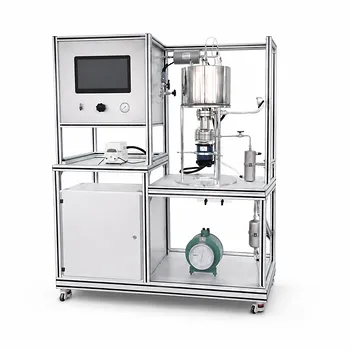
In educational chemical reactor pilot plants, indirect temperature control is the go-to method for regulating conversion rates, leaving direct composition analysis in the dust. While online analyzers like gas chromatographs or spectrophotometers measure the exact chemical makeup of your stream, they introduce long measurement delays, high complexity, and non-trivial maintenance costs. For exothermic reactions—the backbone of countless teaching experiments—conversion is directly proportional to the temperature difference between the reactor inlet and outlet. That makes measuring and controlling this thermal delta a fast, reliable, and cost-effective proxy, perfectly aligned with the hands-on learning goals of a teaching lab.
For exothermic reactions, the temperature rise across the reactor is a real-time, low-maintenance indicator of conversion extent. Direct composition control, though conceptually pure, burdens educational pilots with slow feedback, delicate instrumentation, and high overhead—distracting from, rather than serving, the core mission of building fundamental engineering intuition.
The Problem with Direct Composition Control
Measurement Delays Undermine Real-Time Control
Online analytical instruments require sampling, separation, and detection cycles that can take several minutes or more.
This dead time between sampling and result means the control loop is always reacting to a past state—a recipe for sluggish performance and instability when the goal is rapid, stable regulation of conversion.
In a teaching environment, closed-loop speed and stability are more instructive than a perfect but late measurement.
High Complexity and Maintenance Burdens
Process analyzers demand exacting calibration, clean sample lines, carrier gases, and periodic component replacement.
These demands run counter to the simplicity and robustness that educational pilot plants require to stay operational through multiple lab sections each week.
A probe that measures temperature, on the other hand, is a rugged, drift-free device students can trust without daily troubleshooting.
Educational Labs Prioritize Learning Over Perfect Fidelity
The goal of a teaching reactor is not to mirror a full-scale plant’s instrumentation strategy in every detail.
It is to illustrate fundamental relationships between temperature, kinetics, and conversion in a way that learners can see, manipulate, and grasp quickly.
When a composition analyzer becomes the centerpiece of your control loop, the lesson often shifts from “how does temperature drive reaction rate?” to “how do I keep this finicky analyser running?”
Why Temperature Control Is an Elegant Proxy
The Kinetic Link Between Temperature and Conversion
Reaction rate constants are highly sensitive to temperature; even a small increase can exponentially accelerate the rate, as captured by the Arrhenius relationship.
For exothermic reactions, this means the heat released is proportional to the extent of reaction—so the temperature difference from inlet to outlet becomes a direct, continuous indicator of conversion.
The primary reference confirms this proportional link: when you hold the feed temperature constant, controlling the outlet temperature (or the delta) effectively controls how far the reaction has proceeded.
Fast, Robust, and Cost-Effective Measurement
Thermocouples and RTDs provide near-instantaneous, drift-resistant readings with minimal signal processing.
There is no sample transport line, no separation column, and no complex chemometric model to maintain; a student can wire, calibrate, and interpret the signal in minutes.
This allows the control system to respond in real time, delivering the tight regulation that educational experiments on reaction kinetics demand.
Directly Demonstrating Core Principles
By using temperature as the controlled variable, students immediately see the link between manipulating cooling water flow (or heating power) and changes in reactor performance.
They learn that conversion cannot be commanded arbitrarily; it emerges from the energy balance and the reactor’s thermal dynamics—a key lesson in process control and safety.
This hands-on experience cements the concept of indirect control strategies that are ubiquitous in industry when direct composition sensors are too slow or expensive.
Understanding the Trade-offs and When Temperature Control Fails
Not Every Reaction Has a Strong Thermal Signature
If a reaction is only mildly exothermic or heavily diluted, the temperature rise can be too small to discriminate changes in conversion from ambient noise.
In such cases, a composition analyzer may become necessary, but for the majority of reactions chosen for educational pilots (e.g., esterification, neutralization, or saponification), the thermal signal is robust enough.
Phase-Change Systems Demand Different Logic
The supplemental reference on reboilers and evaporators highlights a critical nuance: when saturated steam is present, temperature is fixed by pressure.
In those unit operations, temperature control is useless for regulating heat transfer, and educators shift to level and flow-based strategies.
If your educational reactor is operating near a boiling point or involves significant phase change, a pure temperature-control proxy can break down, and you must integrate pressure or level management.
Disturbances from Ambient Conditions
In a poorly insulated pilot plant, ambient temperature swings can masquerade as conversion changes, introducing a bias into the temperature-to-conversion relationship.
This can be mitigated with good jacket design and feed temperature pre-conditioning, but it underscores that indirect control always requires a validated model of the correlation.
The Educational Value of Indirect Temperature Control
Teaching Reaction Kinetics and Activation Energy
Stable, precise temperature control allows students to measure rate constants at multiple setpoints and extract activation energy from the Arrhenius plot.
When the loop itself is transparent (PID on a jacket valve), students can experiment with tuning parameters and immediately observe their effect on reaction trajectory—something opaque with a chromatograph’s dead time.
Safety and Thermal Runaway Awareness
Exothermic reactions managed via temperature control force students to confront thermal runaway scenarios in a safe, observable manner.
They learn to recognize symptom patterns—such as a sudden jump in cooling demand—and understand why immediate temperature measurement is the frontline defense in industrial reactors.
Bridging Theory and Industrial Practice
Most industrial reactor control schemes for highly exothermic processes rely on jacket temperature, reactor temperature, and feed-temperature loops rather than continuous composition feedback.
By using indirect temperature control, students practice a strategy they will encounter in real plants, bridging the gap between textbook kinetics and operational reality.
Making the Right Choice for Your Educational Pilot Plant
- If your primary focus is demonstrating fundamental kinetics: Use indirect temperature control to keep the experimental setup simple and the cause–effect relationship between temperature and rate crystal clear.
- If your experiments involve strongly exothermic reactions with a measurable temperature rise: Lean on the temperature-difference proxy; it delivers the speed, reliability, and low maintenance that a busy teaching lab needs.
- If you must study reactions near boiling or with negligible thermal signature: Supplement temperature control with sampling-based analysis or adopt level/flow strategies, but explain to students why the standard proxy broke down.
In the classroom, the fastest and most robust measurement that faithfully mirrors conversion is the one that empowers understanding—not the one that merely gives the right chemical analysis.
Summary Table:
| Feature | Indirect Temperature Control | Direct Composition Control |
|---|---|---|
| Response Time | Real-time / Instantaneous | Sluggish (minutes of delay) |
| Maintenance | Low (rugged, drift-free sensors) | High (calibration & delicate parts) |
| Cost & Complexity | Budget-friendly & simple | Expensive & complex overhead |
| Educational Focus | Direct correlation to reaction kinetics | Troubleshooting complex analyzer loops |
Enhance your engineering curriculum with reliable, hands-on learning systems. LABPARK provides state-of-the-art Educational and Vocational Unit Operations Pilot Plants in chemical engineering, bioprocess & biotech, and environmental & water treatment. Designed specifically for universities, research institutes, and enterprises, our pilot plants prioritize robust control systems and clear educational outcomes to build genuine engineering intuition.
Ready to upgrade your laboratory? Contact LABPARK today to find the perfect pilot plant solution for your institution!
Related Products
- Fixed Bed Gas Solid Catalytic Reaction Educational Pilot Plant
- Tubular Reactor Flow Characteristics Determination Educational Unit Operations Pilot Plant
- Multi-Reactor Educational Pilot Plant for Reaction Engineering Unit Operations
- Fixed-Bed Chemical Reaction and Gas Dust Tar Removal Unit Operations Pilot Plant
- Residence Time Distribution and Reactor Flow Characteristics Determination Educational Pilot Plant
People Also Ask
- How do reactor pilot plants safely study gas-solid reactions? Master kinetics with thermal & flow control.
- How does the Mears criterion evaluate transport resistance? Key Guide to Intrinsic Kinetics
- Fluidized vs. Fixed Bed Reactors: Comparing Heat & Complexity in Pilot Plants
- Why is a multibed configuration necessary for exothermic reactions? Optimize your pilot plant trajectory.
- How is the friction factor determined for fixed-bed pilot plants? Select the best pressure drop correlation.