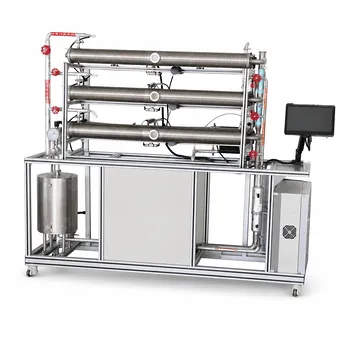
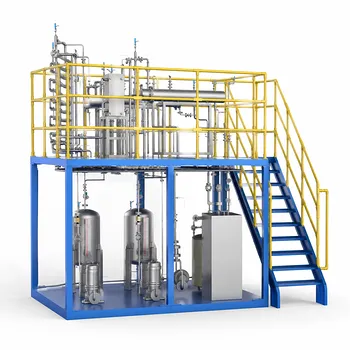
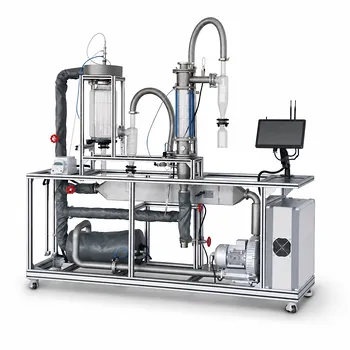
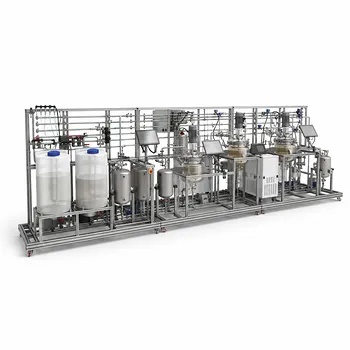
Your bench-scale experiment worked perfectly in a clean flask, but it will almost certainly fail in a real plant. The transition from glassware to an integrated pilot plant is not an upgrade—it's a necessity. At bench scale, you use pure reactants and run for minutes or hours, so you never see the slow accumulation of poisons in a recycle loop, nor the gradual death of your catalyst from coking or attrition. An integrated pilot plant runs continuously for weeks or months with real feeds, exposing those hidden failure modes long before you invest millions in a commercial facility.
Bench-scale glassware provides an idealized snapshot that hides the slow, systemic killers of chemical processes. Integrated pilot plants are the only tool that reveals impurity build-up, catalyst deactivation profiles, and the true operational envelope, effectively bridging the gap between a promising reaction and a profitable, safe industrial process.
The Dangerous Gap Between the Flask and the Factory
Bench-scale experiments are engineered for discovery, not for scale-up. Their very design omits the conditions that determine commercial survival.
Idealized Inputs vs. Real-World Feedstocks
In a glass flask, you typically start with high-purity reagents—because you want to understand the core chemistry, not troubleshoot the supply chain. This perfectly clean starting point masks one of the most brutal realities of industrial operation: the slow, relentless build-up of trace impurities. Without an integrated pilot plant that recycles unreacted materials and solvents, you will never see the concentration of those trace components rise to a level that poisons your catalyst, fouls your heat exchangers, or crystallizes in your piping.
The Myth of Instant Stability
Short-term laboratory tests measure initial activity, not lifetime performance. A catalyst can look brilliant for a few hours and then collapse due to coking, sintering, or leaching. Pilot plants run long enough to expose the deactivation curve, the regeneration frequency, and the mechanical attrition that reduces bed height or creates fines. This data is not optional; the economics of catalyst replacement and waste handling often dictate whether a process is viable, not just the initial yield.
The Invisible Problem of Recycle Buildup
The most dangerous blind spot is the recycle loop, a feature almost never present in bench-scale glassware. When you recycle solvents or unconverted reactants, you also recycle the by-products that you didn’t even know existed. Over time, these side-products can accumulate to levels that shift equilibrium, corrode equipment, or form tars. An integrated pilot plant makes this invisible accumulation visible and quantifiable, so you can design a purge strategy or a separation step before the problem bankrupts the project.
Why a Full Integration Matters More Than Individual Parts
Studying a reaction in a single flask is like judging a symphony by listening to one violin. Integrated pilot plants show you the full orchestration—and the chaos when sections collide.
From Isolated Steps to a Connected System
A bench-scale setup studies a reactor in isolation. A pilot plant forces you to connect the reactor to a distillation column, a decanter, a scrubber, and a dozen other unit operations. Suddenly you see interactions: a pressure drop in one unit starving the next, a heat-integration scheme that works on paper but oscillates wildly in practice, or a recycle stream that changes composition so dramatically that the reactor’s steady state is never actually steady. This networked complexity is the real job of a chemical engineer, and it cannot be learned from a textbook or a single glass vessel.
Validating Measurement and Control Strategies
Industrial sensors do not behave the same way as a lab thermometer. An integrated pilot plant lets you evaluate real-time measurement capabilities—sensitivity, accuracy, repeatability, and the ruggedness of probes in a fouling environment. You can test process control loops on a living, breathing process, develop chemometric calibration models that compensate for matrix effects, and define the true “design space” for parameters that keep the process safe and efficient. These are not academic exercises; they are the disciplines that prevent runaways and off-spec product.
Bridging Theory and Reality for Future Engineers
For research and educational institutions, the pilot plant is the ultimate teaching tool. Students who have only distilled ethanol in a flask will never grasp the significance of a temperature profile across a 20-tray column or the impact of flooding on separation efficiency. When they operate a pilot-scale unit, they collect empirical data on heat transfer, mass transfer, and fluid dynamics that validates—or violently contradicts—their simulation models. That hands-on shock prepares them for the messy real world far better than any cleaned-up lab experiment.
De-risking Scale-Up Through Empirical Data
Scale-up is not an exercise in proportional multiplication. Heat transfer, mixing, and mass transfer are scale-dependent phenomena that defy linear prediction. A unit operations pilot plant provides the empirical foundation that theory alone can never supply.
A commercial reactor’s size, cooling capacity, and agitation design cannot be finalized from kinetic equations alone. Pilot-scale runs reveal unexpected hot spots, non-ideal flow patterns, and mass transfer limitations that slash yield or selectivity. Similarly, you cannot trust a process simulator’s economic projections until you have fed it real data from a pilot plant—data on solvent make-up rates, waste stream compositions, and actual energy balances. The pilot plant is where you discover that your elegant, high-yield chemistry also produces a gooey by-product that clogs every filter in sight, and you adjust the design before cutting steel.
Understanding the Trade-offs of the Pilot Plant Approach
An honest technical advisor must acknowledge the price you pay for this insight. It is significant, but so is the cost of ignorance.
The Investment Cost in Time and Resources
Pilot plants demand capital, space, skilled operators, and—most vexingly—time. A continuous run lasting months eats up research funding and delays publication. The complexity of an integrated system introduces maintenance headaches and the risk of experimental noise that obscures, rather than illuminates, the underlying science. If your process is a well-characterized variation on a mature platform, a full pilot-plant campaign might be overkill. The key is to assess the novelty and the financial consequence of failure before committing.
When Bench-Scale Still Plays a Role
This is not a call to abandon glassware. Bench-scale experiments remain irreplaceable for reaction screening, kinetic parameter estimation, and fundamental thermodynamics. The transition to a pilot plant should happen only after a candidate process meets a clear set of criteria—viable selectivity, manageable hazards, and a realistic economic target. The pilot plant does not replace the bench; it validates the bench’s most optimistic promises under the ruthless conditions of the real world.
Making the Right Choice for Your Institution or Lab
The decision to invest in an integrated pilot plant depends on your primary objective. Use these goal-specific filters to guide your thinking.
- If your primary focus is educational outcomes: Prioritize pilot plants that are modular and transparent, allowing students to trace every stream and sensor signal. The goal is to teach the language of process integration, measurement validation, and model fitting, not to optimize a specific chemical.
- If your primary focus is commercializing a new process: You cannot skip the pilot-plant step. Run the integrated system long enough to quantify impurity accumulation, catalyst deactivation rates, and the reliability of all recycle, purge, and control strategies before any serious financial commitment.
- If your primary focus is validating a specific catalyst or adsorbent: Use the pilot plant to expose that material to the full thermal, mechanical, and chemical stress of a continuous, recycled stream. Only then will you obtain a realistic lifetime and selectivity curve, which is the real basis for economic decisions—not the unit cost of the material itself.
The flask gives you a glimpse; the pilot plant gives you the truth, however inconvenient. Embrace that truth early, and you’ll build processes that endure rather than collapse at the first sign of a dirty feed.
Summary Table:
| Feature | Bench-Scale Glassware | Integrated Pilot Plants |
|---|---|---|
| Feedstock | High-purity reagents | Real-world feedstocks with trace impurities |
| Recycle Loops | None (idealized batch) | Fully integrated (detects impurity buildup) |
| Catalyst Evaluation | Short-term activity tests | Long-term deactivation & attrition profiles |
| Process Control | Basic manual measurements | Industrial sensors & automated control loops |
| Scale-Up Value | Theoretical modeling | Empirical validation of mass & heat transfer |
Bridge the Gap from Lab to Industry with LABPARK
Are you ready to transition from idealized flask reactions to robust, scalable processes?
LABPARK provides state-of-the-art Educational and Vocational Unit Operations Pilot Plants in chemical engineering, bioprocess & biotech, and environmental & water treatment. Designed specifically for universities, research institutes, and enterprises, our solutions help you:
- Validate process scale-up with empirical heat, mass transfer, and recycle loop data.
- Train future chemical engineers on industrial-grade measurement and control systems.
- De-risk commercial investments by uncovering catalyst deactivation and impurity buildup early.
Don't let hidden process killers delay your scale-up. Contact LABPARK today to discuss your pilot plant requirements!
Related Products
- Multi Pump Fluid Transport Process Piping Unit Operations Training Pilot Plant
- Educational Unit Operations Pilot Plant for Intraparticle Diffusion Effective Factor Measurement
- Three-Tube Heat Transfer Educational Pilot Plant for Unit Operations Training
- Multimodal Absorption and Desorption Pilot Plant for Unit Operations Training
- Multi-Reactor Educational Pilot Plant for Reaction Engineering Unit Operations
People Also Ask
- Why distinguish Newtonian & non-Newtonian fluids in pilot plants? Prevent design errors.
- Why is the chemical plant startup schedule crucial? De-risk scale-up with pilot plants.
- When to transition from PID to adaptive control in pilot plants? Key process indicators.
- How to study gasification in pilot plants? Compare exit gas composition & efficiency
- How do deviations in estimating latent heat impact pilot plant thermal systems? Avoid hardware mis-sizing.