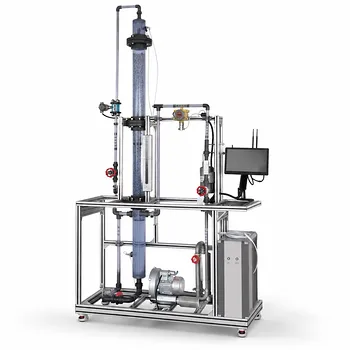
A steady-state kinetic model is a static snapshot of a reactor’s average performance. When researchers use these models to predict how a packed-bed catalytic reactor will behave under transient conditions—like startup, shutdown, or sudden feed changes—they are effectively ignoring the reactor’s most important dynamic feature: the catalyst itself. The actual residence-time distribution of reactants deviates sharply from ideal plug flow because species adsorb onto and desorb from the catalyst surface, creating a slow internal exchange that only becomes visible when conditions change. A rate expression built from steady-state data cannot account for this, so dynamic predictions will be fundamentally misleading unless the complex adsorption-desorption RTDs of all key species are measured and embedded in the model.
A packed-bed catalytic reactor is never a simple pipe. The catalyst acts as a dynamic reservoir that holds and slowly releases reactants. Steady-state kinetics that assume perfect plug flow collapse into dangerous inaccuracies the moment you ask them to describe anything other than a fixed, stable operating point.
The Hidden Dynamic That Steady-State Data Misses
Steady-State Models Assume Ideal Plug Flow
Traditional steady-state kinetic modeling treats the reactor as an idealized plug-flow system. In that framework, all fluid elements travel through the bed at the same velocity, with no axial mixing and no hold-up beyond the bulk gas volume. This simplification is excellent for sizing a reactor or estimating conversion at a steady operating point. It lets engineers extract rate constants from steady-state experiments and scale up reliably under stable conditions. But the assumption is exactly that: an assumption that erases the real molecular traffic between the gas phase and the catalyst surface.
When the system is at steady state, the hidden exchanges are continuously balanced, so the plug-flow approximation does not significantly distort the overall performance metrics. The error is buried because the net fluxes in and out of the catalyst cancel out. That comfortable cancellation disappears the moment the system is perturbed.
The Catalyst Surface Is a Dynamic Reservoir, Not an Inert Wall
In a packed-bed catalytic reactor pilot plant, the actual residence-time distribution (RTD) of reactants is often highly non-uniform and deviates from ideal plug flow due to adsorption on the catalyst. Every activated site acts as a temporary trap that holds molecules for a variable time before releasing them back into the flowing stream. This creates a broad, multi-modal RTD that cannot be captured by a single plug-flow residence time.
Crucially, the slow exchange between the adsorbed phase and the gas phase means the catalyst effectively stores mass. During a transient event—say, a ramp in feed concentration—the inventory of adsorbed species changes slowly, lagging far behind the bulk flow. The reactor’s dynamic response is no longer governed by the gas-phase convection time but by the kinetics of adsorption and desorption, which steady-state rate laws never had to describe.
Why the Dynamic Response Breaks Steady-State Predictions
When a perturbation hits the reactor, the adsorbed phase acts like a buffer that smears out concentration fronts. A model built exclusively from steady-state data will predict a sharp, plug-like propagation of a concentration wave. In reality, the wave is stretched, delayed, and attenuated because molecules continuously enter and leave the catalyst surface along the entire bed length.
This mismatch becomes catastrophic in pilot-plant scenarios where feed perturbations, startups, and shutdowns are frequent and deliberate. The reactor’s observed outlet composition can take orders of magnitude longer to stabilize than a plug-flow steady-state model would suggest. Control strategies based on such flawed dynamic predictions risk over-correction, unstable operation, or even dangerous thermal runaways if heat effects couple with the delayed desorption.
The Trap of Assuming Steady-State Rate Expressions Are “Close Enough”
It is tempting to treat the steady-state rate expression as an approximate dynamic model by simply plugging it into a transient mass balance. But that approach implicitly assumes the catalyst surface is always at instantaneous equilibrium with the local gas-phase composition. Real catalysts, especially those with strong or multi-site adsorption, often have adsorption-desorption time scales that are comparable to or longer than the space time of the reactor. Rate expressions derived solely from steady-state experiments fail to represent these real molecular events. The error is not a minor correction; it is a structural blind spot that can reverse the qualitative shape of the dynamic response.
Understanding the Trade-offs
Steady-state kinetics are irreplaceable for design and scale-up. They distill complex catalytic networks into practical, measurable constants and have been the backbone of reactor engineering for decades. The caution here is not about abandoning them but about acknowledging their boundaries. The trade-off is between simplicity and dynamic fidelity. Gaining dynamic accuracy requires a much more expensive experimental campaign to characterize the complex adsorption-desorption RTDs of individual species. This means tracer studies, transient response experiments, or specialized spectroscopic probes that go far beyond standard kinetic testing.
Ignoring this trade-off leads to two classic pitfalls: first, a researcher may interpret a slow pilot-plant transient as a sign of a new reaction mechanism, when it is simply the catalyst’s mass storage effect; second, a student may attempt to design a closed-loop controller based on a steady-state model and find it violently unstable because the actual plant has a huge unmodeled time delay. Both mistakes stem from applying a tool outside its domain.
Applying This Knowledge to Your Research or Pilot-Plant Project
Whether you are a graduate student designing your first catalytic experiment or an engineer planning a pilot-plant campaign, your approach must change depending on your objective. The key is to match the model’s capability to the behavior you need to predict.
- If your primary focus is steady-state performance and scale-up: The conventional plug-flow steady-state model with kinetics from integral reactor data remains your most efficient tool. Just be explicit that all dynamic conclusions are out of scope.
- If your primary focus is transient behavior during startup, shutdown, or disturbance rejection: You must invest in residence-time distribution characterization that resolves adsorption-desorption dynamics for each species. Without this, any dynamic model is speculative.
- If your primary focus is developing a dynamic process control strategy: Never base the controller design on a steady-state model. Run dedicated transient experiments—such as step-response or frequency-response tests—to directly identify the true dynamic time constants imposed by the catalyst’s surface inventory.
- If your primary focus is interpreting anomalous pilot-plant data: Assume the catalyst’s dynamic hold-up is a suspect until proven otherwise. A simple RTD tracer test combined with a non-adsorbing tracer can quickly separate hydrodynamic effects from genuine reaction anomalies.
The discipline is simple: steady-state kinetics tell you where the reactor will end up; only dynamic adsorption-desorption data tell you how long it will take to get there and what will happen along the way. Respect that division, and your predictions—and your pilot plant—will perform exactly as intended.
Summary Table:
| Feature | Steady-State Models | Dynamic Behavior |
|---|---|---|
| Flow Assumption | Ideal plug flow (no axial mixing) | Non-uniform RTD due to adsorption |
| Catalyst Role | Static operating point | Dynamic mass reservoir |
| Application | Steady-state design & scale-up | Startup, shutdown, & process control |
| Data Required | Rate constants from stable runs | Adsorption-desorption transient data |
Bridge the Gap Between Reactor Theory and Real-World Dynamics
Accurately predicting reactor behavior requires the right experimental tools. LABPARK provides premium Educational and Vocational Unit Operations Pilot Plants in chemical engineering, bioprocess & biotech, and environmental & water treatment for universities, research institutes, and enterprises. Our systems empower students and researchers to master both steady-state operations and complex transient dynamics.
Ready to elevate your training and research capabilities? Contact our experts today to find the perfect pilot plant solution for your lab!
Related Products
- Micro-Scale Gas-Solid Catalytic Reaction Educational Pilot Plant
- Fixed Bed Gas Solid Catalytic Reaction Educational Pilot Plant
- Multi Functional Catalytic Reaction and Reactor Evaluation Educational Unit Operations Pilot Plant
- Fluidized Bed Gas Solid Catalytic Reaction Educational Pilot Plant
- Packed Bed Absorption Educational Unit Operations Pilot Plant
People Also Ask
- How to determine catalyst pore radius & porosity? Optimize your chemical engineering pilot plant.
- 1D vs 2D Catalytic Reactor Models: What Are the Practical Trade-Offs?
- How does identifying the rate-limiting step optimize reaction conditions? Pilot Plant Guide
- What reactor configurations study gas-solid reactions? Guide to key types and applications.
- Why Control WHSV & Residence Time in Catalytic Reactor Pilot Plants? Optimize Yield