Non-ideal fluid properties are not academic curiosities—they are the hidden determinants of whether your pilot plant succeeds or fails.
When you ignore excess molar volume, your volumetric flow calculations become fiction. Pipes, pumps, and control valves end up incorrectly sized because you’ve assumed a simple additive volume that nature refuses to deliver. If low-temperature liquid-liquid immiscibility is overlooked, a clean gas-liquid separation can suddenly disintegrate into a flooded, poorly distributed column that destroys mass transfer efficiency and yields meaningless data.
Pilot plants exist to shrink the gap between theory and industrial reality. But if you treat a highly non-ideal mixture as an ideal one, you shrink that gap by distorting reality itself. Excess molar volume directly sabotages equipment sizing and column hydraulics, while unexpected liquid-liquid phase splits turn a controlled separation into an unpredictable hydraulic failure. Accounting for these properties is the only way to keep the pilot plant within safe, predictable, and physically meaningful operating boundaries.
The Domino Effect of Excess Molar Volume
A real mixture’s volume is rarely the sum of its pure-component volumes. Excess molar volume quantifies that deviation, and it triggers a cascade of physical consequences in a gas-liquid pilot plant.
Volume Isn’t Additive in Real Mixtures
When polar molecules meet nonpolar ones, or when strong hydrogen‑bonding networks reorganize, the mixture can contract or expand.
This means the density you get from an ideal mixing rule is wrong.
Wrong density leads to wrong volumetric flow rates for the same mass flow—your entire material balance drifts off-course.
Piping and Valve Sizing Errors
In a pilot plant, volumetric flow rate is the number that dictates line size, pump selection, and control valve Cv.
If excess molar volume contracts the liquid phase by 5%, your “design” flow rate is actually 5% low.
You end up with undersized piping that creates excessive pressure drop, or a pump that cannot deliver the target liquid throughput, choking the entire gas-liquid operation.
Inaccurate Column Hydraulics and Scale-Up
Distillation and absorption columns rely on known liquid and vapor loads to stay inside weeping, flooding, and entrainment limits.
When the real volumetric liquid flow differs from the assumed ideal, the column’s turndown ratio, tray hydraulics, or packing wetting behavior are no longer what you designed.
This corrupts the pilot plant’s primary mission: generating data you can scale to production with confidence.
The Hidden Danger of Low-Temperature Liquid-Liquid Immiscibility
Many gas-liquid systems are designed assuming a single homogeneous liquid phase. But when temperature drops, a second liquid phase can appear—and that changes everything.
Unexpected Phase Splits Inside the Column
A mixture that is fully miscible at ambient temperature can develop a liquid‑liquid miscibility gap as cooling occurs in a condenser or a chilled absorption section.
Suddenly, instead of one liquid stream, you have two immiscible liquids competing for space on trays or packing.
This is a physical reality, not a sensor malfunction, and it strikes without warning if you didn’t consult the ternary phase diagram.
Flooding, Poor Mass Transfer, and Phase Maldistribution
A second liquid phase fundamentally alters the column’s hydraulic resistance.
The heavier phase can accumulate on trays, blocking vapor passages and causing premature flooding.
Even if flooding doesn’t occur, the phases distribute unevenly across the packing, creating dead zones where mass transfer collapses—your separation performance plummets and your experimental results become unreproducible.
Breaking Model Assumptions
Standard design equations for gas‑liquid columns—like the two-film theory or the F-factor—assume a single continuous liquid phase.
When a second liquid appears, those models no longer apply. A pilot plant that stumbles into immiscibility without awareness becomes a physical experiment in multi-phase chaos, not a controlled scientific instrument.
Understanding the Trade-offs
Ignoring non-idealities promises simplicity, but it inevitably delivers a pilot plant that lies.
- Measurement effort vs. operational certainty: Measuring excess volumes and phase boundaries requires additional experiments (densimetry, cloud‑point titrations), which lengthens the planning phase. However, skipping this step guarantees that your pilot plant’s physical limits—piping diameter, pump head, column diameter—are based on guesswork.
- Model complexity vs. data integrity: Using a non‑ideal thermodynamic model (e.g., activity coefficient-based equations) is harder to set up than an ideal one. But an ideal model that predicts a single liquid phase when two phases exist makes your experimental results worthless for scale‑up.
- Safety and reliability: A pilot plant that floods due to an unanticipated liquid-liquid split is not just an academic failure—it is a process safety incident that can damage equipment and waste expensive feeds. The cost of the upfront thermodynamic work is always smaller than the cost of troubleshooting a broken unit.
Making the Right Choice for Your Goal
Before you build or modify a gas-liquid pilot plant, step back and ask what you are truly trying to achieve. Treating the fluid as non-ideal from the start is an investment in credibility.
- If your primary focus is scale‑up reliability: Start with a full thermodynamic characterization of your feed mixture, including excess volume data and low‑temperature miscibility limits. Size piping, pumps, and column internals using the real volumetric flow rates, not the ideal ones.
- If your primary focus is process safety and stable operation: Always map the liquid‑liquid phase envelope across the full operating temperature range your plant will see. Insulate and heat‑trace lines where necessary to stay safely above the two‑phase region, or design the column internals to handle a known second liquid phase.
- If your primary focus is educational or proof‑of‑concept: Deliberately include a non‑ideal mixture as a test case. Measure its properties, then document how ignoring them would have led to specific sizing errors or column failures—this turns a classroom exercise into a lasting lesson in real‑world thermodynamics.
A pilot plant that faithfully reflects the non-ideality of its fluids is the only kind that gives you the truth about your process. Give it that truth, and it will reward you with data you can build on.
Summary Table:
| Non-Ideal Property | Physical Effect | Pilot Plant Impact |
|---|---|---|
| Excess Molar Volume | Volume contraction/expansion; non-additive density | Sizing errors in pipes/valves; inaccurate column hydraulics |
| Liquid-Liquid Immiscibility | Unexpected phase split (two immiscible phases) | Column flooding; poor mass transfer; failed model assumptions |
Build Predictable and Accurate Pilot Plants with LABPARK
Don't let non-ideal fluid properties compromise your experimental data or lead to costly scale-up failures. LABPARK provides state-of-the-art Educational and Vocational Unit Operations Pilot Plants in chemical engineering, bioprocess & biotech, and environmental & water treatment. Tailored for universities, research institutes, and enterprises, our pilot plants ensure precise process control and reliable thermodynamic modeling.
Contact us today to optimize your pilot plant configuration and secure accurate, scale-up ready results.
Related Products
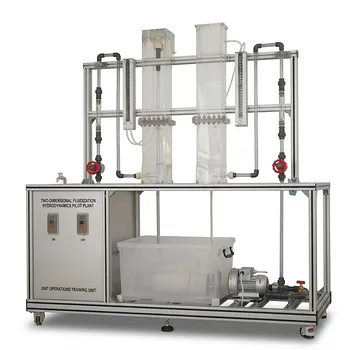
- Two-Dimensional Fluidization Hydrodynamics Educational Pilot Plant for Unit Operations Training
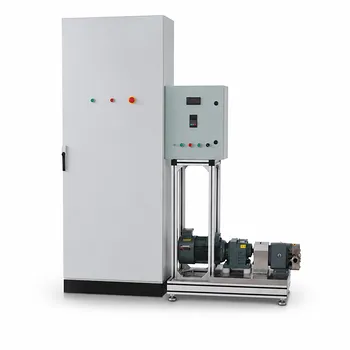
- Quantitative Dosing and Liquid Flow Control Educational Unit Operations Pilot Plant
- Educational Unit Operations Pilot Plant for Intraparticle Diffusion Effective Factor Measurement
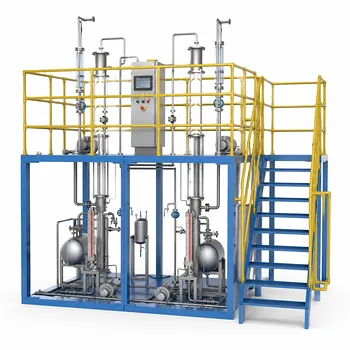
- Dual-Mode Gas Absorption and Desorption Unit Operations Training Pilot Plant
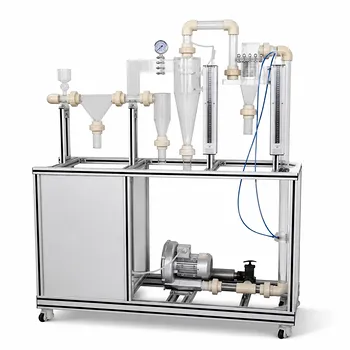
- Gas-Solid Heterogeneous Separation Demonstration Educational Unit Operations Pilot Plant
People Also Ask
- What pressure drop characteristics should students & researchers monitor in a fluidization pilot plant?
- How does active time pulsing mixing enhance fluid homogenization? Configuration Guide for Educational Pilot Plants
- How can acoustic chemometrics prevent reactor clogging in educational fluidized bed pilot plants?
- What is the operational significance of solids feed rate on emulsion phase dynamics in fluidized bed pilot plants?
- How can inline NIR & microwave sensors study fluidized bed drying dynamics? A Real-Time Guide