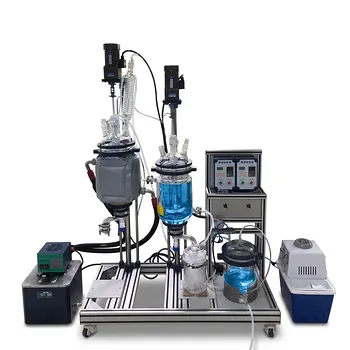
The moment students measure a pilot-plant precipitate yield, they see a number that doesn't match the textbook calculation. This gap isn’t a measurement error—it’s the salt effect in action. In chemical engineering unit operations, strong non-common electrolytes present in the feed raise the apparent solubility of the target precipitate, making it impossible to hit the yield predicted by a simple $K_{sp}$ calculation. Instructors who don’t explicitly account for this effect leave students with a broken link between classroom thermodynamics and real pilot-plant data.
The salt effect arises because high concentrations of spectator ions increase the solution’s ionic strength, shielding reacting ions and reducing their activity coefficients. This makes the precipitate more soluble, directly lowering the mass of product recovered. For an instructor, omitting this phenomenon means forfeiting the prime opportunity to teach why industrial crystallization and precipitation don’t behave like ideal dilute systems—and why process design must rely on measured, not just calculated, solubilities.
The Science Behind the Salt Effect
What the Salt Effect Actually Is
When a solution contains a high concentration of strong, non-common electrolytes—ions that don’t participate in the precipitation reaction—the solution’s ionic strength jumps. These spectator ions form an “ionic atmosphere” that envelopes each reacting ion.
That atmosphere restricts the free movement of the ions that need to come together to form the solid. Their effective concentration—their activity—drops, and so does the driving force for precipitation. The result is a higher measured solubility than what the $K_{sp}$ alone suggests.
Ionic Strength and Activity Coefficients
The quantitative root of the salt effect is the decrease in activity coefficients at high ionic strength. For a sparingly soluble salt like $BaSO_4$ or $AgCl$, the thermodynamic solubility product stays constant, but the concentration-based product $[Ba^{2+}][SO_4^{2-}]$ must increase to compensate for the lowered coefficients. At the pilot scale, this translates directly to more dissolved ions remaining in the mother liquor and a smaller mass of precipitate on the filter.
Consequences for Common Precipitates
Precipitates such as $BaSO_4$ and $AgCl$ are textbook examples, yet in a pilot plant they dissolve to an unexpected extent when background electrolytes like $NaCl$ or $KNO_3$ are present. A student’s mass balance will show a systematic shortfall that grows with the ionic burden of the feed. Only by quantifying the salt effect can the instructor explain that this isn’t a process failure—it’s a predictable and manageable consequence of solution non-ideality.
The Salt Effect in Pilot Plant Experiments
Why Textbook $K_{sp}$ Fails at Scale
Classroom equilibrium problems assume infinite dilution where activity equals concentration. A pilot plant never runs at infinite dilution. The moment a feed contains dissolved salts, acids, or buffer ions, the ionic background invalidates that assumption.
Instructors who neglect the salt effect set up experiments where students expect a recovery of, say, 99 % but observe 92 % —and then misattribute the gap to poor mixing or human error. Accounting for the salt effect reframes the discrepancy as a core process engineering variable, not a nuisance.
The Interplay with the Common Ion Effect
Crystallization pilot plants often deliberately add an excess of a constituent ion to drive the equilibrium toward the solid. This is the common ion effect, and it suppresses solubility. But the same excess reagent also carries a counterion—often a spectator—that increases the ionic strength and triggers the salt effect. The net solubility is a balance between these two opposing forces. Pilot runs are essential to find the reagent dosage that maximizes yield without overshooting into the zone where the salt effect dominates and solubility rises again.
Pilot Plant Specifics: High Ionic Backgrounds
In real feed streams—such as brines, process liquors, or treated wastewater—the background electrolyte concentration is already high. Cooling crystallization, reactive precipitation, and antisolvent addition all take place in a soup of non-participating ions. Even a well-designed antisolvent process can produce less than 50 % of the expected yield if the added non-solvent doesn’t compensate for the salt effect on the target solute. At the pilot scale, ignoring this leads to oversized downstream equipment, incorrect mass balances, and flawed teaching of industrial practice.
Understanding the Trade-offs
When Excess Reagent Backfires
Adding more precipitant seems like the natural fix: push the common ion effect to counteract the salt effect. But this path has limits. An over-dosage raises the ionic strength further, sometimes accelerating the salt effect faster than the common ion effect pushes the equilibrium forward. In other systems, the excess reagent can form soluble complexes that actually increase the apparent solubility. At the pilot scale, this turns into wasted chemicals, larger waste streams, and a confused student asking why “too much” reagent made things worse.
The Risk of Overlooking the Salt Effect in Education
If the salt effect is never introduced at the pilot-plant stage, students graduate with an idealized image of precipitation that shatters the first time they step into a plant. They won’t anticipate yield shortfalls, they won’t know how to diagnose ionic strength problems, and they’ll lack the vocabulary to discuss process robustness with operators. For the instructor, ignoring this effect means missing the chance to teach that good process design doesn’t fight the salt effect—it measures it, models it, and uses it to set realistic performance targets.
Guiding Students to Use the Salt Effect as a Process Lever
A pilot-plant experiment on crystallization or precipitation is not a demonstration of perfect theory; it’s a training ground for thinking in terms of activities, not just concentrations. Below are practical goals instructors can set, depending on the lesson they want to emphasize.
- If your focus is connecting thermodynamics to real processes: Design an experiment where students measure yield at multiple background salt levels. Have them plot the apparent solubility against ionic strength and calculate activity coefficients from the data. This single exercise bridges the entire semester.
- If your focus is process optimization and efficiency: present multiple feed compositions and challenge students to find the precipitant dose that minimizes dissolved loss. Teach them that the ideal dose is the point where the marginal gain from the common ion effect equals the marginal loss from the salt effect—a real economic trade-off.
- If your focus is preparing students for industrial troubleshooting: introduce a “mystery” yield shortfall in a simulated waste stream and ask students to diagnose it. Their investigation will naturally lead to the ionic background and the salt effect, building the diagnostic mindset they’ll need in the field.
When the salt effect stops being an invisible error source and becomes a quantifiable variable in the student’s toolkit, the pilot plant transforms from a scale-up demonstration into a true learning system. Every gram of “missing” product becomes a story they can read, interpret, and manage.
Summary Table:
| Feature | Common Ion Effect | Salt Effect |
|---|---|---|
| Primary Cause | Excess of a reacting constituent ion | High concentration of spectator (non-reacting) ions |
| Effect on Activity | Drives equilibrium toward precipitate formation | Lowers activity coefficients due to high ionic strength |
| Solubility Impact | Decreases solubility | Increases solubility |
| Pilot Plant Outcome | Maximizes initial yield | Leads to unexpected yield shortfalls (lower than textbook Ksp) |
Equip Your Lab for Real-World Chemical Engineering Challenges
Bridge the gap between textbook theory and industrial reality for your students. LABPARK provides premium Educational and Vocational Unit Operations Pilot Plants in chemical engineering, bioprocess & biotech, and environmental & water treatment. Designed specifically for universities, research institutes, and enterprises, our pilot plants enable hands-on mastery of complex phenomena like crystallization, precipitation, and solution thermodynamics.
Ready to elevate your engineering curriculum or research capabilities? Contact LABPARK today to request a quote or custom solution!
Related Products
- Potassium Salt Thermal Dissolution and Crystallization Separation Educational Unit Operations Pilot Plant
- Multi Pump Fluid Transport Process Piping Unit Operations Training Pilot Plant
- Natural Product Extraction Unit Operations Training Pilot Plant
- Multi Functional Membrane Crystallization Educational Unit Operations Pilot Plant
- Multi-Modal Distillation Unit Operations Training Pilot Plant
People Also Ask
- How does solubility modeling assist crystallization pilot plants? Master the BETA parameter.
- What are the benefits of integrating online PAT tools like ATR-FTIR into crystallization unit operations pilot plants?
- How do crystallization pilot plants improve student learning? Shift from manual observation to process control.
- Control Crystallization Pilot Plant Secondary Nucleation: 4 Key Adjustments
- Why is precise temperature control critical in crystallization pilot plants? Key to Scale-Up Success