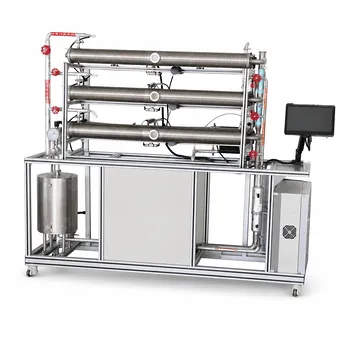
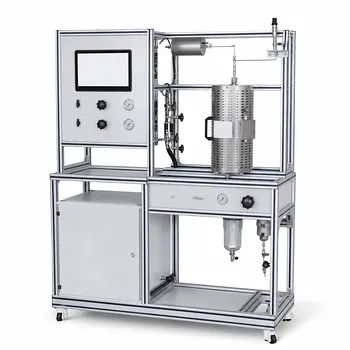
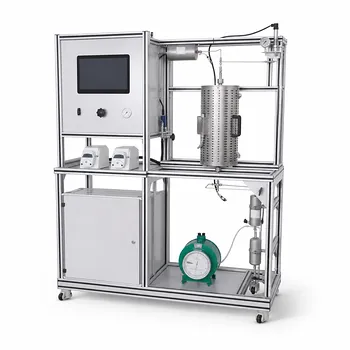
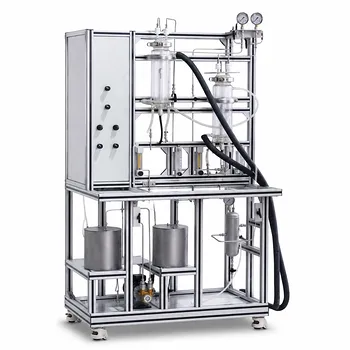
High temperature is the indispensable engine of condensation polymerization, but it's also the source of its greatest molecular-level chaos. In chemical engineering pilot units, these reactions are operated at elevated temperatures—typically 250°C or higher—to drive the equilibrium forward by continuously removing low-molecular-weight byproducts like water or glycol. However, that same heat inevitably triggers reversibility and interchange reactions, which randomly break and remake polymer chains. The net result is a dynamic reshuffling that drives the molecular weight distribution toward a predictable “most probable” shape—a fundamental trait you must either exploit or counteract, depending on your product goals.
The core tension in condensation polymerization is this: you need high temperatures to push the reaction to high conversion, but those temperatures also unleash reversible cleavage and chain-to-chain interchange reactions. Together, they erase any narrow or “designed” distribution you might have started with, relentlessly driving the system toward the most probable molecular weight distribution. Mastering pilot-plant operation means understanding exactly when and how to manage this built-in randomization.
The Thermodynamic Imperative: Why Heat Drives the Reaction Forward
Condensation polymerizations are equilibrium-limited processes. Simply mixing monomers at room temperature will not yield a useful polymer because the reaction stalls long before reaching a high degree of polymerization.
Breaking the Equilibrium Barrier
Every step in a polyesterification or polyamidation produces a small-molecule condensate—water, methanol, ethylene glycol. These byproducts remain in the reaction mixture and quickly drive the reverse reaction (hydrolysis, alcoholysis), capping the achievable molecular weight at a low ceiling.
Elevating the temperature serves a dual purpose. First, it makes the byproduct molecules more volatile, enabling them to be stripped out of the viscous melt. Second, it increases the reaction rate constant, allowing chain-building steps to occur faster than the reverse reactions if the byproducts are efficiently removed.
Rate Enhancement and Practical Throughput
A pilot plant is not just a chemistry experiment; it is a scale-up test bed. High temperatures substantially accelerate the inherently sluggish esterification and amidation kinetics. Without sufficient heat, the reaction would take days to reach even moderate conversion, making the process economically unviable and masking the residence-time effects you need to study.
This is why pilot reactors are equipped with high-temperature heating systems, distillation columns, and vacuum extraction. The objective is to separate the condensate as quickly as it forms, pulling the equilibrium relentlessly toward high-molecular-weight polymer.
The Double-Edged Sword: How Reversibility and Interchange Reshape Your Polymer
Once you apply the necessary heat, you activate two interconnected side-processes that are inseparable from the main polymerization. Both involve the random unlinking and relinking of polymer chains.
Reversibility: The Unlinking of Chains
The same equilibrium that you manipulate to drive the reaction forward also works in the opposite direction. Even under vacuum, a small concentration of byproducts or reactive end-groups can cause chain scission. A water molecule can attack an ester linkage, cleaving a long polyester chain back into two shorter fragments. This reversibility does not just slow down net growth—it constantly reshuffles the chain lengths.
Interchange Reactions: Random Relinking Between Chains
Interchange reactions—transesterification in polyesters, transamidation in polyamides—occur when two polymer chains exchange segments. One chain’s end-group can attack a mid-chain linkage of another, literally splicing the two chains together and creating two new chains of different lengths. Because these reactions happen between any two chains at random, they erase the “memory” of how the chains were originally built. This holds true whether you started with a monodisperse prepolymer, a block copolymer, or a blend. Over time, the entire population mixes and re-equilibrates.
The Resulting Molecular Weight Distribution
The combined effect of reversibility and interchange is that the molecular weight distribution converges to the most probable (Flory) distribution. In simple step-growth systems, this gives a dispersity (Đ) of approximately 2.0. For a pilot-plant operator, this means:
- You cannot “lock in” a narrow distribution if interchange remains active at your operating temperature.
- The final polymer will always exhibit a predictable breadth of chain lengths, which directly impacts melt viscosity, crystallinity, and mechanical properties.
- Even a block copolymer, if held at high temperature for too long, will randomize into a statistical copolymer through transesterification.
Pilot Plant Realities: Control Strategies to Manage the Heat and the Chaos
The job of a pilot unit is not to avoid these side reactions entirely—that’s impossible—but to manage them so they serve your objectives.
Continuous Byproduct Removal
Efficient vacuum systems and swept-surface evaporators become critical. By keeping the byproduct concentration near zero, you suppress the back-reaction, allowing the forward polymerization to dominate. This shifts the average molecular weight upward even as the distribution continues to broaden toward the most probable shape.
Temperature Profiling and the Optimal Trajectory
Because the reaction is reversible and exothermic, there exists an optimum temperature for each level of conversion that maximizes the net reaction rate. In a pilot plant, you can program the jacket temperature to follow this (T_{opt}) trajectory, accelerating the early stages when equilibrium is less restrictive, then easing off to prevent excessive thermal degradation or unwanted side reactions later.
Reactor Configuration and Residence-Time Distribution
The interplay of heat, mixing, and residence time becomes starkly visible in continuous pilot reactors. The molecular weight distribution you measure is a convolution of the chemical randomization from interchange and the physical residence-time distribution of the reactor. Batch reactors, by contrast, give you a more uniform thermal history but still cannot escape the most probable distribution if you hold the melt at temperature long enough for interchange to act.
Understanding the Trade-offs: When High Temperatures Become a Problem
While high temperatures are unavoidable, they introduce risks you must weigh against the gains.
Thermal degradation can kick in at very high temperatures, causing unzipping or discoloration that ruins product quality. Uncontrolled interchange can destroy the blockiness of a specialty copolymer you are trying to preserve for a specific performance function. High temperature also increases the energy cost and demands more robust materials of construction.
A pilot plant serves as the arena for quantifying these trade-offs. You can deliberately vary the temperature, vacuum level, and hold time to map exactly how the polymer’s dispersity, end-group fidelity, and physical properties shift—data that no Arrhenius equation alone can predict for your specific formulation.
Making the Right Choice for Your Polymerization Process
Your operating strategy depends entirely on what you need the polymer to do.
- If your primary focus is achieving a high degree of polymerization rapidly: Run at the highest temperature your chemistry can tolerate without degradation, and combine with aggressive vacuum stripping. Accept that the distribution will be broad and random.
- If your primary focus is preserving a specific block structure or narrow dispersity: Minimize the time the melt spends at high temperature after the required conversion is reached. Quench or strip the catalyst as early as feasible to freeze the interchange before it randomizes the architecture.
- If your primary focus is studying kinetics or scaling up a reproducible process: Use the pilot plant to identify the (T_{opt}) profile that maximizes space-time yield while carefully monitoring the onset of interchange and reversibility side reactions. Document the resulting most probable distribution as the baseline against which any process change is measured.
In every case, the elevated temperature is the enabler of condensation polymerization, but the reversibility and interchange it triggers are the inescapable chemists inside your reactor—constantly renegotiating the chain lengths until they reach their statistical equilibrium. The art of pilot-scale operation is in knowing how to let that equilibrium work for you, not against you.
Summary Table:
| Process Element | Direct Impact | Pilot Plant Control Strategy |
|---|---|---|
| High Temperature | Accelerates reaction kinetics and volatilizes byproducts to drive equilibrium. | Implement optimal temperature ($T_{opt}$) profiling throughout the reaction. |
| Reversibility | Byproduct accumulation causes chain scission, limiting molecular weight growth. | Utilize aggressive vacuum extraction and swept-surface evaporators. |
| Interchange Reactions | Transesterification/transamidation randomizes chain lengths ($Đ \approx 2.0$). | Quench the melt or deactivate catalysts early to preserve specific block structures. |
Optimize Your Polymerization Scale-Up with LABPARK
Mastering complex reaction kinetics and thermodynamic controls requires precise, reliable equipment. LABPARK provides state-of-the-art Educational and Vocational Unit Operations Pilot Plants in chemical engineering, bioprocess & biotech, and environmental & water treatment.
Designed specifically for universities, research institutes, and enterprises, our pilot units empower you to safely analyze variables like temperature profiling, vacuum stripping, and residence-time distribution.
Ready to elevate your research and training capabilities? Contact LABPARK today to find the perfect pilot plant solution for your lab!
Related Products
- Polymerization Granulation and Pellet Processing Educational Unit Operations Pilot Plant
- Three-Tube Heat Transfer Educational Pilot Plant for Unit Operations Training
- Carbon Material Thermal Pretreatment Multiphase Separation Educational Pilot Plant
- Carbon Dioxide Hydrogen Methanol Synthesis Educational Unit Operations Pilot Plant
- Carbon Dioxide Hydrogenation Methanol Synthesis Educational Unit Operations Pilot Plant
People Also Ask
- How do educational unit operations pilot plants address safety and waste management when scaling up?
- How do educational unit operations pilot plants bridge theory and design? Bridge the Engineering Gap
- Why Compare Predicted and Experimental Excess Enthalpy? Key to Accurate Pilot Plant Scale-up
- When to transition from PID to adaptive control in pilot plants? Key process indicators.
- How to study gasification in pilot plants? Compare exit gas composition & efficiency