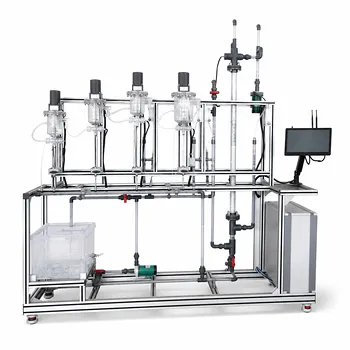
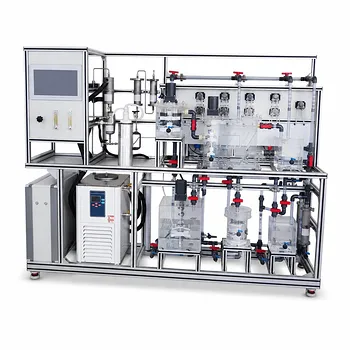
Catalyst performance is not static—it evolves during every second of a reaction, and recognizing how and why it changes is exactly what separates a technician from a proficient pilot plant operator. Understanding catalyst phase transitions and deactivation phenomena, such as carburization, is crucial during pilot plant training because it is the only way to reliably translate a lab-scale recipe into a predictable, safe, and profitable industrial process. Without this knowledge, students and engineers cannot diagnose performance drift, optimize activation protocols, or generate the meaningful long-term kinetic data required for reactor scale-up.
Pilot plant training is fundamentally about learning to “see” the hidden life of the catalyst. Understanding phase transitions and deactivation transforms an operator from a recipe follower into a problem solver—someone who can correlate reactor conditions with catalyst health, extend run lengths, and design regeneration strategies that make commercial plants economically viable.
The Catalyst: A Dynamic, Not a Static, Piece of Hardware
The surface-level question asks why you need to care about carburization and phase changes. The deep need is to bridge fundamental catalytic chemistry with everyday pilot plant decisions. The answer is simple: a catalyst is a material that changes chemically and physically during operation, and those changes directly dictate everything you measure in the plant.
Active Phases Are Created by Intentional Phase Transitions
Many industrial catalysts are not active as-synthesized. They require a precise pretreatment step to deliberately form the working phase. Improper activation can completely prevent the formation of the active alloy or crystalline phase, rendering the catalyst useless before the run even begins. In a pilot plant, you might reduce a metal oxide to its active metal form or, for Fischer-Tropsch synthesis, carefully carburize a catalyst to create the active iron carbide. If you don’t understand that this phase transition must happen—and how temperature and gas composition drive it—you will fail to generate any meaningful data from the entire experiment.
Reaction Conditions Can Trigger Undesirable Phase Changes
Even a well-activated catalyst can undergo further, unintended phase transitions when exposed to reaction conditions. For example, in Fischer-Tropsch systems, the catalyst can continue carburizing or oxidize, shifting selectivity and activity. These phase changes can be monitored in real time via spectroscopy (like in-situ XRD or Raman) attached to the pilot plant. Training with such instruments teaches the correlation between a spectroscopic signal and the actual chemical state of the material, a skill that directly informs when to adjust the feed or temperature before catastrophic deactivation sets in.
Pilot Plants: The Only Place to Connect Microscopic Events to Macroscopic Decisions
You can measure a catalyst’s initial activity in a microreactor, but that tells you nothing about how it will behave over weeks in a real plant. The pilot plant is the crucial link where phase transitions and deactivation mechanisms become visible through their impact on process parameters.
Long-Duration Runs Expose the Real Kinetics of Deactivation
Obtaining accurate kinetic data for both fresh and gradually deactivating catalysts is essential for reactor design. Without it, model parameters must be tuned arbitrarily, violating their physicochemical basis and making safety predictions unreliable. In a pilot plant running for 50 hours or more, you can watch the decline in conversion, track changes in selectivity, and measure how the thermal profile shifts as the catalyst phase changes or active sites are lost. This long-term data cannot be guessed; it must be measured under realistic flow, pressure, and recycle conditions.
Understanding Deactivation Mechanisms Prevents Misdiagnosis
A drop in performance is not a single problem—it is a symptom with many possible root causes. In a pilot plant, you can manipulate conditions to distinguish between reversible deactivation (like platinum oxidation that can be partially restored by a reduction treatment) and irreversible deactivation (such as sintering of metal nanoclusters into larger particles, permanently reducing surface area). Without knowing that carburization might be a necessary activation step for one catalyst but a deactivating coking event for another, an operator would misread the data and apply the wrong fix, wasting hours of runtime and expensive feedstock.
Correlating Macroscopic Parameters with Catalyst Stability
The core skill taught by a reaction pilot plant is the ability to use everyday knobs—feed composition, space velocity, temperature—to keep the catalyst in its desired phase and maximize yield.
Process Parameters Govern Phase Stability
Catalyst phase transitions are directly tied to the gas atmosphere and temperature. If you understand that a certain hydrogen-to-CO ratio prevents oxidation of an active carbide phase, you can adjust the feed to remain inside the stable thermodynamic window. This bridges the gap between a phase diagram in a textbook and the real-time operation of a reactor. In training, you learn that a seemingly small change in a single parameter can push the catalyst across a phase boundary, causing immediate and irreversible damage.
Monitoring Enables Data-Driven Regeneration Cycles
In processes like Fluid Catalytic Cracking, coke formation is an unavoidable part of the mechanism—carbocation intermediates cyclize and condense, depositing carbon on the acid sites. The stability of those intermediates dictates the coking rate. By understanding that this is a direct consequence of the reaction chemistry, you recognize that a continuous regeneration loop is not a failure of the catalyst but a design necessity. In a pilot plant, you can test different regeneration strategies (temperature, oxygen content, duration) and watch how the catalyst’s activity and phase composition recover, data that commercial operators will use daily.
The Economic and Safety Consequences of Ignoring Deactivation
Treating a catalyst as a black box that simply “wears out” is expensive and dangerous. Phase-aware pilot plant training prevents this.
Deactivation Dictates Reactor Choice and Process Economics
The timescale of deactivation dictates the reactor design. A catalyst that deactivates over years (like steam reforming) works in a simple fixed bed; one that deactivates in days requires swing reactors or moving beds; one that deactivates in seconds demands entrained flow with continuous regeneration. In a pilot plant with a modular configuration, you can directly experience these trade-offs, learning that the economic viability of an entire plant hinges on matching the reactor type to the catalyst’s phase stability.
Runaway Reactions and Selectivity Loss
For highly exothermic reactions, like selective oxidations, a slight change in catalyst phase can alter the reaction pathway, suddenly producing more heat and less desired product. Understanding the precursor to such phase changes allows you to set safe temperature limits and mass transfer conditions. This is not abstract theory: it is what prevents a pilot reactor from turning into a runaway hazard that can destroy equipment and endanger personnel.
Understanding the Trade-offs and Common Pitfalls
Pilot plant training is only valuable if it teaches you what can go wrong and why. Several traps await those who ignore catalyst phase behavior.
Pretreatment Neglect
The most common failure mode is rushing through activation. An improperly reduced catalyst will show low activity, and without phase awareness, you might blame the recipe or the feed. You waste a full run chasing a non-existent problem when the real issue was that you never formed the metallic active phase in the first place.
Misinterpreting Kinetic Data
If you fit a kinetic model to data taken during a period when the catalyst was still undergoing phase change (e.g., slow carburization), the rate constants you obtain are meaningless for design. They reflect a transient state, not the steady-state catalyst performance. Training with in-situ spectroscopy teaches you to wait for the catalyst to stabilize before drawing conclusions.
Ignoring Feed Impurities
Laboratory-scale tests often use pure feeds. Real industrial streams contain impurities that can adsorb on active sites or induce phase transformations (sulfiding, etc.). A pilot plant using a recycle loop can concentrate these poisons, showing you how deactivation accelerates in a real plant—data that would blindside you at commercial scale if not understood.
Making the Right Choice for Your Goal
Apply your understanding of catalyst phase transitions and deactivation to extract maximum value from pilot plant training.
- If your primary focus is process optimization: Use in-situ monitoring to pinpoint the exact temperature and feed window where the active phase is stable, then tighten your control loops around that sweet spot to maximize yield over long runs.
- If your primary focus is catalyst development: Deliberately push the catalyst into deactivating conditions to quantify its robustness and identify whether deactivation is reversible or irreversible, so you can propose a more stable formulation or a regeneration protocol.
- If your primary focus is safe scale-up: Gather the deactivation kinetics over the full expected catalyst lifetime in the pilot plant; this single data set will prevent you from undersizing the commercial reactor and creating a runaway thermal risk.
Ultimately, the pilot plant is your laboratory for failure—the place where you learn every way a catalyst can drift, die, or be revived. Mastering the phase transitions behind those behaviors is what turns classroom chemistry into industrial reality.
Summary Table:
| Key Phenomenon | Cause/Trigger | Impact on Pilot Plant Operations |
|---|---|---|
| Phase Activation | Controlled pretreatment (e.g., reduction, carburization) | Creates the active catalytic phase; improper activation leads to inactive runs. |
| Undesirable Phase Change | Reaction conditions (temperature, gas composition shifts) | Causes performance drift, activity loss, and shifts in selectivity. |
| Reversible Deactivation | Coke deposition or transient oxidation | Temporarily reduces activity; restorable via controlled regeneration. |
| Irreversible Deactivation | Sintering or permanent poisoning | Permanently reduces active surface area; requires catalyst replacement. |
Elevate Your Reaction Engineering Training with LABPARK
Are you looking to bridge the gap between classroom catalytic chemistry and industrial-scale operations? LABPARK designs and manufactures state-of-the-art Educational and Vocational Unit Operations Pilot Plants in chemical engineering, bioprocess & biotech, and environmental & water treatment.
Our systems empower universities, research institutes, and enterprises to:
- Simulate Real-World Scenarios: Replicate complex catalyst phase transitions, carburization, and deactivation phenomena.
- Enhance Practical Skills: Train operators to safely diagnose process drift, interpret kinetic data, and optimize regeneration protocols.
- Ensure Reliable Scale-Up: Generate accurate long-term data under realistic pressure, flow, and recycle conditions.
Equip your team with the tools to master reaction engineering. Contact us today to customize your pilot plant solution!
Related Products
- Carbon Dioxide PVT Curve Determination Educational Unit Operations Pilot Plant
- Methanol Synthesis and Catalyst Performance Evaluation Educational Unit Operations Pilot Plant
- Multi Functional Catalytic Reaction and Reactor Evaluation Educational Unit Operations Pilot Plant
- Educational Unit Operations Pilot Plant for Intraparticle Diffusion Effective Factor Measurement
- Fixed-Bed Chemical Reaction and Gas Dust Tar Removal Unit Operations Pilot Plant
People Also Ask
- How do temperature variations affect CO2 transport models in pilot plants? Model vs Reality
- What unit operations are critical for CCUS training pilot plants? Build hands-on engineering expertise.
- What are the applications and limitations of the Virial EOS? Enhance Your Pilot Plant Lab
- What precautions prevent sample loss when volatilizing silica with HF? Crucial Steps for Safe Lab Training
- Why is selecting the correct EOS critical in pilot plants? PR vs. SRK compared.