The silent killer of heat transfer efficiency in any condensation process is the accumulation of non-condensable gases. In a pilot plant condenser, the immediate answer is that these gases must be continuously vented because they otherwise form a stagnant, insulating gas film on the cooling surface. This film acts as a massive thermal barrier, drastically reducing the heat transfer coefficient and causing a sharp, measurable drop in performance.
Non-condensable gases act as a diffusion barrier, forcing the process vapor to navigate through a resistive, inert gas layer before it can reach the cold wall to condense. In pilot plant operations, effective venting is non-negotiable: it’s the difference between obtaining trustworthy, scalable data and generating results that are dangerously misleading for industrial design.
The Silent Efficiency Killer: The Gas-Blanket Effect
Understanding why a tiny amount of gas causes such a massive problem is fundamental to diagnosing pilot plant behavior. The issue isn't chemical; it is a purely physical mass-transfer limitation.
How Inert Gases Create a Thermal Brick Wall
When a vapor like steam enters a condenser, it must physically travel to the cold tube wall to release its latent heat. Non-condensable gases do not disappear. As the steam condenses, the mass fraction of the inert gas left behind rises dramatically near the wall. This builds a localized, high-concentration gas "blanket" that the incoming steam molecules must diffuse through. This slow diffusion process becomes the rate-limiting step, replacing the highly efficient condensation mechanism with a much slower one.
The Exponential Rise in Thermal Resistance
The gas-film layer introduces a dominant new thermal resistance in series with the condensate film. Because this gas-film resistance is significantly larger than the liquid film resistance, the overall heat transfer coefficient can plummet. This is not a linear drop; even a few percent of non-condensable gas by volume can reduce the local heat transfer coefficient by over 50%. For student operators, observing this sudden drop on a data logger is a critical learning moment, directly demonstrating the difference between pure component theory and real-world thermal hydraulics.
From Data Distortion to Equipment Damage
The impact extends far beyond an academic observation of lower numbers on a flow meter. Leaving these gases unvented corrupts the entire experimental purpose and can damage the pilot unit.
Corrupting the Scale-Up Calculation Basis
A pilot plant’s primary job is to generate data for scaling to industrial units. If the measured heat transfer coefficient is contaminated by unvented gases, the data becomes useless. The calculated design area will be grossly overestimated, leading to an oversized and excessively costly full-scale plant. Researchers must understand that ignoring this venting step means they are not measuring a condenser's true capability but rather the diffusion properties of an air-steam mixture.
The Risk of Liquid Carryover and Flooding
Without proper venting, a non-isothermal condition develops, creating a layer of subcooled gas. If the bulk temperature inside the shell drops below the dew point, the vapor does not condense as a film; instead, it forms a mist or fog. These fine liquid droplets do not drain easily and are swept out of the condenser by the gas flow. Without a mist eliminator at the vapor outlet, this carryover contaminates downstream vacuum systems or leads to the physical loss of product, a particular hazard in pilot-scale vacuum distillation columns.
Bridging Theory and Practice: The Flow-Regime Map
Addressing the deep need requires applying the correct analytical model. The behavior of the condenser fundamentally changes depending on just how much non-condensable gas you have, and pilot plant operation must account for this.
Selecting the Right Model for High Gas Concentrations
When simulating an overwhelmed system with a high volume fraction of inerts (greater than 70%), the condensation phase itself becomes negligible relative to the need to simply cool a non-condensable gas mixture. In this regime, operators must abandon condensation correlations entirely and instead apply forced convection heat transfer models. Recognizing this threshold prevents a common mistake in pilot plants—trying to calculate a condensation coefficient that physically does not exist.
Applying the Silver Method for Transitional Mixtures
The biggest challenge lies in the intermediate zone (0.5% to 70% gas volume fraction), where both liquid film resistance and gas-phase mass-transfer resistance matter. The Silver-Bell-Ghaly method is the definitive tool here. It calculates an effective local coefficient by combining the liquid film coefficient with a sensible gas-phase heat transfer coefficient, weighted by the ratio of sensible heat change to total enthalpy change. Using this method allows a researcher to accurately model the non-linear temperature-enthalpy curve and correctly size the condenser for a specific volumetric inert load.
The Hidden Trade-offs of Proper Venting
An objective advisor must acknowledge that venting is not a simple "set and forget" action. It involves operational trade-offs that directly impact safety and yield.
The Loss of Vapor with Inerts
The vent line that removes the non-condensable gases is also an exit path for the valuable process vapor. A common pitfall is over-venting, where excessive steam or solvent is lost to the atmosphere or vacuum system in the pursuit of purity. The engineer's task is to find the precise point of diminishing returns on the vent valve, minimizing thermal resistance while maximizing vapor recovery. This often requires routing the mixture to a small auxiliary condenser on the vent line to recover the saturated vapors before the inert gas is released.
Process Safety and Overpressure Hazards
In the context of pilot-scale reaction engineering, such as runaway reaction studies, the vent concept takes on a critical safety dimension. A standard process vent is not a safety device. If an exothermic reaction generates inert gas and vapor at a rate that chokes the condenser, the vent path must switch to a sized emergency relief system, such as a bursting disc. Confusing a manual needle valve for gas purging with an engineered relief vent is a catastrophic error, making the distinction between operational venting and safety relief calculations a vital part of pilot-plant training.
Making the Right Choice for Your Pilot Plant Goal
The strategy for dealing with non-condensable gases is directly tied to the objective of your experiment or unit operation.
- If your primary focus is teaching fundamental heat transfer: Vent extensively and measure the exact condensate load. Point the vent valve upward and use a cold-water coil on the vent line to create a steam/air boundary layer, visually demonstrating the diffusion barrier concept before the gas escapes.
- If your primary focus is generating precise data for industrial scale-up: Implement a controlled, continuous vent and model the results using the Silver-Bell-Ghaly method. Log the vent rate and composition meticulously to subtract the gas-phase resistance from your data and isolate the true pure-component condensation coefficient.
- If your primary focus is ensuring a stable material balance for high-value products: Install an automated back-pressure regulator on the vent line combined with a mist eliminator. This ensures that only the minimal necessary amount of gas is released, preventing the unaccounted-for loss of process fluids.
- If your primary focus is demonstrating safe operation of reactive systems: Clearly label manual process vents separately from engineered safety relief devices. Run exercises that calculate the required relief vent diameter based on a simulated gas generation rate, reinforcing that thermal efficiency and overpressure protection are two entirely different design problems.
Mastering the venting of a pilot plant condenser is the gateway to transforming a purely academic exercise into an operational insight that applies directly to the safety and profitability of a chemical plant.
Summary Table:
| Key Issue | Impact on Condenser Operation | Recommended Solution / Action |
|---|---|---|
| Gas-Blanket Effect | Drastic drop in heat transfer coefficient (>50% drop) | Continuous venting; Silver-Bell-Ghaly modeling |
| Data Distortion | Oversized and costly industrial scale-up design | Controlled venting & precise composition logging |
| Liquid Carryover | Downstream vacuum contamination & product loss | Automated back-pressure regulator & mist eliminator |
| Overpressure Hazard | Choked vent line, safety risks during runaways | Separation of manual process vents from safety relief systems |
Optimize Your Unit Operations with LABPARK
Accurate thermal and mass transfer data is critical for successful research and scale-up. LABPARK provides high-quality Educational and Vocational Unit Operations Pilot Plants in chemical engineering, bioprocess & biotech, and environmental & water treatment.
Engineered specifically for universities, research institutes, and enterprises, our pilot plants feature precise control systems that allow you to manage venting, observe real-time thermodynamic changes, and ensure process safety.
Ready to elevate your laboratory capabilities? Contact LABPARK today to find the perfect pilot plant solution for your training and research needs!
Related Products
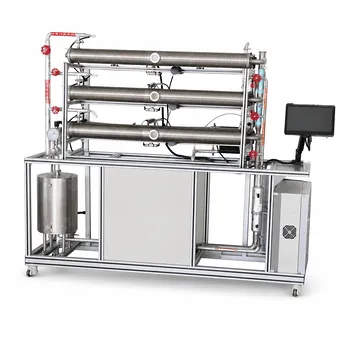
- Three-Tube Heat Transfer Educational Pilot Plant for Unit Operations Training
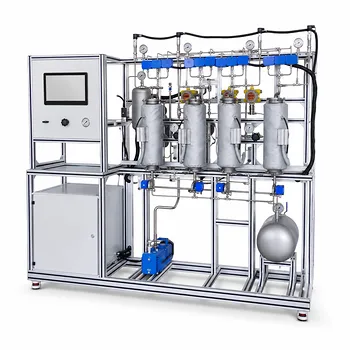
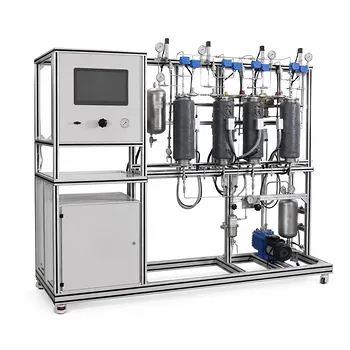
- Carbon Dioxide Adsorption and Capture Educational Unit Operations Pilot Plant
- Constant Pressure Filtration Educational Unit Operations Pilot Plant
- Multimodal Absorption and Desorption Pilot Plant for Unit Operations Training
- Dual Mode Heat Transfer Pilot Plant for Unit Operations Training
People Also Ask
- When is ε-NTU preferred over LMTD in pilot plants? Predict heat exchanger performance without iteration.
- Why is emissivity critical in heat transfer pilot plants? Bridge the Gap Between Theory & Industrial Design
- How can a heat transfer pilot plant demonstrate waste heat recovery? Learn to optimize industrial thermal systems.
- How does cascade control achieve superior disturbance rejection in heat transfer pilot plants?
- What engineering trade-offs must students analyze in a heat transfer pilot plant? Balance performance & cost.