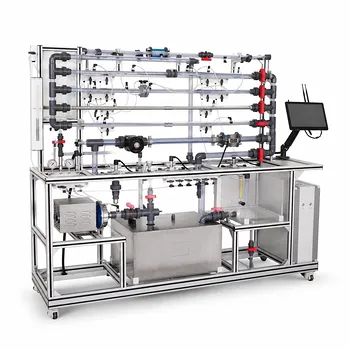
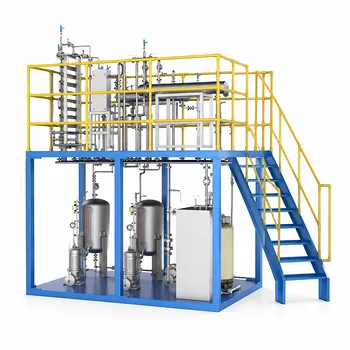
Precise thermal design and safe pilot‑plant operation begin with one variable: enthalpy.
The empirical equation (C_p = A + BT + CT^2 + DT^{-2}) directly converts a temperature measurement into a substance’s true heat capacity. When you integrate it between inlet and outlet conditions, you get the exact sensible heat and enthalpy change of a stream. Without this temperature‑dependent model, energy balances would drift into dangerous guesswork, heating/cooling utilities would be mis‑sized, and both process safety and experimental validity would collapse.
Understanding why this single polynomial is critical goes far beyond “calculating a number.” It is the precision link that transforms raw temperature readings into the calibrated heat duties, equilibrium predictions, and safety margins that keep a pilot plant both instructive and incident‑free.
The Fundamental Link Between (C_p(T)) and Pilot‑Plant Energy Balances
Every distillation column, heat exchanger, and reactor in a pilot plant ultimately runs on a closed energy balance. The polynomial form is the practical engine that drives that balance.
Calculating Sensible Heat and Enthalpy Changes
Process fluids rarely enter and leave at the same temperature.
The enthalpy change (\Delta H) is the integral of (C_p) with respect to temperature:
[ \Delta H = \int_{T_1}^{T_2} C_p(T) , dT ]
Substituting the polynomial gives an exact analytic solution that avoids numerical shortcuts.
This one calculation tells you exactly how much energy the fluid stream has absorbed or released—the cornerstone of all downstream decisions.
Sizing Heating and Cooling Utilities
A pilot plant’s jacket heater, steam supply, or cooling water system cannot be guessed.
The heat duty (Q) demanded by a process stream flows directly from the (\Delta H) above.
Correctly integrating (C_p(T)) stops you from undersizing a condenser that could cause a pressure spike, or oversizing a furnace that wastes energy and budget.
Students and engineers learn that real‑world utility sizing is only as good as the heat capacity model that feeds it.
Beyond Heat Duty: The Equation’s Role in Reaction Engineering and Safety
The polynomial’s influence runs deeper than simple heating requirements. It underpins the thermodynamic predictions that govern reaction yield and safe operating windows.
Predicting Equilibrium Shifts Through Thermodynamic Databanks
Computer‑based thermodynamic databanks store the standard enthalpy, entropy, and the (C_p) polynomial coefficients for every substance.
By integrating these data, the software computes the temperature‑dependent enthalpy (H^\circ(T) - H^\circ(298)) and entropy (S^\circ(T) - S^\circ(298)).
Those values then feed the van’t Hoff equation and the calculation of the equilibrium constant (K).
When you see an exothermic reaction lose yield at higher temperatures during a pilot run, you are witnessing the direct consequence of a temperature‑sensitive heat capacity rooted in that polynomial.
Enabling Accurate Process Simulation and Mixture Analysis
Pilot plants rarely work with pure components.
For gas mixtures, the mixture heat capacity is the mole‑fraction‑weighted average of the individual (C_{p_i}^{ig}) values.
A robust, temperature‑explicit polynomial for each species lets a simulation pull consistent thermodynamic properties from a single equation of state framework.
This consistency eliminates rogue data mismatches and ensures that the calculated heat loads, flash drum sizes, and compressor duties are physically coherent from cold start‑up to full operating temperature.
Understanding the Trade‑offs
No model is perfect, and the (C_p) polynomial is no exception. Recognizing its limits builds a safer design mindset.
- Empirical Validity Range: The coefficients are fitted to experimental data within a specific temperature range. Extrapolating far beyond that range can produce nonsensical heat capacity values.
- Phase‑Specific Coefficients: The polynomial changes completely across a phase change. It does not account for latent heat; you must separately add the enthalpy of vaporization or fusion.
- Data Quality Dependency: Using coefficient sets from different sources for a multi‑component mixture can introduce subtle but cumulative energy‑balance errors.
- Other Temperature‑Dependent Properties: While (C_p) captures the energy storage term, other properties like thermal conductivity also vary with temperature and affect overall heat transfer rates. The polynomial addresses thermodynamic accuracy, not the complete transport picture.
Common Pitfalls to Avoid
Even experienced engineers stumble when they forget the fundamentals behind the equation.
- Assuming Constant (C_p): The most dangerous shortcut. Over a 200 K temperature swing, a substance’s heat capacity can change by 30 % or more. A fixed value can lead to utility undersizing and a genuine safety risk.
- Misapplying Gas‑Phase Coefficients to Liquids: The polynomial for an ideal gas is different from that of a saturated liquid. Swapping them destroys the enthalpy balance of a condenser or reboiler.
- Ignoring the (DT^{-2}) Term: At low temperatures, the (T^{-2}) term can dominate. Dropping it because it looks “small” at first glance introduces systematic error in cryogenic or cold‑start simulations.
- Neglecting Mixture Weighting Rules: Summing pure‑component (C_p) values without the correct mixing rules overlooks residual effects. Use the mole‑fraction‑weighted average only for ideal gases, and verify the assumption at your operating pressure.
How to Apply This to Your Pilot Plant Work
Your next step depends on which operational risk you are trying to control.
- If your primary focus is energy efficiency and utility sizing: Always integrate the full (C_p) polynomial over the entire temperature span of each process stream. Use the resulting (\Delta H) to set heat exchanger duties, steam trace requirements, and cooling water flow rates with zero guesswork.
- If your primary focus is reaction yield and equilibrium optimization: Pull the (C_p) coefficients from your plant’s thermodynamic databank and ensure they are used to compute the temperature‑dependent Gibbs free energy. Correlate pilot‑plant equilibrium shifts back to this calculation to validate your model.
- If your primary focus is scale‑up reliability: Run sensitivity analyses showing how small errors in the polynomial coefficients propagate into large deviations in predicted heat loads. Use pilot‑plant data to confirm or refine the coefficients before trusting them in a full‑scale design.
- If your primary focus is safety under temperature excursions: Simulate worst‑case scenarios with the correct temperature‑dependent (C_p) to ensure that over‑pressure relief and emergency cooling systems are sized for the true thermal inertia of the process.
A pilot plant is a truth‑testing ground, not a black‑box exercise. Treating the (C_p) polynomial as the precision instrument it is transforms your thermal design from an academic exercise into a robust, safe, and genuinely instructive operating reality.
Summary Table:
| Application Area | Role of $C_p(T)$ Equation | Impact of Ignoring It |
|---|---|---|
| Utility Sizing | Exact calculation of sensible heat & enthalpy change ($\Delta H$) | Over/undersized heaters/condensers, utility waste |
| Reaction Safety | Predicts equilibrium shifts & thermal runaway margins | Dangerous temperature excursions, process failure |
| Simulation & Scaling | Feeds thermodynamic databanks for mixture calculations | Incoherent process models, inaccurate flow rates |
Elevate Your Engineering Lab with LABPARK
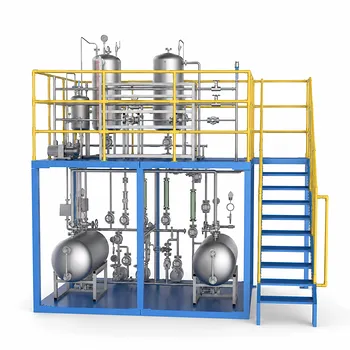
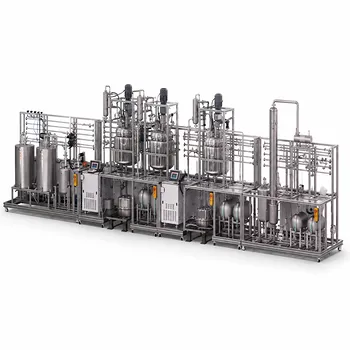
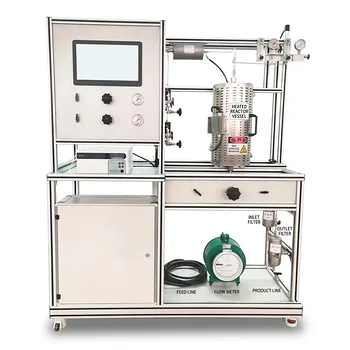
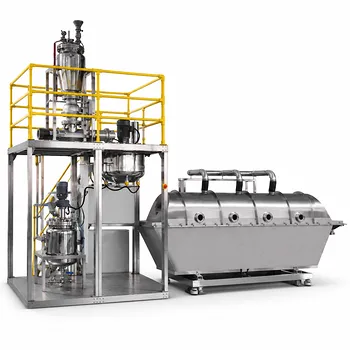
Are you looking to bridge the gap between thermodynamic theory and practical plant operations? LABPARK provides state-of-the-art Educational and Vocational Unit Operations Pilot Plants in chemical engineering, bioprocess & biotech, and environmental & water treatment.
Designed specifically for universities, research institutes, and enterprises, our pilot plants empower you to:
- Validate Theoretical Models: Put equations like temperature-dependent heat capacity into practice with precise, hands-on thermal measurements.
- Ensure Operational Safety: Train students and researchers on systems engineered with realistic safety and utility margins.
- Accelerate Research & Scale-up: Rely on robust, industrial-grade data output to confidently transition from pilot to commercial scale.
Ready to enhance your training and research capabilities? Contact us today to explore our tailored pilot plant solutions!
Related Products
- Carbon Dioxide Hydrogen Methanol Synthesis Educational Unit Operations Pilot Plant
- Multi-Reactor Educational Pilot Plant for Reaction Engineering Unit Operations
- Ethyl Acetate Synthesis Unit Operations Pilot Plant for Practical Training
- Multi Pump Fluid Transport Process Piping Unit Operations Training Pilot Plant
- Natural Product Extraction Unit Operations Training Pilot Plant
People Also Ask
- How do temp & pressure affect methanol synthesis pilot plants? Optimize equilibrium and catalyst performance.
- Why is a purge system necessary when operating a gas recirculation loop in a methanol synthesis pilot plant? (Guide)
- Why do modern methanol pilot plants operate at lower pressures? Catalyst & Feed Requirements Explained
- What are the operational requirements for catalyst activation? Safe Methanol Pilot Plant Operation
- Why is the chemical plant startup schedule crucial? De-risk scale-up with pilot plants.