Because a reactor that isn’t understood is a reactor that will fail—silently, expensively, and often dangerously.
The study of hydrodynamics in three-phase fluidized bed pilot plants is crucial because it directly reveals how solid catalysts or biological media, liquid reactants, and gas bubbles interact under flow. By quantifying parameters like bed porosity, phase holdup, and axial mixing, researchers can predict and prevent catalyst entrainment, ensure uniform fluidization, and maximize the overall mass transfer coefficient—the engine of every reaction. Without this pilot-scale insight, scaling up a process from a beaker to an industrial column remains a high-stakes gamble.
The ultimate value of a three-phase fluidized bed pilot plant isn’t just the data it produces—it’s the de-risking it provides. It transforms multiphase reactor design from a theoretical exercise into a controlled, observable, and optimizable practice, bridging the gap between idealized equations and the chaotic reality of industrial flow.
The Heart of Multiphase Reactors: Why Hydrodynamics Dictates Everything
The Delicate Balance of Three Phases
In a three-phase fluidized bed, gas, liquid, and solid particles coexist in a dynamic equilibrium. The solid phase—often a catalyst or biomass support—must be fully suspended by the upflowing liquid and gas, yet remain inside the reactor.
Bed porosity (the void fraction) directly determines how much catalyst can fit in the reactor and how easily fluids can flow through it. When porosity drops too low, pressure drop spikes and particles begin to aggregate; when it rises too high, the catalyst inventory becomes inefficiently dilute. Studying this on a pilot scale makes these shifts visible before they destroy an industrial campaign.
Beyond the Ergun Equation: Why Theory Alone Fails
Classroom equations like the Ergun correlation provide a starting point for predicting pressure drop and minimum fluidization velocity, but they assume idealized, single-phase systems. In a three-phase unit, the interaction of a rising gas bubble with a liquid-solid slurry generates turbulence, wake effects, and coalescence that no simple equation can capture.
Pilot plant study reveals the true phase holdup—the actual volume fraction each phase occupies at a given flow rate. This measurement is critical because the local holdup of gas and liquid dictates the wetting of catalyst particles and the residence time of reactants, directly controlling selectivity and yield.
Preventing Catastrophic Failure: Entrainment, Channeling, and Dead Zones
Catalyst Entrainment: The Silent Profit Killer
Catalyst entrainment occurs when solid particles are carried out of the bed by the upward fluid flow. In a pilot unit, you can observe the exact superficial gas and liquid velocities at which this begins, defining the safe operating window.
This is not just an efficiency concern; it’s an economic and safety one. Losing a platinum-group catalyst into a downstream separator can halt production instantly and cost millions. Hydrodynamic studies give engineers the precise threshold they must stay below.
The Uniformity Imperative: Avoiding Channeling and Stagnation
A well-fluidized bed is a homogenous mixture. But when gas distribution fails, it can form channeling—high-speed gas pathways that bypass most of the bed—or slugging, where large bubbles lift entire sections of solids as a piston.
Pilot plants allow visualization and measurement of these maldistribution patterns. By mapping axial mixing (the back-mixing of liquid along the column height), researchers can identify dead zones where reactants stagnate and hot spots where local reactions run away. Correcting these at pilot scale, by redesigning distributors or adjusting particle size, is exponentially cheaper than discovering them in a 20-meter-tall production column.
Optimizing the Mass Transfer Engine
The Direct Link to Reaction Rate and Efficiency
In many three-phase reactions—like hydrodesulfurization in refineries or aerobic wastewater treatment—the limiting step is the transfer of a gaseous reactant (like hydrogen or oxygen) into the liquid phase, and then to the solid catalyst surface.
The overall mass transfer coefficient ($k_La$) is a direct function of the interfacial area created by bubble size and the turbulence generated by solid particles. Pilot plant hydrodynamics studies measure how this coefficient changes with gas and liquid flow rates, particle density, and bed height, enabling you to design for the peak mass transfer rate without over-pumping.
Axial Mixing: A Double-Edged Sword
Some back-mixing is necessary to keep solids suspended and to distribute heat. However, excessive axial mixing turns the reactor from an efficient plug-flow design into a poorly performing continuously stirred tank, reducing the driving force for reaction.
By conducting residence time distribution (RTD) studies on a pilot column—injecting a tracer and measuring its dispersion—researchers can quantify the extent of this mixing and decide whether internals or flow adjustments are needed. This single measurement often explains why a full-scale reactor’s yield does not match the kinetic promise seen in the lab autoclave.
Understanding the Trade-offs
The Scalability Paradox: When Pilot Data Misleads
A pilot column, often 10–20 cm in diameter, suffers from wall effects that can support particles via friction, reducing the measured minimum fluidization velocity. A direct linear scale-up to a larger column where wall support vanishes can lead to under-designed distributors and defluidized zones.
Furthermore, bubble coalescence behavior changes dramatically with diameter. A bubbling regime observed in a narrow pilot may transition to a vigorously coalesced, churn-turbulent flow in a wider industrial unit. Blindly trusting pilot-scale flow patterns without accounting for these changes is a common pitfall.
The Complexity Cost: Instrumentation and Interpretation Pitfalls
Accurately measuring phase holdup often requires nuclear densitometry or advanced tomography—expensive and complex techniques. Many pilot plants instead rely on pressure drop profiles, which provide only a cross-sectional average and can mask internal segregation.
There is also a risk of drawing conclusions only from steady-state data while ignoring the more dangerous transient conditions of startup and shutdown. A period of slugging during a gas flow ramp-up can fluidize and then abruptly drop a bed, causing significant mechanical fatigue. The crucial hydrodynamic insight often lies not in the stable condition, but in the moments of change.
Making the Right Choice for Your Lab’s Focus
Your research goal determines which hydrodynamic aspect demands the most attention. Here is how to prioritize:
- If your primary focus is fundamental kinetic and transport research: Center your study on bed porosity and axial mixing, directly linking them to the measured mass transfer coefficient. Use cold-flow models to isolate fluid dynamics from reaction chemistry.
- If your primary focus is industrial wastewater treatment optimization: Prioritize phase holdup profiles and minimum fluidization velocity maps for your specific biomass carrier. The goal is to maximize oxygen transfer while minimizing carrier washout.
- If your primary focus is educational training for future chemical engineers: Design experiments that visually demonstrate the transition from packed bed to bubbling, channeling, and slugging fluidization regimes. Let them measure the Ergun equation’s prediction, observe its limitations, and then calculate the true $u_{mf}$ by their own pressure drop curve.
- If your primary focus is preventing catalyst-related failures during scale-up: Rigorously investigate the entrainment velocity limits and the uniformity of the solids’ distribution under transient conditions, not just steady state.
What transforms a three-phase fluidized bed from an academic curiosity into an engineering tool is the deliberate, critical study of its hydrodynamics—and that mastery begins, reliably and safely, only at the pilot scale.
Summary Table:
| Hydrodynamic Parameter | Key Process Impact | Operation & Scale-up Risk |
|---|---|---|
| Bed Porosity | Dictates catalyst volume & fluid flow pathway | Particle aggregation or inefficient catalyst dilution |
| Phase Holdup | Controls reactant wetting & residence time | Low product selectivity and decreased reaction yield |
| Catalyst Entrainment | Defines safe operating fluid velocity limits | Expensive catalyst loss and downstream contamination |
| Axial Mixing | Directs heat distribution & reaction efficiency | Channeling, bypass, and thermal hot spots |
| Mass Transfer ($k_La$) | Serves as the primary engine for reaction rate | Reduced reactor performance and high pumping costs |
De-Risk Your Multiphase Reactor Designs with LABPARK
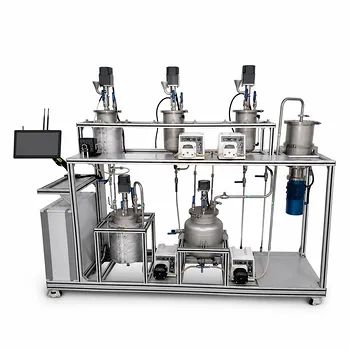
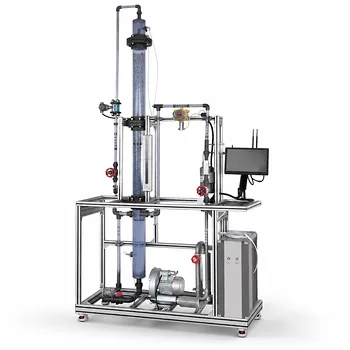
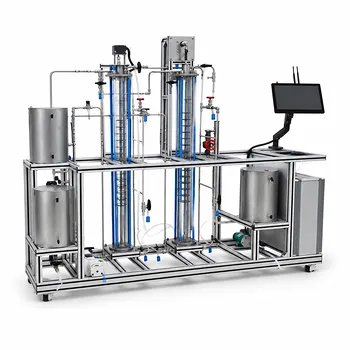
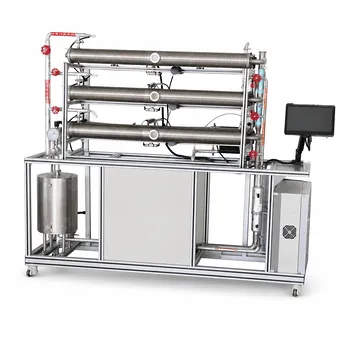
Bridging the gap between theoretical equations and industrial reality requires reliable, real-world data. LABPARK provides state-of-the-art Educational and Vocational Unit Operations Pilot Plants in chemical engineering, bioprocess & biotech, and environmental & water treatment.
Designed specifically for universities, research institutes, and enterprises, our pilot systems enable researchers and students to safely study complex hydrodynamics, optimize mass transfer coefficients, and prevent scaling failures.
Take the gamble out of scale-up. Contact LABPARK today to find the perfect pilot plant solution for your lab!
Related Products
- Fluidized Bed Gas Solid Catalytic Reaction Educational Pilot Plant
- Two-Dimensional Fluidization Hydrodynamics Educational Pilot Plant for Unit Operations Training
- Multi-Reactor Educational Pilot Plant for Reaction Engineering Unit Operations
- Multi-Functional Drying Educational Unit Operations Pilot Plant
- Multi Functional Catalytic Reaction and Reactor Evaluation Educational Unit Operations Pilot Plant
People Also Ask
- Why is the bed height-to-diameter ratio (L/dt) critical? Fluidized bed pilot plant selection guide.
- How is the minimum fluidization velocity (U_mf) determined and utilized? A Unit Operations Guide
- How does the Mears criterion evaluate transport resistance? Key Guide to Intrinsic Kinetics
- How do reactor pilot plants safely study gas-solid reactions? Master kinetics with thermal & flow control.
- How do pilot plants demonstrate fluidized-bed reactor advantages over fixed-bed? Find Out Now