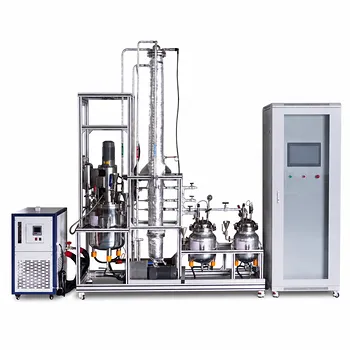
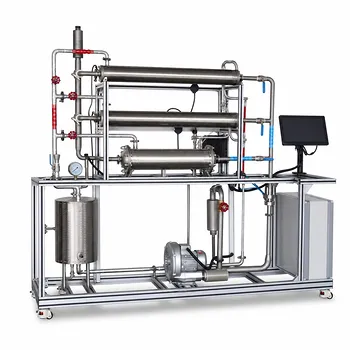
The cooling jacket is far more than a simple heat exchanger—it is the primary safeguard that dictates a non-isothermal CSTR’s stability, safety, and product quality.
In any pilot plant running exothermic reactions, the cooling jacket controls the reactor’s temperature balance. Studying its dynamics reveals exactly how heat is actually removed, how fast it can respond to surges, and why idealized assumptions fail in real hardware. Without this hands‑on understanding, operators cannot reliably prevent thermal runaway, tune control loops, or scale‑up processes from benchtop to production.
Cooling jacket dynamics govern the real‑time heat removal rate, thermal lag, and the reactor’s stability landscape. Because ideal mathematical models often assume a perfectly mixed, instantly responsive jacket, pilot‑plant study exposes the critical mismatch between theory and physical inertia—a gap that decides whether a process stays safe and profitable.
The Central Role of the Cooling Jacket in Non-Isothermal CSTRs
Primary Heat Removal Safeguard
In an exothermic CSTR, the heat generated by reaction must be continuously removed. The cooling jacket acts as the primary heat removal mechanism—without it, temperature rises unchecked.
If the jacket fails to extract heat quickly enough, the reactor can enter thermal runaway, destroying product quality, damaging equipment, or creating a process safety incident.
Studying the jacket’s dynamic behavior directly teaches how to maintain that critical balance between heat generation and heat removal.
Bridging Theory and Reality
Textbook models often treat the jacket as a single, perfectly mixed volume with instantaneous temperature equalization. In a real pilot plant, thermal inertia, dead zones, and temperature gradients introduce lags that no perfect‑mixing equation captures.
By measuring live temperatures at different jacket points and varying coolant flow, students and engineers close the gap between the theoretical heat transfer equation (Q = U·A·ΔT) and the physical system’s actual response.
This mismatch explains why purely model‑based control can fail and why industrial reactors require careful empirical tuning.
Key Dynamics That Demand Practical Study
Thermal Inertia and Response Lag
When the reactor temperature begins to rise, the cooling jacket does not respond instantly. Its walls, the coolant itself, and the overall thermal mass create a measurable delay.
This lag is especially dangerous during a disturbance—by the time the control system acts, the reactor may have already crossed an unsafe threshold.
Pilot plant exercises demonstrate how coolant flow rate changes influence that delay, providing invaluable insight for setting alarm limits and tuning emergency shutdown triggers.
Heat Transfer Coefficients and Flow Effects
The overall heat transfer coefficient U is not a fixed constant; it depends on Reynolds numbers, impeller‑driven turbulence, and baffle configuration.
In the pilot plant, varying the impeller speed or coolant flow rate directly alters boundary layer thickness and the heat removal capability.
Empirical correlations (Nu ∝ Re^a) come alive when students measure U at different conditions, learning why high turbulence improves heat transfer but also requires more pumping energy.
Multiple Steady States and Instability
Exothermic CSTRs can exhibit multiple steady states—some stable, some unstable—for the same jacket temperature.
The cooling jacket’s thermal capacitance (often raised by filling it with water) increases the Lewis number, which can dampen oscillations and shift the reactor from a dangerous oscillatory mode into a stable, high‑conversion operating point.
Directly observing these shifts in a safe pilot environment teaches how to map heat generation and removal curves and avoid crossing unstable bifurcation points.
Understanding the Trade-offs and Pitfalls
The Perfect‑Mixing Assumption and Its Limits
Many models treat the jacket as a single, homogeneous temperature zone. In practice, coolant enters cold at one side and exits warmer, creating axial gradients.
Relying on the perfect‑mixing assumption can underestimate peak local temperatures near the jacket wall, leading to hot spots, unwanted side reactions, or underestimation of fouling potential.
Pilot study forces the operator to confront these non‑idealities and develop a more conservative, safety‑conscious approach to jacket design and operation.
Compromises Between Stability and Responsiveness
Increasing the jacket’s thermal mass (e.g., adding more coolant volume) raises the Lewis number and stabilizes the reactor, suppressing oscillations.
However, a large thermal mass also slows the system’s response to deliberate temperature changes, making precise control during product transitions or start‑up more sluggish.
Operators learn to balance the desire for a wide safety margin against the need for reactive, fast‑acting control—a negotiation that defines every industrial reactor.
Flow Rate Trade‑offs
A high coolant flow rate improves heat transfer and reduces the risk of runaway, but it can waste energy, vibrate the jacket, or cause rapid temperature cycling that stresses glass‑lined vessels.
Too low a flow rate risks temperature hot spots and poor distribution.
The pilot plant allows systematic exploration of these trade‑offs under safe conditions, generating data that directly translates to minimizing operating cost without sacrificing safety.
Making the Right Choice for Your Training or Research Goals
The cooling jacket dynamics you choose to emphasize depend on your primary objective. Pilot plants offer a flexible platform to tailor the learning or research outcomes.
- If your primary focus is process safety: Concentrate on measuring lag times, mapping stable and unstable steady states, and practicing emergency cooling strategies to prevent thermal runaway.
- If your primary focus is control loop tuning: Study the real‑time step‑response of the jacket to coolant flow changes, quantify dead time and time constants, and develop empirical PID settings that work on imperfect hardware.
- If your primary focus is scale‑up: Investigate how jacket geometry, baffle placement, and impeller‑to‑tank ratios affect heat transfer coefficients, enabling you to replicate small‑scale thermal behavior in production reactors.
- If your primary focus is operator education: Use the pilot plant to confront the limits of the perfectly mixed jacket assumption, teaching the value of direct sensor data over blind trust in simplified models.
Mastering cooling jacket dynamics turns a pilot plant from a static teaching aid into a true process‑development tool, where every manipulated flow rate and observed temperature trace builds the intuition needed to run real industrial reactors safely and efficiently.
Summary Table:
| Dynamic Feature | Operational Impact | Practical Challenge |
|---|---|---|
| Thermal Inertia & Lag | Delayed heat removal response | Increases risk of thermal runaway |
| Variable Heat Transfer (U) | Influenced by flow rate and turbulence | Renders static theoretical models inaccurate |
| Multiple Steady States | Shifts system between stability & oscillation | Requires precise mapping to avoid bifurcation |
| Jacket Thermal Mass | High volume stabilizes reactor | Slows response during start-up or transition |
Optimize Your Chemical Engineering Lab with LABPARK
Bridge the gap between theoretical kinetics and real-world process control. LABPARK provides premium Educational and Vocational Unit Operations Pilot Plants in chemical engineering, bioprocess & biotech, and environmental & water treatment. Designed specifically for universities, research institutes, and enterprises, our pilot plants empower students and researchers to master crucial dynamics like CSTR heat transfer, control loop tuning, and scale-up safety.
Ready to elevate your training and research capabilities? Contact our experts today to find the ideal pilot plant configuration for your facility!
Related Products
- Multi-Stage Stirred Tanks in Series Residence Time Distribution and Mixing Performance Determination Educational Pilot Plant
- Residence Time Distribution and Reactor Flow Characteristics Determination Educational Pilot Plant
- Gas Phase Mixing and Residence Time Distribution Determination Educational Unit Operations Pilot Plant
- Multi-Reactor Educational Pilot Plant for Reaction Engineering Unit Operations
- Multi Functional Catalytic Reaction and Reactor Evaluation Educational Unit Operations Pilot Plant
People Also Ask
- How does MRF model impeller rotation in CFD? Key Boundary Conditions Explained
- How can a CSTR pilot plant demonstrate reactor staging? Visualize volume savings.
- How does steady-state multiplicity affect the operation and safety of exothermic reactions within a CSTR pilot plant? - Guide
- What parameters to monitor transitioning from Batch to CSTR? Master Pilot Plant Setup
- Why is temperature regulation via a cooling jacket a critical feature in CSTR pilot plants used for laboratory training?