Transition metal impurities are the silent killers of optical clarity. Even a handful of iron, cobalt, nickel, or copper atoms scattered through silica fiber can absorb the light that should travel for kilometers—turning a glass thread into an opaque barrier. To slash transmission loss from early fibers’ 500 dB/km down to the theoretical floor below 0.2 dB/km, these contaminants must be driven down to the parts-per-billion (ppb) level. Chemical engineering students can study the purification wizardry behind this feat using pilot‑scale equipment that combines high‑purity distillation and gas‑phase deposition reactors.
The leap from unusably high attenuation to near‑theoretical low‑loss fiber is a story of purity. Only by removing transition metals to concentrations of 10⁻⁹ can silica transmit light signals over transcontinental distances. Pilot‑scale distillation columns and CVD reactors let chemical engineering students explore the separation thermodynamics, reaction kinetics, and transport phenomena that make this ultra‑purification possible.
Why a Few Atoms Can Ruin a Kilometer of Glass
The Role of Transition Metal Ions
Transition metal ions in silica possess partially filled d‑orbitals that create energy levels matching the visible and near‑infrared wavelengths used in fiber optics. When a photon hits these ions, the energy is absorbed and converted to heat rather than continuing down the fiber. Iron, for example, can cause losses of tens of decibels per kilometer even at part‑per‑million concentrations.
From Parts‑per‑Million to Parts‑per‑Billion: A Purification Mandate
Early optical fibers contained metal impurities at parts‑per‑million levels, yielding attenuation around 500 dB/km—so high that light barely travelled a few meters. Achieving today’s sub‑0.2 dB/km long‑haul fibers demands reducing transition metals to the ppb range. This requires purifying the chemical precursors to extreme levels before they ever touch the deposition zone.
How Precursor Purification Solves the Problem
Distillation: Separating Impurities by Boiling Point
The liquid precursors for optical fiber—typically silicon tetrachloride (SiCl₄) and germanium tetrachloride (GeCl₄)—are purified by multiple‑stage distillation. Most transition‑metal chlorides have boiling points significantly higher than SiCl₄’s 57.6 °C, so a well‑designed distillation column can strip them out. Vacuum distillation often enhances this separation by lowering operating temperatures and preventing thermal degradation of the precursor.
CVD: Turning Ultra‑Pure Vapors into Pristine Glass
In chemical vapor deposition, the purified precursor vapor is mixed with oxygen and fed into a deposition reactor (e.g., a heated silica tube for MCVD). The gas‑phase reaction forms fine silica soot that sinters into high‑purity glass layer by layer. Because the precursor itself is free of transition metals, the deposited core and cladding inherit that exceptional purity.
Studying the Process with Pilot‑Scale Equipment
The Pilot‑Plant Toolkit: Distillation Columns and CVD Reactors
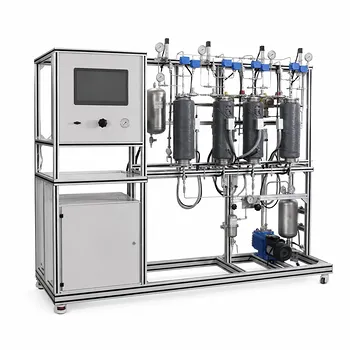
Chemical engineering pilot plants can replicate this purification‑deposition chain at a teachable scale. A typical setup includes:
- A high‑purity distillation module with a corrosion‑resistant column (e.g., borosilicate glass or PTFE‑lined steel), integrated vacuum control, and a reflux splitter.
- A gas‑phase deposition reactor equipped with mass‑flow controllers, a high‑temperature furnace, and a sealed sample collection system.
Students can purify a silicon tetrachloride surrogate (or actual SiCl₄ under strict safety protocols) and then use the condensate in a deposition run, correlating impurity levels with fiber transmission measurements.
Hands‑On Learning Objectives: Kinetics, Transport, and Separation Science
Operating such a pilot plant lets students investigate:
- Vapor‑liquid equilibrium by measuring stage efficiencies under different reflux ratios and pressures.
- Mass transfer limitations in packed versus tray columns.
- Gas‑solid reaction kinetics during the CVD silica formation step, linking deposition rate to temperature, flow rate, and precursor concentration.
- Purification factor analysis, where trace metal concentrations are measured (or simulated via a tracer) to validate theoretical stage models.
A Real‑World Analogy: Lessons from Mercury Vacuum Distillation
Vacuum distillation of mercury—demonstrated in many educational pilot plants—offers a safe, analogous system. Mercury’s purification relies on boiling‑point differences under reduced pressure, just like SiCl₄. Students first practice on mercury units with sealed condensation systems and corrosion‑resistant distillation columns, learning to manage toxic material containment, pressure control, and energy input. These same principles transfer directly to the more hazardous metal‑chloride precursors used in optical fiber, preparing students for industrial‑scale purification challenges.
Understanding the Trade‑offs and Practical Challenges
The Energy Cost of Ultra‑High Purity
Achieving ppb purity isn’t free. Multi‑stage distillation consumes significant energy, and operating under vacuum demands robust sealing and pumping systems. At pilot scale, students can measure the energy input per mole of purified product and see the exponential increase in energy as the target impurity level tightens.
Process Control and Safety in CVD Pilot Plants
Deposition reactors handle flammable, corrosive, and sometimes toxic precursors. Students must learn to integrate gas detection, scrubber systems, and inert gloveboxes into their process design. Even trace levels of moisture can generate HCl vapour, corroding equipment and ruining purity. These real‑world constraints turn a pilot plant into a rigorous lesson in process safety and material compatibility.
How to Apply This to Your Project
Pilot‑scale capability should be matched to the specific educational or research goal.
- If your primary focus is separation thermodynamics and column design: Start with the high‑purity distillation module and a benign surrogate mixture. Measure HETP (height equivalent to a theoretical plate) and map the McCabe‑Thiele operating lines.
- If your primary focus is thin‑film materials science and gas‑phase kinetics: Emphasize the CVD reactor, studying deposition uniformity and incorporation of dopants (germanium, fluorine) for refractive‑index control.
- If your primary focus is process integration and safety: Combine both units in a sealed‑loop pilot plant, adding analytical sampling at each stage. Challenge teams to achieve a target final impurity level while minimizing downtime and risk.
Pilot‑scale distillation and deposition are the proving grounds where chemical engineering fundamentals meet the extreme purity demands of modern optical fiber.
Summary Table:
| Process Step | Purification Mechanism | Key Equipment | Student Learning Objectives |
|---|---|---|---|
| Precursor Purification | Multi-stage distillation separating impurities by boiling point under vacuum | Corrosion-resistant distillation column, reflux splitter | Vapor-liquid equilibrium (VLE), column mass transfer, thermal efficiency |
| Glass Deposition | Chemical Vapor Deposition (CVD) forming ultra-pure silica soot | High-temperature reactor, mass-flow controllers (MFCs) | Gas-solid reaction kinetics, transport phenomena, deposition control |
Bring Industrial-Scale Purification to Your Lab with LABPARK
Hands-on experience with advanced separation and deposition processes is essential for preparing the next generation of chemical engineers. LABPARK provides Educational and Vocational Unit Operations Pilot Plants in chemical engineering, bioprocess & biotech, and environmental & water treatment for universities, research institutes, and enterprises.
Our custom-engineered pilot systems allow students to safely master complex thermodynamic, kinetic, and transport phenomena—bridging the gap between classroom theory and real-world industrial applications like optical fiber purification.
Ready to upgrade your engineering curriculum? Contact our experts today to find the perfect pilot plant solution for your institution.
Related Products
- Continuous Sieve-Plate Distillation Pilot Plant for Unit Operations Laboratory Education
- Electrolyte Distillation Purification and Formulation Educational Pilot Plant
- Continuous Batch Extractive Distillation Educational Pilot Plant
- Multi-Functional Special Distillation Educational Pilot Plant
- Multi-Modal Distillation Unit Operations Training Pilot Plant
People Also Ask
- How do distillation pilot plants validate VLE data? Achieve reliable solvent separation scale-up.
- How does catalyst water concentration affect distillation pilot plant design? Key separation train choices.
- How does thermodynamic model selection affect pressure-sensitive azeotropic distillation pilot plants? Design with validated VLE
- What are the primary reflux ratio control strategies? Master Distillation Unit Operations
- Why is experimental validation on a distillation unit operations pilot plant essential? Reduce azeotropic scale-up risk