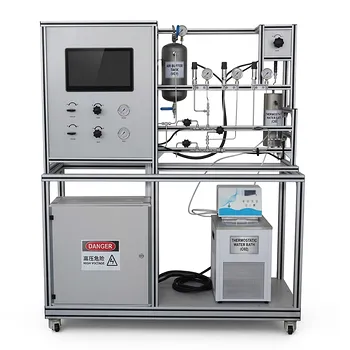
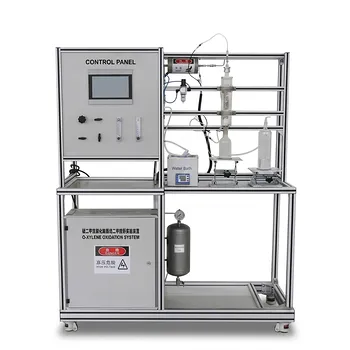
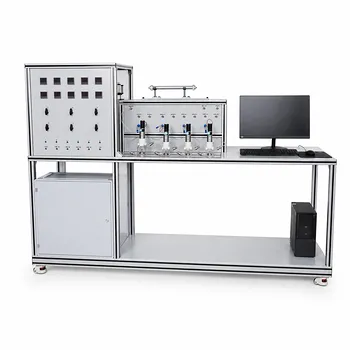
The placement of quench streams in a nonisothermal, adiabatic fixed‑bed reactor pilot plant is the single most critical design decision that dictates temperature control, catalyst longevity, and the quality of your research data. By injecting cold feed or an inert fluid at precise axial locations, you directly reshape the reactor’s temperature profile, preventing runaway exotherms and enabling accurate kinetic measurements.
In highly exothermic, adiabatic systems, a fixed‑bed reactor’s temperature can spike uncontrollably. Strategic quench placement flattens these temperature discontinuities and halts reactions at defined points—simultaneously safeguarding the catalyst, preserving metallurgical integrity, and ensuring the data you collect truly represents the chemistry you set out to study.
How Quench Placement Governs Reactor Operation
Quench positions are not arbitrary. They are the lever you use to manage the unavoidable temperature rise in an adiabatic fixed bed while retaining the simplicity of a plug‑flow configuration.
Preventing Runaway and Hot‑Spot Formation
In an adiabatic bed, every mole converted releases heat with nowhere to go except into the process stream. Without interstage cooling, the temperature can climb hundreds of degrees, triggering side reactions or runaway.
A mid‑bed quench stream breaks this chain. It instantly dilutes the hot process fluid with cold material, lowering the local bulk temperature and slowing the reaction rate.
Flattening the Temperature Profile
Properly placed quench points turn a dangerous, exponential temperature ramp into a series of manageable, step‑shaped profiles. Each injection resets the adiabatic temperature rise, allowing you to operate multiple beds in series without exceeding safe limits.
This profile engineering is what makes pilot‑scale demonstrations so powerful. Students and researchers see directly how a simple injection port translates into a stable, controllable process.
Maintaining Catalyst Activity Over Long Cycles
Catalyst deactivation accelerates sharply with temperature. Even if the bulk stream stays below the metallurgical limit, a localized hot spot can permanently sinter or foul the catalyst in that zone.
By preventing these hot spots, well‑positioned quench streams keep the entire catalyst inventory active longer. In a pilot plant, this means more consistent data from run to run and a longer useful campaign between reloads.
Preserving Mechanical Integrity of the Reactor
Every metal alloy has a maximum design temperature. Even if the catalyst could survive a hotter spot, the reactor tube might not. Quench placement ensures that no point in the bed—regardless of local reaction rate—exceeds the vessel’s safe operating limit.
This is not just a safety discussion; it’s a practical lesson in industrial reactor design. The pilot plant becomes a living illustration of how quench systems are the first line of defense against catastrophic material failure.
The Second Role: Locking the Reaction for Accurate Data
Beyond process safety, quench placement at the very end of the catalytic zone is essential for measurement integrity—a point reinforced by advanced microreactor and flow chemistry practice.
Defining Residence Time with Zero Uncertainty
If you simply let the hot effluent travel through unquenched outlet tubing, the reaction continues—at an unknown temperature and for an unknown volume. This adds significant uncertainty to any kinetic parameter you try to extract.
A quench right at the catalyst bed outlet instantly stops the chemistry. The fluid that reaches your analytical instruments is effectively “frozen” at the condition you designed, not altered by uncharacterized post‑reactor volume.
Avoiding Product Degradation and Side Reactions
Many exothermic syntheses produce thermally fragile molecules. If the reaction stream isn’t cooled immediately, the final product can decompose or react further, forming impurities that never appeared in your ideal kinetic model.
In a pilot‑scale fixed‑bed, this means the difference between measuring a clean yield and measuring a mixture of primary, secondary, and degradation products. The quench stream, often combined with a static mixer or a compact heat exchanger, ensures that you see the true selectivity of your catalyst at the chosen residence time.
Understanding the Trade‑offs and Common Pitfalls
Quench placement is not a silver bullet. Executed poorly, it can undermine the very performance you aim to achieve.
Too early: Injecting cold fluid before significant conversion has occurred wastes catalyst length and reduces overall per‑pass conversion. The reactor becomes needlessly large for the throughput required.
Too late: If you delay the quench until after the hot spot has already formed, you’ve already damaged catalyst and lost temperature control. The quench becomes a last‑ditch safety measure rather than a performance enhancer.
Incomplete mixing: A quench stream that doesn’t rapidly homogenize with the main flow creates radial temperature gradients. The core can remain dangerously hot while the wall is cold, violating the adiabatic assumption and corrupting your data.
Pressure drop penalties: Adding quench zones and mixing devices increases the overall system pressure drop. In a pilot plant where you’re trying to study intrinsic kinetics at low pressure drop, this added complexity can mask the true behavior of the catalyst pellet.
Making the Right Choice for Your Pilot Plant Goal
The ideal quench configuration depends entirely on the question you’re asking.
- If your primary focus is process safety education: Place quench points explicitly to demonstrate how a dangerously accelerating temperature profile is arrested. Make the temperature discontinuities visible and explicit so students can grasp the cause‑and‑effect relationship.
- If your primary focus is generating accurate kinetic data: Position a quench mixer immediately after the catalyst bed to lock the reaction state. Validate that the quench reduces the temperature and halts conversion within a negligible volume.
- If your primary focus is demonstrating industrial catalyst longevity: Design a multi‑bed setup with interstage quench injection that keeps every bed within a narrow, predefined temperature window. Measure deactivation rates over time to illustrate the economic value of even a few degrees of temperature control.
Applied correctly, quench placement transforms a simple tube full of pellets into a precise, safe, and phenomenally instructive platform that reveals the beating heart of industrial reaction engineering.
Summary Table:
| Quench Scenario | Impact on Reactor | Effect on Data & Safety |
|---|---|---|
| Too Early | Reduced conversion per pass | Wastes catalyst active volume |
| Too Late | Hot-spots and runaway exotherms | Catalyst sintering and safety risks |
| Incomplete Mixing | Radial temperature gradients | Corrupts kinetic models and data validity |
| Optimal Placement | Step-shaped temperature profile | Protects reactor integrity and locks reaction kinetics |
Optimize Your Reaction Engineering Education & Research with LABPARK
Designing reliable chemical reactors requires precise control. LABPARK provides premium Educational and Vocational Unit Operations Pilot Plants in chemical engineering, bioprocess & biotech, and environmental & water treatment for universities, research institutes, and enterprises.
Our advanced pilot plants feature robust process controls and engineered quench systems designed to ensure maximum safety, prevent catalyst deactivation, and deliver high-fidelity kinetic data.
Ready to elevate your training and research capabilities? Contact LABPARK today to discover our custom reactor solutions!
Related Products
- Multi Functional Catalytic Reaction and Reactor Evaluation Educational Unit Operations Pilot Plant
- Fixed Bed Gas Solid Catalytic Reaction Educational Pilot Plant
- Throttling Effect Determination Educational Unit Operations Pilot Plant
- Multi-Reactor Educational Pilot Plant for Reaction Engineering Unit Operations
- Fixed-Bed Chemical Reaction and Gas Dust Tar Removal Unit Operations Pilot Plant
People Also Ask
- What reaction engineering principles are shown in a catalytic reactor pilot plant? SO2 Oxidation Guide
- Why is FTIR integration in catalytic pilot plants important? Real-Time Student Insights
- How to analyze active metal distribution & identify catalyst poisoning in pilot plants? Expert Diagnostic Guide
- How do temperature limits and WHSV influence catalytic reactor optimization? Scale-Up Guide
- Why is XPS Critical for Catalytic Reactor Pilot Plants? Optimize Catalyst Performance