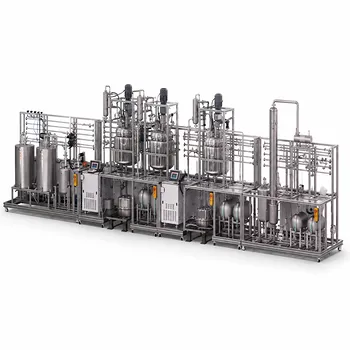
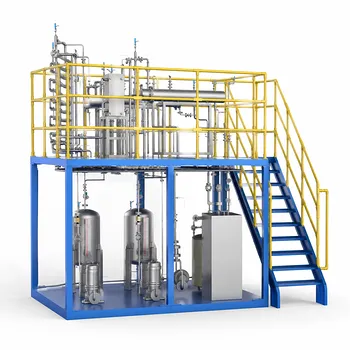
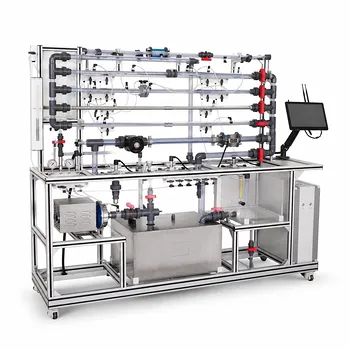
The real reason advanced sensors are critical isn't about having fancy equipment—it's about bridging the unspoken gap between textbook theory and industrial reality. Integrating industrial-grade instrumentation and Process Analytical Technology (PAT) into educational pilot plants transforms them from simple demonstration rigs into powerful platforms for data-driven learning. This shift allows students to move beyond static observations and engage in dynamic process control, real-time troubleshooting, and multivariate data analysis, directly mirroring the workflows of modern automated industries.
The core challenge of engineering education is teaching students to manage dynamic, unpredictable systems, not just static textbook problems. Advanced instrumentation solves this by turning a pilot plant into a data-rich, responsive environment where students can practice real-time decision-making and control—the exact skills that define industrial competence but are impossible to teach with simple, manually-operated equipment.
The Fundamental Problem: The Theory-Practice Data Gap
Traditional university labs often rely on manual sampling and offline analysis, creating a significant lag between an action and its measured result. This teaches students about unit operations in a steady state, but fails to expose them to the dynamic, time-sensitive nature of real industrial processes.
Moving Beyond the Manual "Snapshot" Mindset
In a manual setup, a student might take a sample every 15 minutes, run it on a Gas Chromatograph (GC), and adjust a valve 30 minutes later. This "snapshot" approach completely misses the transient behaviors that dominate real plant operations.
It breeds a reactive, rather than proactive, control mentality. Students learn to fix problems after they happen, rather than to anticipate and prevent process deviations in real-time.
The Critical Skill of Dynamic Disturbance Management
The primary reference highlights that monitoring properties like viscosity, pressure, and flow rate is essential for safety and control. The key word is "dynamic." Industrial processes are constantly perturbed by feedstock variations, ambient temperature changes, and equipment fouling.
Integrating in-line sensors and a Supervisory Control and Data Acquisition (SCADA) system allows instructors to deliberately introduce these disturbances. Students can then observe, on a second-by-second basis, how these variables interact, learning to distinguish between normal operational noise and a genuine process threat.
The Core Framework: From Reactive Operation to Proactive Control
The true power of advanced instrumentation is unlocked when it's integrated into a closed-loop control system. This is the paradigm shift from being a plant operator to a process engineer. The supplementary references on continuous flow chemistry and PAT reinforce this powerfully.
Closing the Loop with Real-Time PAT
Consider a continuous flow reaction where redox potential is the critical process parameter. An offline High-Performance Liquid Chromatography (HPLC) analysis introduces a measurement delay that makes precise, immediate control impossible.
Integrating an in-line redox sensor transforms the operation. This aligns with the supplementary reference detailing how automated feedback can regulate reactant pump speeds based on that real-time signal. This direct, instantaneous link between measurement and action is the essence of modern process control and is fundamental for teaching students how to prevent runaway reactions and minimize waste.
De-risking Failure and Training for Troubleshooting
A pilot plant with comprehensive sensors is a safe sandbox for failure. As the primary reference states, this experience is vital for troubleshooting process deviations. A student can mis-tune a controller, close a valve too quickly, or simulate a sensor fault without catastrophic real-world consequences.
They see the immediate cause-and-effect chain: a pressure spike in kPa, the resulting flow rate drop in m³/h, and the automatic safety interlock trigger. This visceral, data-backed experience is the most powerful teacher for building an engineering intuition that prevents disasters in future industrial roles.
Building the Complete Bioprocess Picture
The need for integration is amplified in bioprocessing due to the inherent complexity of the feedstock and process streams, a point strongly emphasized in the supplementary references. A single sensor on a single unit is dangerously insufficient.
Managing Non-Homogeneous and Parallel Streams
Biomass feedstocks are non-homogeneous. A single process line cannot fully utilize the material. An integrated pilot plant must run hydrolysis, fermentation, and anaerobic digestion in parallel.
This inherently generates diverse, unpredictable waste streams. An advanced sensor network across the entire facility—not just on the main reactor—is therefore critical for the non-specific environmental and water treatment units to function effectively. Students learn to manage the facility as a holistic, interconnected system rather than a collection of independent operations.
The Multivariate Reality of Bioprocesses
The supplementary reference on MVDA (Multivariate Data Analysis) tools is key here. Bioprocess parameters are highly intertwined; a change in dissolved oxygen isn't just about oxygen—it could signal a shift in metabolic activity, which will later affect pH and byproduct formation.
Integrating PAT sensors and teaching MVDA allows students to study these multivariate process interactions. They learn that real-time release (RTR) and true quality control are based on patterns of data, not just single-point specifications, a concept that aligns with green chemistry principles by drastically reducing physical sampling and batch waste.
Connecting to Industrial Workflows and Career Skills
This training is not an abstract academic exercise. It directly mirrors the most critical, high-value industrial workflows, preparing students to contribute on day one.
Bridging the Revamping and Retrofitting Education Gap
The supplementary reference notes a critical deficiency: plant revamping is rarely taught effectively because live industrial data is inaccessible. A well-instrumented pilot plant closes this gap completely.
Students don't just read about identifying bottlenecks; they use the plant's sensor array to find them. They can establish real mass and energy balances, build a simulation model, and then physically test a proposed revamp—like adding a parallel heat exchanger or evaluating a new pump against a measured pressure drop. This data-driven workflow is exactly how industrial retrofitting is done.
Demystifying Instrument Drift and Maintenance
Industrial sensors are not magic boxes; they are physical devices that drift and require calibration. The supplementary reference on dual-beam UV-Vis spectroscopy provides a perfect example of a teachable, industrially relevant lesson.
By configuring a system with a reference fiber loop to compensate for lamp intensity fluctuations, a student doesn't just learn what an absorbance measurement is. They learn how to engineer a robust, low-maintenance analytical method, directly understanding the source of instrument drift and how to mitigate it. This is the difference between a button-pusher and a skilled process analyst. This also connects to the primary reference's goal of teaching accurate parameter conversion and the supplementary point on operating manuals, as students must understand the instrument's first principles to write a reliable Standard Operating Procedure (SOP) for its calibration and verification.
Understanding the Trade-offs and Implementation Pitfalls
A purely celebratory view of technology is incomplete and untrustworthy. Integrating advanced sensors introduces genuine challenges that must be considered in an educational context.
- The "Black Box" Danger: A sensor that outputs a perfect digital number every second can prevent students from understanding the underlying physics. If the in-line viscometer is never cross-validated against a manual method, the student loses the tactile and conceptual understanding of what viscosity truly means. The instrument must be a teacher, not a curtain.
- Data Deluge Over Pedagogy: An advanced SCADA system can generate thousands of data points per second. Without a carefully designed curriculum, students can become overwhelmed by noise, missing the critical signal. The focus must shift from just collecting data to strategically analyzing it to answer a specific hypothesis.
- Maintenance is a Crucial, Not a Bug: These sensors and systems break, foul, and fail—especially with the complex streams described in the supplementary references. This is a brilliant teaching opportunity but a logistical challenge. Faculty and lab managers must budget significant time and resources for system upkeep and treat these failure events as unplanned but essential troubleshooting classes.
Making the Right Choice for Your Educational Goals
The instrumentation strategy should be a direct function of your specific pedagogical objectives.
- If your primary focus is training operations technicians for batch processing: Prioritize robust, single-loop controllers and sensors for fundamental parameters (T, P, Flow, pH) with a heavy emphasis on procedural SOPs and safety interlocks.
- If your primary focus is developing process engineers for continuous manufacturing: Focus heavily on integrating multiple PAT tools (like Raman spectroscopy or in-line UV-Vis with reference loops), closed-loop control strategies, and curriculum around chemometrics and multivariate data analysis (MVDA) to understand dynamic interactions.
- If your primary focus is teaching plant design and retrofitting: The most critical element is a flexible, open-architecture data historian and SCADA system that allows students to easily extract high-resolution time-series data for mass and energy balancing and to test the impact of simulated (or real) equipment modifications on the entire system's behavior.
An advanced pilot plant is ultimately a flying simulator for the process industry, where the only true failure is the failure to learn.
Summary Table:
| Key Challenge | Sensor-Driven Solution | Student Career Benefit |
|---|---|---|
| Manual "Snapshot" Mindset | In-line PAT & Real-Time Sensors | Shift from reactive operation to proactive process control |
| Complex & Parallel Streams | Integrated Sensor Networks | Holistic system management & waste stream optimization |
| Abstract Design Concepts | SCADA & Historical Data Analysis | Real-world troubleshooting & plant retrofitting skills |
Equip Your Lab for Modern Industry with LABPARK
Bridge the gap between academic theory and industrial practice. LABPARK provides advanced Educational and Vocational Unit Operations Pilot Plants in chemical engineering, bioprocess & biotech, and environmental & water treatment for universities, research institutes, and enterprises.
By integrating industrial-grade sensors, SCADA, and Process Analytical Technology (PAT), we help you train the next generation of industry-ready engineers with hands-on, data-driven learning.
Contact LABPARK today to customize a pilot plant solution for your institution!
Related Products
- Natural Product Extraction Unit Operations Training Pilot Plant
- Fixed-Bed Chemical Reaction and Gas Dust Tar Removal Unit Operations Pilot Plant
- Ethyl Acetate Synthesis Unit Operations Pilot Plant for Practical Training
- Methanol Synthesis and Catalyst Performance Evaluation Educational Unit Operations Pilot Plant
- Electrolytic Hydrogen Production Educational Unit Operations Pilot Plant
People Also Ask
- How to Demo Solubility Sensitivity in SFE Pilot Plants? Practical Thermodynamics
- How do pilot plants differentiate physical vs chemical extraction? Enhance Chemical Engineering Training
- How are HTU and NTU applied to determine extraction column height? Guide to Pilot Plant Scaling
- How can Hotelling's T² & Q statistics detect pilot plant abnormalities? Optimize Safety
- Why use split-plot designs in pilot plants instead of CRD? Optimize process parameters effectively.