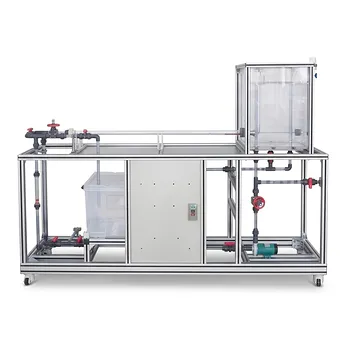
The silent guardian of your pilot plant’s fluid system is a simple swing check valve. Yet its entire protective function hinges on a single, often overlooked detail: the angle at which it’s bolted into the pipe. In chemical engineering training systems, where seeing principles in action is the entire point, incorrect orientation doesn’t just invite equipment damage—it teaches a dangerously flawed lesson about how process safety devices work.
Preventing backflow with a swing check valve is entirely dependent on gravity to slam the disc shut. If the valve is installed in a plane where gravity can’t pull the disc into its seat, the valve will fail silently and completely. For a training environment, this transforms a core unit operation lesson into an unrecognized safety hazard.
How a Swing Check Valve Actually Works
To grasp why orientation is non-negotiable, you first have to strip the valve down to its essential physics. It’s a device with no actuator, no spring, and no external control signal.
The Gravity-Dependent Closing Mechanism
Inside the valve body, a hinged disc swings freely on a pivot. Forward flow pushes the disc open, allowing process fluid to pass. When flow stops or tries to reverse, the disc must fall back against the seat to block the reverse path. That falling motion is powered by nothing more than gravity and the disc’s own weight. There is no motor or magnetic assist. If gravity is not pulling the disc in the right direction, the valve cannot do its job.
Why Orientation Determines Valve Function
The hinge pin must be horizontal and the disc must swing in a vertical plane. This is why the valve is installed with its cover facing up in a horizontal pipe run, or in a vertical pipe with upward flow. In the horizontal orientation, gravity pulls the disc straight down onto the seat. In the vertical upward-flow orientation, when flow ceases, gravity pulls the disc back down against the direction of potential reverse flow. In both cases, the force vector aligns with the sealing surface. Any other orientation—like a vertical pipe with downward flow or a sloped line where the disc can hang open—defeats gravity and leaves the valve permanently cracked open.
The Specific Risks of Improper Orientation
An improperly oriented swing check valve in a training skid is not just a theoretical failure. It creates a cascade of physical and educational consequences.
Incomplete Disc Seating and Leakage
If the valve is mounted in a non-vertical swing plane, the disc may not contact the seat uniformly. Even a small gap allows a continuous leak of process fluid backward through the system. In a pilot plant, this can silently contaminate upstream feeds, skew mass balance calculations, and ruin experimental results that students rely on to validate their calculations.
Water Hammer and Surge Damage
When the disc fails to close immediately upon flow reversal, the reverse flow gains momentum. Once the disc finally slams shut—often violently—it can generate a pressure surge, or water hammer. In a compact training system with glass or plastic components, this surge can crack rotameters, burst sight glasses, or dislodge tubing connections. The damage is instant and physical.
Compromising the Training Environment
The deeper failure is pedagogical. A training system is a living textbook. If a swing check valve is installed incorrectly and appears to work (because students don’t notice the subtle backflow), they internalize a wrong installation as correct. They leave the lab believing that orientation doesn’t matter, a misconception that can have costly consequences when they specify valves in a full-scale plant.
Understanding the Trade-offs
While orientation correctness is a hard requirement, it’s worth understanding what you sacrifice by choosing a swing check valve in the first place. This awareness helps in selecting the right teaching tool.
Not Suitable for All Flow Conditions
Swing check valves are not designed for pulsating flows or very low-velocity service. In such conditions, the disc can flutter open and closed, causing wear and inconsistent backflow prevention. The same gravity dependence that makes orientation critical also makes the valve inappropriate for lines where flow never fully stops.
Orientation Flexibility vs. Reliability
Spring-loaded check valves or ball check valves can be installed in any orientation, but they introduce a pressure drop and have their own failure modes. Swing check valves offer very low flow resistance when open, but their reliability is entirely traded off against the strict horizontal or vertical-up installation requirement. In a training system, teaching this trade-off is exactly the point: you show students that simple, passive safety devices demand careful mechanical sympathy.
Making the Right Choice for Your Training Goal
Apply these recommendations based on what you need the training system to demonstrate.
- If your primary focus is teaching fundamental check valve principles: Insist on a clear, visible swing check valve in a horizontal line with the bonnet up. Make its gravity-dependent action obvious and measurable with clear sight glasses or pressure taps.
- If your primary focus is maximizing system safety with first-time operators: Choose a spring-loaded check valve that is orientation-independent. Then use a dedicated cutaway swing check valve model, off-line, to teach the orientation concept without risk to the live system.
- If your primary focus is troubleshooting and fault diagnosis: Deliberately install a swing check valve in a correct and an incorrect orientation on parallel test loops. Let students measure the backflow leakage and observe the pressure surge, turning a common mistake into a memorable, data-driven lesson.
Install the valve the way gravity intends, and your training system will protect both its hardware and the quality of the education it delivers.
Summary Table:
| Valve Orientation | Suitability | Impact on System & Pedagogy |
|---|---|---|
| Horizontal (Cover Up) | Correct | Gravity pulls disc onto seat; ensures zero-backflow sealing. |
| Vertical (Upward Flow) | Correct | Disc falls back against reverse flow; prevents system contamination. |
| Vertical (Downward Flow) / Sloped | Incorrect | Disc hangs open; leads to leakage, water hammer, and flawed student lessons. |
Build Safer & More Effective Engineering Labs with LABPARK
Ensure your students master real-world chemical processes with industry-aligned training systems. LABPARK provides state-of-the-art Educational and Vocational Unit Operations Pilot Plants in chemical engineering, bioprocess & biotech, and environmental & water treatment.
Tailored for universities, research institutes, and enterprises, our systems teach critical hands-on lessons in safety, fluid mechanics, and process design. Ready to elevate your training facilities? Contact us today to explore our tailored pilot plant solutions!
Related Products
- Orifice and Venturi Flowmeter Calibration Educational Pilot Plant for Fluid Mechanics Laboratory
- Centrifugal Pump Performance and Orifice Flowmeter Calibration Educational Pilot Plant
- Cavitation Phenomenon Demonstration and Analysis Educational Unit Operations Pilot Plant
- Bernoulli Equation Demonstration Unit Operations Pilot Plant
- Fluid Friction Resistance Determination Educational Unit Operations Pilot Plant
People Also Ask
- What is the difference between static and stagnation pressure? Master Pilot Plant Flow Measurement
- How is the hydrodynamic entrance length estimated for high-Re channel flows? Design accurate pilot-plant measurements
- How does high-frequency pressure oscillation affect velocity distribution and boundary layer behavior? Discover Stokes-layer effects
- How do velocity profiles and flow rates differ in Newtonian and power-law fluids? A Pilot Plant Guide
- What primary boundary conditions are applied at fluid-solid surfaces when conducting flow experiments on fluid mechanics educational pilot plants?