The role of an outlier fundamentally shifts depending on your objective. In the research phase, an outlier is primarily a statistical nuisance that distorts models and obscures trends; in pilot plant validation, that same anomalous point becomes a critical piece of process intelligence that could warn of a catastrophic failure. Treating both phases with an identical, purist data-cleaning mindset is a common and costly mistake.
The entire purpose of identifying data outliers is inverted when you move from research to validation. Early on, you discard them to see the mathematical "forest for the trees." Later, you must investigate them, because a single outlier can be an early warning of unstable scale-up dynamics, modeling inaccuracies, or equipment failure that a simple average will never show you.
The Research Phase: Why You Must Hunt Statistical Ghosts
In the initial research and development stage, your goal is to build a clean, predictive, and fundamental model of the chemical process. A single anomalous data point acts like a rock in a stream, diverting the entire analytical flow.
The Destructive Power of a Single Point on Multivariate Models
Statistical models like Principal Component Analysis (PCA) and Partial Least Squares (PLS) are not robust to extreme values. Because these methods minimize squared errors, they will warp the entire model space to accommodate one bad point.
This distortion pulls principal components away from the true process trends. Consequently, you build a baseline model that doesn't represent reality, but a mathematical artifact. The foundation for all your future scale-up work becomes fundamentally flawed.
Obscuring Fundamental Kinetics and Thermodynamics
Regression curves for critical parameters—like mass transfer coefficients or Arrhenius rate constants—are highly sensitive to outlier-driven leverage.
An errant point at the extreme end of your experimental space will artificially tilt a regression line. This can mask a true reaction order or suggest a false transition point. Your deep need here is to see the clean signal through the noise, and outlier removal is the only way to achieve that initial clarity.
The Pilot Plant Transition: Treating Outliers as Process Signals
Once you move from establishing theory to proving it in a pilot plant, the context is completely inverted. Your deep need shifts from building a clean model to de-risking a scale-up process that involves real equipment, impurities, and hazards.
Why an Outlier is Now a Potential "Whistleblower"
In a pilot plant, an anomalous data point is rarely just random error. It is often a signal of a physical reality your lab-scale models didn't account for.
It could indicate a fouling event in a sample cell window, a sudden change in catalyst selectivity due to a feed impurity spike, or the onset of a two-phase flow regime your model cannot predict. If you blindly apply the same statistical outlier tests and discard the point, you are literally throwing away the most valuable safety and diagnostic information your experiment can provide.
The Danger of Invalid Model Predictions
Applying a chemometric model built on clean lab data to a new, unstable process state in the pilot plant yields an invalid prediction. This is not just a bad number; it’s a dangerous one.
If the model gives a false flow rate or composition without warning the operator, incorrect control actions can follow. This can lead to costly experimental failures, damaged catalysts, or even safety incidents. Your precautionary framework must diagnose this in real-time.
Statistical Tools: A Mandatory, Objective Framework
Sentiment and instinct are not valid reasons to keep or discard data. You must implement a rigorous statistical protocol that changes its objective between phases.
Univariate Analysis: The Grubbs' Test
For a single suspect value in a dataset, the Grubbs' test provides an objective, statistically valid decision method.
Calculate the mean (x̄) and standard deviation (s) of your dataset. Then calculate the test statistic T for the suspect minimum value (T = (x̄ - x₁) / s) or maximum value (T = (xₙ - x̄) / s). Compare this calculated T against the critical T value from a Grubbs' table at a 95% confidence level (α = 0.05). Only if the calculated T is greater than the critical value do you have statistical permission to discard it; otherwise, it must be retained.
Multivariate Diagnostics for Process Monitoring
When using a PLS or PCA model for online pilot plant monitoring, you need real-time, multivariate sentinels.
- Hotelling's $T^2$ statistic: This detects if a new process sample is operating within the model space but far from the center of your calibration data, indicating an extreme but valid process condition.
- Q residuals: This is even more critical. A high Q residual flags that a significant portion of the sample's spectral or data response falls completely outside the model space. This means the model is now blind and its prediction is invalid. A reduced value of Q greater than 1 is a red alert for an abnormal analyzer response.
Validating the Sampling Protocol Itself
Before you even analyze an outlier, you must ensure the data stream itself is not corrupted. Process variography, based on the Theory of Sampling (TOS), is your quality control tool here.
It estimates the Total Sampling Error (TSE) by analyzing variogram nugget effects and sill levels. If the TSE is above acceptable limits, you don't have an outlier problem; you have a sampling bias problem. Efforts must be redirected to redesigning the sampling system rather than analyzing unreliable data.
Understanding the Trade-offs and Pitfalls
An over-reliance on statistical purity without physical insight is the biggest pitfall in this transition.
The Danger of a Pure-Statistics Mindset
The Grubbs' test and Q residuals are diagnostic tools, not decision-makers. Discarding a data point because it fails a test, without a physical root cause investigation, is scientific negligence.
A failing pump, a leaking valve, or catalyst deactivation will all produce statistically "outlying" data. The correct action is not to discard the data and proceed, but to halt the run, diagnose the equipment, and understand the physical mechanism.
Knowing What Needs a Pilot Plant
The precautionary principle also applies to deciding what to pilot. Some processes are predictable and don't need the full outlier-hunting framework.
According to established chemical engineering rules of thumb, single-phase fluid flow and standard distillation columns rarely require pilot plants. Conversely, reactors, extraction units, dryers, and solids handling systems almost always do. For these complex systems, expecting a perfect, outlier-free data stream is itself a failure in planning. You must budget time and resources precisely for investigating the anomalies that will inevitably occur.
Making the Right Choice for Your Project Goal
Your strategy must dynamically shift from a "modeling" to a "diagnosing" posture.
- If your primary focus is building a baseline kinetic model: Apply the Grubbs' test rigorously to lab data to remove outliers and prevent statistical leverage points from distorting the fundamental rate law.
- If your primary focus is real-time pilot plant process monitoring: Never auto-discard. Use Hotelling's T² and Q residuals to flag invalid model states and treat high Q values as a command to investigate equipment or chemistry, not to delete data.
- If your primary focus is validating a new catalyst formulation: Deliberately introduce expected feed impurities and recycle streams in your pilot plant to force "outlier" behaviors that test the catalyst's real-world stability and deactivation rate.
- If your primary focus is ensuring pilot plant data quality: First perform process variography to certify that your Total Sampling Error is below the threshold, ensuring that the outliers you are chasing are real chemical phenomena and not artifacts of a poorly designed sampling system.
An outlier’s value is entirely contextual: it is a barrier to a clean model in research, but a spotlight on hidden physics in validation—and knowing which role it plays is what separates a successful scale-up from a costly failure.
Summary Table:
| Phase | Role of Outliers | Core Objective | Key Statistical Tools |
|---|---|---|---|
| Research Phase | Statistical nuisance/noise to be discarded | Build clean, predictive kinetic & thermodynamic models | Grubbs' Test, Regression curves |
| Pilot Plant Validation | Process signal / "Whistleblower" | De-risk scale-up & detect equipment/process faults | Hotelling's $T^2$, Q residuals, TOS |
Scale Up Your Unit Operations Safely with LABPARK
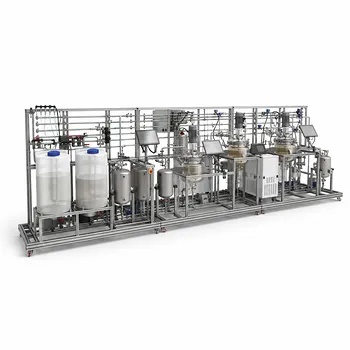
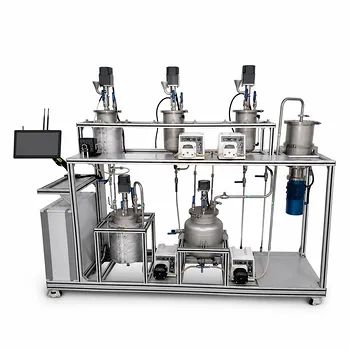
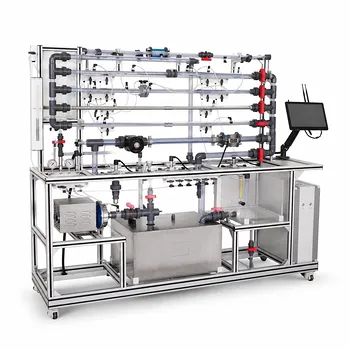
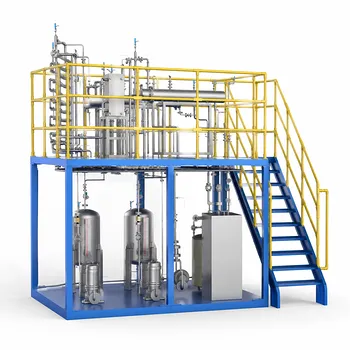
Transitioning from lab-scale research to pilot plant validation requires reliable equipment and precise data control to manage unpredictable process anomalies. LABPARK provides state-of-the-art Educational and Vocational Unit Operations Pilot Plants in chemical engineering, bioprocess & biotech, and environmental & water treatment.
Tailored for universities, research institutes, and enterprises, our pilot plants help you safely bridge the gap between theory and practice, ensuring robust data quality, system safety, and equipment reliability.
Ready to elevate your engineering lab and de-risk your scale-up processes? Contact us today to explore our pilot plant solutions!
Related Products
- Natural Product Extraction Unit Operations Training Pilot Plant
- Fixed-Bed Chemical Reaction and Gas Dust Tar Removal Unit Operations Pilot Plant
- Ethyl Acetate Synthesis Unit Operations Pilot Plant for Practical Training
- Methanol Synthesis and Catalyst Performance Evaluation Educational Unit Operations Pilot Plant
- Electrolytic Hydrogen Production Educational Unit Operations Pilot Plant
People Also Ask
- How to Demo Solubility Sensitivity in SFE Pilot Plants? Practical Thermodynamics
- How do pilot plants differentiate physical vs chemical extraction? Enhance Chemical Engineering Training
- How are HTU and NTU applied to determine extraction column height? Guide to Pilot Plant Scaling
- What are the limitations of acentric factor models? Avoid pilot plant errors with polar fluids.
- Why use step disturbance in pilot plants? Master process control dynamic response.