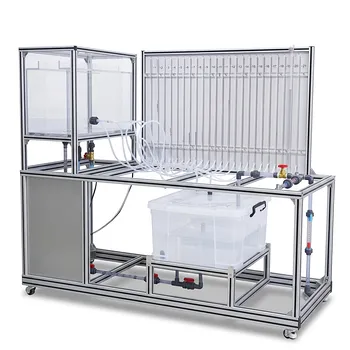
Laminar flow analysis in a unit operations lab isn't just about plotting a line; it's about validating the fundamental, deterministic link between a fluid's physical properties and its transport behavior. The Hagen-Poiseuille equation is critical because it provides a direct, analytical relationship to predict pressure drop in laminar flow, and it is verified by experimentally demonstrating the linear proportionality between flow rate and pressure drop in a controlled, low-Reynolds-number system.
While the flow of energy and mass often feels abstract, the Hagen-Poiseuille equation grounds it in a tangible, verifiable linearity. Its true power in the lab setting is that it serves as both a predictive model and an experimental anchor for confirming that a system is operating purely in the viscous-dominated laminar regime, a prerequisite for analyzing more complex unit operations.
The Analytical Cornerstone of Laminar Flow
The Hagen-Poiseuille equation is fundamental because it provides an exact solution to the Navier-Stokes equations for the specific case of laminar, incompressible flow in a straight pipe. This exactness is what makes it invaluable.
The Formula as a Direct Predictor
The equation crystallizes the physics of viscous flow. It clearly states that pressure drop is directly proportional to fluid viscosity, pipe length, and average velocity, but inversely proportional to the square of the pipe diameter.
This provides a powerful, deterministic tool for prediction. Unlike turbulent flow, which requires empirical friction factors, laminar flow allows for exact calculation. This precision is essential in applications requiring delicate fluid handling, such as bioprocess media transport or polymer processing, where even slight operational changes have predictable, linear consequences.
Connecting the Micro and Macro Scales
The equation bridges the microscopic property of a fluid—its dynamic viscosity—with a macroscopic, measurable quantity: the pressure drop across a pipe section. This connection is vital for a unit operations lab because it transforms a fluid’s internal resistance to flow into a quantifiable energy loss.
Understanding this link allows engineers to directly assess how a fluid's inherent nature dictates system requirements. It makes the abstract concept of viscosity a concrete variable in the design and operation of low-speed fluid transport systems, forming the basis for pump sizing and energy calculations.
Verifying the Principle through Controlled Experimentation
Verifying the Hagen-Poiseuille relationship in a pilot plant is an exercise in confirming that theory governs reality under prescribed conditions. The experiment hinges on isolating the key variables and demonstrating their predicted influence.
Establishing the Laminar Regime
Before any verification can occur, you must first ensure the flow is laminar. This is achieved by maintaining a low flow rate of a viscous fluid, such as a light oil or glycerol solution, through a test pipe section of known dimensions.
The process is governed by the Reynolds number. By keeping the product of velocity and diameter low relative to the fluid's kinematic viscosity, the experiment controls the flow regime. This initial step is critical because the Hagen-Poiseuille equation's validity is entirely conditional on a fully developed, laminar flow profile.
Demonstrating the Linear Velocity-Pressure Relationship
The core verification involves demonstrating the direct proportionality between pressure drop and average velocity. In the lab, this is done by systematically increasing the flow rate through the test section and using a differential pressure transmitter to measure the resulting pressure drop.
The expected outcome is a clear, linear trend on a plot of pressure drop versus velocity. A non-linear deviation signals a departure from the laminar regime, likely indicating the onset of transitional flow. This visual confirmation is a powerful, direct validation that the theoretical model perfectly describes the physical system's behavior.
Understanding the Trade-offs and Pitfalls
The model's elegant simplicity comes with a strict operational envelope. Recognizing its limitations is essential for avoiding misapplication and interpreting results correctly.
The Unforgiving Requirement of Full Development
The equation is only valid for fully developed flow, where the parabolic velocity profile is completely established and unchanging. A common mistake is taking pressure measurements too close to the pipe entrance or any flow disturbance, like a valve or bend.
Ignoring the entrance length leads to significant measurement errors. The pressure gradient in this developing region is steeper, and if these data points are used, they will not conform to the Hagen-Poiseuille prediction, leading to a false conclusion that the system is not behaving as expected.
The Isolation from Other Losses
The equation only describes frictional pressure loss from the pipe wall shear stress. It does not account for minor losses from fittings, expansions, or contractions.
In a real-world unit operations setup, neglecting to place pressure taps well away from these disturbances will contaminate the data. The measured pressure drop will be a sum of major and minor losses, making it impossible to verify the pipe friction component in isolation without careful experimental design.
Making the Right Choice for Your Experimental Goal
How you apply and verify the Hagen-Poiseuille equation depends entirely on your primary objective in the unit operations lab.
- If your primary focus is validating fundamental physics: Design the experiment to test a single variable against the model's prediction, such as confirming the linear relationship between flow rate and pressure drop while holding all other parameters constant.
- If your primary focus is characterizing a process fluid: Use the equation in reverse. By accurately measuring all geometric and flow parameters, you can solve for the fluid's dynamic viscosity and compare it to known values, turning the apparatus into a precise viscometer for Newtonian fluids.
- If your primary focus is benchmarking system energy loss: Use the Hagen-Poiseuille equation as a baseline. Measure the actual pressure drop in your complex pipe network and compare it to the theoretical loss for the straight pipe sections alone, thereby isolating the contribution of laminar friction from the total system head loss.
Mastering the verification of this principle is less about executing a single lab procedure and more about learning to create the perfectly controlled physical environment where a deterministic theory can reveal itself with predictable clarity.
Summary Table:
| Experimental Focus | Core Method / Approach | Critical Pitfalls to Avoid |
|---|---|---|
| Physics Validation | Measure $\Delta P$ vs. flow rate to demonstrate linear proportionality | Taking measurements within the entrance length region |
| Fluid Characterization | Measure geometry and flow rate to calculate dynamic viscosity ($\mu$) | Misidentifying non-Newtonian fluid behavior as experimental error |
| Energy Loss Benchmarking | Compare actual system pressure drop to theoretical straight-pipe losses | Neglecting minor losses from fittings, valves, or bends |
Bring Fluid Mechanics Theory to Life in Your Lab
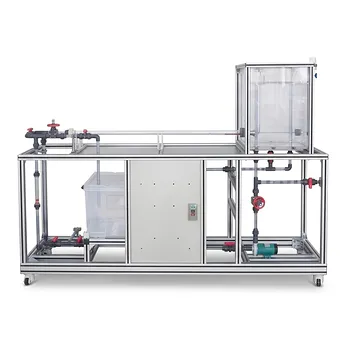
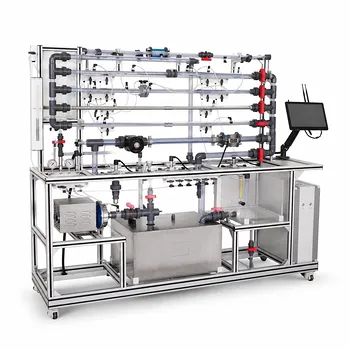
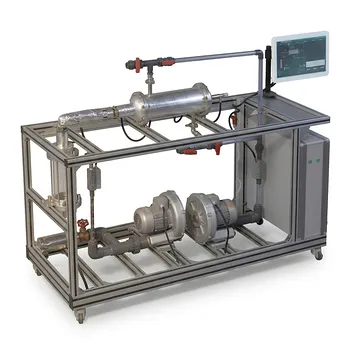
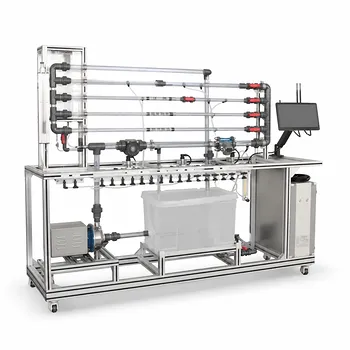
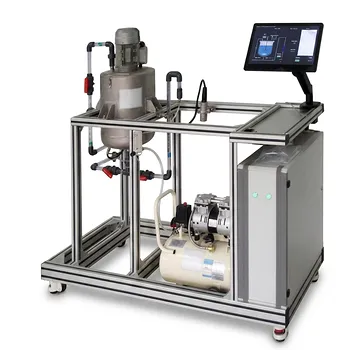
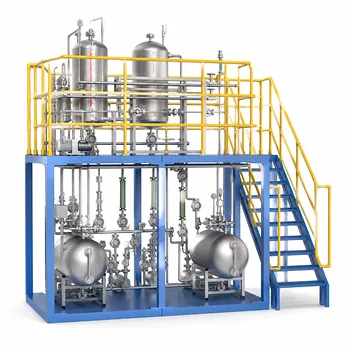
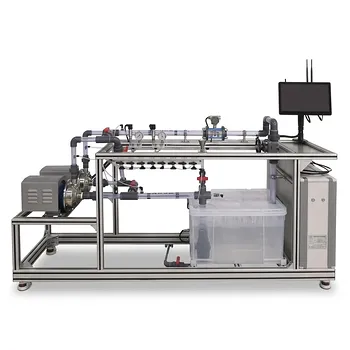
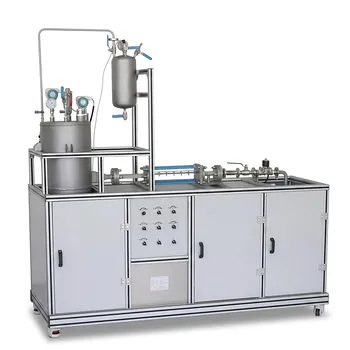
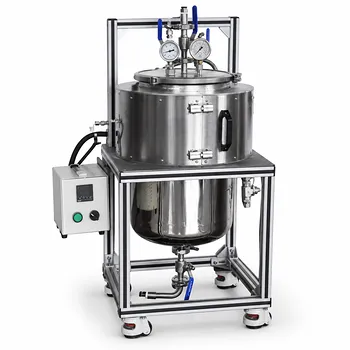
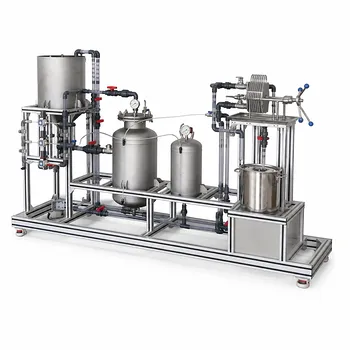
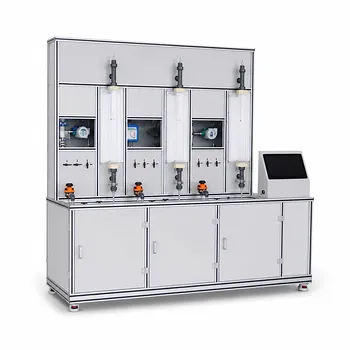
Hands-on verification of fundamental principles like the Hagen-Poiseuille equation requires highly controllable and precise equipment. LABPARK provides premium Educational and Vocational Unit Operations Pilot Plants in chemical engineering, bioprocess & biotech, and environmental & water treatment.
Specifically engineered for universities, research institutes, and enterprises, our pilot plants bridge the gap between complex mathematical equations and physical process dynamics, ensuring students and researchers gain accurate, repeatable experimental data.
Ready to elevate your engineering laboratory? Contact us today to explore our custom pilot plant solutions!
Related Products
- Fluid Reynolds Number Demonstration Educational Unit Operations Pilot Plant
- Multi-Functional Membrane Separation Educational Pilot Plant for Unit Operations Lab
- Comprehensive Fluid Mechanics Educational Unit Operations Pilot Plant
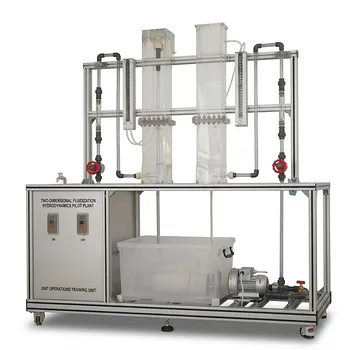
- Two-Dimensional Fluidization Hydrodynamics Educational Pilot Plant for Unit Operations Training
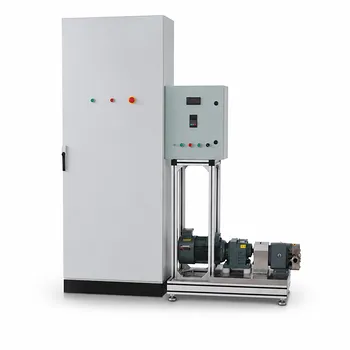
- Quantitative Dosing and Liquid Flow Control Educational Unit Operations Pilot Plant
People Also Ask
- How to use Reynolds number to demonstrate flow transition? Visual Lab Guide
- How does nozzle geometry affect energy efficiency and jet performance in fluid mechanics laboratory demonstration units?
- How do educational pilot plants help visualize Reynolds numbers? Master laminar & turbulent flow.
- How to demonstrate rapid vs slow valve closure? Clear water hammer transient experiments for engineering labs.
- What is the difference between static and stagnation pressure? Master Pilot Plant Flow Measurement