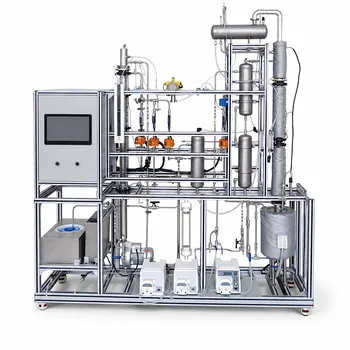
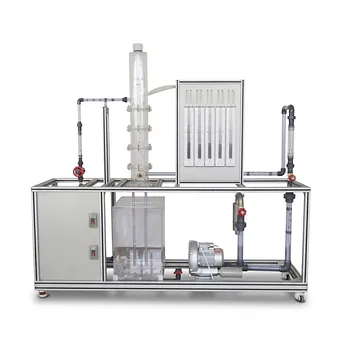
The gap between a clean textbook prediction and a real, plugged pipeline is vast—and potentially catastrophic. The experimental study of gas hydrate formation and multi-phase equilibria in pilot plants is vital because it forces students to confront this gap directly. It transforms abstract thermodynamic models into a tangible, high-stakes exercise where they must measure, validate, and design against a solid phase that can suddenly appear and shut down an entire process. Without this hands-on fight against an invisible, pressure-temperature dependent solid, a chemical engineering education remains dangerously incomplete.
The core purpose is not just to see hydrates form, but to experience the fallibility of predictive models firsthand. Training on a specialized hydrate pilot plant ingrains an engineer's professional instinct: to trust data over theory when safety and flow assurance are on the line, specifically within complex multi-phase regions like the HL1L2G envelope.
The Dangerous Reality of Gas Hydrates
Understanding the threat is the first step in appreciating the need for live experimentation. Gas hydrates are not a theoretical curiosity; they are an operational nightmare.
A Solid Threat in a Flowing System
In a natural gas pipeline, a flowing mixture of gas, liquid water, and liquid hydrocarbons can, under the wrong conditions, suddenly create a third, solid phase. These ice-like gas hydrates can agglomerate and form a plug, acting like a perfect valve that brings production to a halt.
The pressure buildup behind a hydrate plug can rupture pipelines, creating a severe safety and environmental hazard. Learning to prevent this on a live pilot plant imprints the consequences far more deeply than any textbook photo.
Why Textbooks Aren't Enough
Classroom teaching relies on equations of state, like the Peng-Robinson model, to predict phase boundaries. These models are typically tuned to binary data and can fail spectacularly when predicting the exact point where a hydrate phase appears in a multicomponent stream.
Students must learn firsthand that a model's predicted "safe" pressure on a P-T diagram is merely a statistical estimate. The real system can—and often does—generate hydrates at warmer temperatures or lower pressures due to complex interactions the model misses.
The Pilot Plant as the Ultimate Teacher
A high-pressure experimental rig is not just a demonstration tool; it is a crucible where theoretical knowledge is broken down and rebuilt as practical wisdom.
Deconstructing the HL1L2G Enigma
The most complex behavior occurs in four-phase systems, like the HL1L2G region, where a hydrate (H), two liquid phases (L1-water, L2-hydrocarbon), and a gas (G) coexist. Using a pilot plant, students can manipulate pressure and temperature to actually see the formation of this second liquid phase and the subsequent hydrate crystal.
This experimental mapping teaches them that phase behavior is not a linear process. It reveals how a heavy hydrocarbon liquid can act as a hydrate inhibitor at low concentrations but a promoter at high ones—a nuance often absent from simulators.
Putting Costly Models to the Test
The true power of the pilot plant is its role as a ruthless validator. Students can run a simulation using the Peng-Robinson equation of state to predict a hydrate dissociation curve, and then immediately run the experiment.
The inevitable mismatch—where the experimental curve deviates by 2-5%—is the most valuable lesson of all. It forces the critical question: "Do I trust the model, or the reality?" In industry, that 2% difference in operating margin is the gap between a flowing pipeline and a multi-million-dollar remediation event.
Bridging to Full-Scale Process Design
Lessons from a 2-inch pilot loop scale directly to a 24-inch offshore pipeline. When students learn to determine the safe operating envelope for a specific gas mixture experimentally, they are learning the fundamental workflow of flow assurance engineering.
This hands-on verification connects the abstract discipline of molecular thermodynamics directly to the tangible industrial goal of safety and reliability. It stops them from being mere software operators and trains them to be engineering thinkers who understand what the simulation is approximating.
Understanding the Trade-offs and Limitations
An objective training program must also frame exactly what pilot plant experimentation can and cannot do. There are no perfect solutions.
The Pitfalls of Over-Reliance on Equations of State
The primary experimental reference highlights that the Peng-Robinson model has intrinsic limitations. In the context of hydrate formation, this model struggles to accurately account for the interactions between polar water molecules and non-polar gas molecules in the clathrate cage.
Purely classroom-based engineers might apply this model blindly. Pilot plant training exposes this flaw by showing that empirical hydrate inhibitors, like methanol, alter the water activity in a way that generic equations of state severely underestimate. The pitfall is assuming a universal model can solve a specific, complex chemical problem.
The Cost and Complexity of High-Pressure Experimentation
A hydrate pilot plant is inherently a high-pressure, high-stakes environment. The initial setup cost is significant, and the safety protocols are non-negotiable. One common mistake is to rush the thermodynamic stabilization process; because hydrate formation is stochastic, students must learn patience—a data point taken before equilibrium is useless.
This complexity also means that a pilot plant cannot cover every possible gas composition. Students must be taught to strategically use their limited experimental data to tune the model, not replace it entirely.
Integrating This Knowledge Into Your Training
The value of this experimental work depends entirely on how you frame it. The goal is not to create all-purpose hydrate specialists, but to build versatile engineers with a gut-level understanding of phase behavior hazards.
- If your primary focus is instilling a safety-first mindset: Use the pilot plant to demonstrate a deliberate hydrate plug formation and the shutdown sequence. The physical sensation of a pressure spike is an unforgettable lesson in risk management.
- If your primary focus is validating design software: Task students with predicting the hydrate curve for an untested, mixed-refrigerant composition, and then have them experimentally verify it. The quantified error will teach them to factor in design safety margins better than any lecture.
- If your primary focus is accelerating industrial readiness: Simulate a field depressurization strategy on the pilot plant. Let students discover that melting a hydrate plug is a slow, delicate process that requires careful control of differential pressure to prevent catastrophic vibrations.
The ultimate goal is to transition from teaching engineers what hydrates are, to forging engineers who instinctively know how to live with them.
Summary Table:
| Aspect | Classroom Theory (Peng-Robinson) | Pilot Plant Reality |
|---|---|---|
| Phase Prediction | Clean, binary boundary estimates | Complex multi-phase envelopes (HL1L2G) |
| Hydrate Behavior | Theoretical, static models | Stochastic, sudden plugging hazards |
| Flow Assurance | Abstract calculations | Live pressure management & mitigation |
Bring Real-World Flow Assurance Training to Your Lab
Equip your students and researchers with the practical skills needed to tackle complex thermodynamic challenges. LABPARK provides state-of-the-art Educational and Vocational Unit Operations Pilot Plants in chemical engineering, bioprocess & biotech, and environmental & water treatment.
Designed specifically for universities, research institutes, and enterprises, our systems bridge the gap between classroom theory and industrial reality safely and effectively.
Contact us today to explore our custom pilot plant solutions and elevate your chemical engineering curriculum.
Related Products
- Two-Dimensional Fluidization Hydrodynamics Educational Pilot Plant for Unit Operations Training
- Fluidized Bed Gas Solid Catalytic Reaction Educational Pilot Plant
- Fixed-Bed Chemical Reaction and Gas Dust Tar Removal Unit Operations Pilot Plant
- Dual-Mode Gas Absorption and Desorption Unit Operations Training Pilot Plant
- Fixed Bed Gas Solid Catalytic Reaction Educational Pilot Plant
People Also Ask
- What pressure drop characteristics should students & researchers monitor in a fluidization pilot plant?
- Why is minimum fluidization velocity (U_mf) critical? Optimize Your Pilot Plant Operations
- How is total skin friction drag calculated for laminar flat-plate flow? Blasius formula and valid Reynolds range
- How does active time pulsing mixing enhance fluid homogenization? Configuration Guide for Educational Pilot Plants
- How does Reynolds number characterize flow regimes and momentum transfer? Master pilot-plant analysis