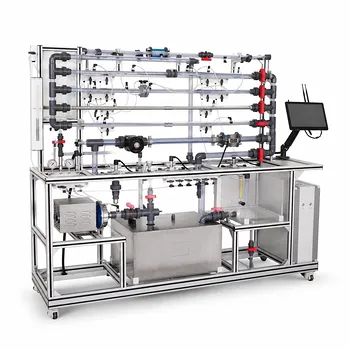
The Dow Fire & Explosion Index (F&EI) transforms pilot plant safety training from a checklist of rules into a quantitative, analytical exercise. By calculating index values from chemical properties and process conditions, students learn to objectively pinpoint high-risk equipment, evaluate hazard severity, and justify specific engineering controls. This method turns abstract concepts like flammability or exothermic reaction hazards into measurable, comparable scores, giving learners a clear, reproducible framework for risk assessment that mirrors real-world process safety management.
The F&EI’s real educational power lies in bridging chemistry, thermodynamics, and process design with tangible safety decisions. It teaches students not just that something is dangerous, but how dangerous it is relative to other units, and exactly what engineering countermeasures will reduce the risk to an acceptable level.
Bridging the Gap Between Theory and Practice
Most students enter the lab with a notebook of safety rules but no systematic way to apply them. The F&EI gives structure to their analysis.
Moving from Intuition to Quantification
Instead of relying on intuition—“this reactor feels riskier”—students must calculate a Material Factor (MF) and Process Hazard Factors. This forces them to engage with the underlying physics: heat of combustion, reactivity, pressure, temperature, and the penalties those variables impose. The outcome is a numerical index that drives risk understanding deeper than a warning label ever could.
Translating Hazards into Engineering Decisions
Once the index is calculated, students don’t stop at a number. They use it to determine mitigation measures such as minimum spacing, drainage capacity, or the need for corrosion-resistant materials. This directly links academic fundamentals—like reaction kinetics or material compatibility—to concrete equipment specifications and layout drawings.
Building a Systematic Risk Assessment Mindset
Safety management in industry relies on reproducible, auditable processes. The F&EI teaches that mindset from the start.
Partitioning the Plant into Logical Units
Students first learn to divide a pilot plant into process units—a distillation column, a reactor, a heat exchanger. This segmentation mirrors the hazard survey approach used in full-scale plants and trains them to think about risk in a compartmentalized, manageable way.
Using P&IDs as the Assessment Foundation
The method’s requirement that the assessment happen after the P&ID and equipment layout are available teaches students that safety analysis is an integral part of design, not an afterthought. They see how a piping diagram transforms into a hazard map, cementing the “design out hazard” philosophy early.
Quantifying Hazards: From Material Properties to Process Risks
The F&EI is not a single number; it is a layered calculation that teaches cause-and-effect relationships.
The Material Factor as a Starting Point
Students first determine the MF, which captures the energy release potential of the chemicals present. For example, acetone yields a different MF than toluene, immediately showing students why certain solvents demand greater care. This step reinforces that safety begins with chemistry, not just containment.
Layering on Process Conditions
The General Process Hazard Factor (F1) and Special Process Hazard Factor (F2) then multiply the MF, incorporating real operational inputs like temperature extremes, pressure, dust explosion risk, or toxic exposure. Students see how even a mildly hazardous chemical becomes high-risk when run at elevated temperature and pressure—a concept simulations alone can’t drive home.
Translating Index Values to Hazard Bands
The final F&EI value maps to a severity range: light to severe. This classification lets students compare, for example, a reactor to a storage tank and recommend proportionate safety compensations. It also links to estimated financial consequences, giving engineering students a taste of the business case for safety.
Hands-On Application: Pilot Plant as a Living Case Study
An educational pilot plant becomes more than a demonstration tool—it becomes a hazard survey canvas.
Using Actual Process Data
Students can calculate the F&EI for the very equipment they operate. They might assess a nitric acid reactor, using real flow rates and temperatures, then estimate whether the existing containment and relief systems are adequate. This authenticity makes the learning permanent. The references emphasize doing this with common teaching solvents (acetone, toluene) for a safe yet realistic exercise.
Evaluating Design Alternatives
Because the index is sensitive to changes in process conditions or materials, students can model “what-if” scenarios: switching to a lower-hazard solvent, adding inert gas purging, or increasing containment bund size. They directly observe how each change reduces the index, reinforcing that safety is a design parameter, not a fixed constraint.
Understanding the Trade-offs
No single index captures every hazard. Understanding the F&EI’s limitations is as instructive as its strengths.
It Is a Screening Tool, Not a Full Risk Assessment
The F&EI quantifies fire, explosion, and acute toxicity hazards, but it does not inherently model long-term health effects, environmental dispersion, or human error probability. Students must learn that the index guides early design, but additional layers like HAZOP or layer of protection analysis are needed for a complete safety case.
Sensitivity to Input Assumptions
The index’s accuracy depends on correct process data and material characterization. If students use generic or estimated values, the risk number becomes less reliable. Teaching this encourages meticulous data gathering and an appreciation for uncertainty in risk analysis.
The Risk of “Number Fixation”
A single index can create a false sense of precision. Educators must emphasize that the F&EI compares units within a process, not across different processes, and that a “light” hazard still requires professional judgment. The value is in the systematic thought process, not just the final digit.
Making the Right Choice for Your Curriculum
The Dow F&EI method can be adapted to a variety of learning objectives, from introductory safety to advanced plant design.
- If your primary focus is building a foundational safety culture: Use the F&EI to ground students in the direct relationship between chemical properties, process conditions, and resulting hazard. Keep the case studies simple—common solvents, mild conditions—so the logic, not the arithmetic, remains the prize.
- If your primary focus is teaching process design integration: Have students recalculate the index for a pilot plant after making a design change (e.g., reducing pressure, adding a relief valve) and require them to justify the resulting hazard reduction in an engineering report. This links index work directly to the design cycle.
- If your primary goal is preparing students for industrial practice: Frame the F&EI as a gatekeeper metric—the index that must be calculated before P&IDs are approved for construction. Encourage them to think in terms of financial risk and insurance, as that’s how many companies prioritize safety investments.
The Dow F&EI gives students something no lecture can: a repeatable, analytical language for translating chemical hazards into engineering action, right at the pilot plant they can see and touch.
Summary Table:
| Training Aspect | Traditional Safety Training | Dow F&EI Method Training |
|---|---|---|
| Risk Evaluation | Qualitative rules & intuition | Quantitative, calculated hazard index |
| Focus Area | General safety checklists | Unit-specific physical & chemical factors |
| Engineering Link | Abstract safety concepts | Direct mitigation & equipment sizing |
| Design Integration | Addressed after design phase | Integrated directly into P&ID reviews |
Equip Your Lab for Safer, Smarter Engineering Education
At LABPARK, we provide state-of-the-art Educational and Vocational Unit Operations Pilot Plants in chemical engineering, bioprocess & biotech, and environmental & water treatment. Designed specifically for universities, research institutes, and enterprises, our pilot plants allow students to safely apply quantitative methods like the Dow F&EI in real-world scenarios.
Ready to elevate your process safety training with hands-on, industry-aligned equipment? Contact LABPARK today to discuss your lab requirements and request a customized solution!
Related Products
- Natural Product Extraction Unit Operations Training Pilot Plant
- Fixed-Bed Chemical Reaction and Gas Dust Tar Removal Unit Operations Pilot Plant
- Ethyl Acetate Synthesis Unit Operations Pilot Plant for Practical Training
- Methanol Synthesis and Catalyst Performance Evaluation Educational Unit Operations Pilot Plant
- Electrolytic Hydrogen Production Educational Unit Operations Pilot Plant
People Also Ask
- How to Demo Solubility Sensitivity in SFE Pilot Plants? Practical Thermodynamics
- How do pilot plants differentiate physical vs chemical extraction? Enhance Chemical Engineering Training
- How are HTU and NTU applied to determine extraction column height? Guide to Pilot Plant Scaling
- How do fluid transport principles apply to pilot plant configuration? Optimize your unit operations.
- What are the limitations of acentric factor models? Avoid pilot plant errors with polar fluids.