In chemical engineering, the leap from a beaker to a production reactor is not a simple matter of “making it bigger”—it is a profound exercise in understanding what does and doesn’t change with scale. The distinction between intensive and extensive macroscopic properties becomes critical because intensive properties—temperature, pressure, concentration, viscosity—are scale‑invariant and define the thermodynamic state of the process, while extensive properties—total mass, volume, internal energy—scale directly with system size. In pilot plants, instruments measure intensive properties that can be directly used to predict full‑scale behaviour and product quality; the extensive properties, however, multiply, demanding fundamentally different equipment design, safety margins, and heat‑management strategies.
The real power of a pilot plant lies in its ability to generate scale‑independent intensive data that authenticate reaction kinetics and selectivity. Yet ignoring the multiplication of extensive quantities—total heat release, volume expansion—can turn a safe, controlled reaction into a catastrophic thermal runaway. The distinction is not just academic; it is the bedrock of safe, successful scale‑up and the core lesson any chemical engineering education must teach.
How Intensive and Extensive Properties Drive Scale‑Up Strategy
What Separates Intensive from Extensive
Intensive properties do not depend on the amount of material. Temperature, pressure, chemical potential, density, and concentration are all intensive. They describe the local state of every fluid element, regardless of the overall size.
Extensive properties, in contrast, are additive—total mass, volume, internal energy (U), and enthalpy (H) scale proportionally with the system. When you double the amount of substance, you double the total heat released, not the temperature.
Why Scale‑Independence Is the Engine of Process Control
Pilot‑plant instrumentation is designed to capture intensive variables. Thermocouples, pressure transmitters, inline refractometers, and pH probes all report values that are independent of how many litres are in the vessel.
Because these measurements are size‑agnostic, the thermodynamic state they define can be transplanted directly to a full‑scale reactor. The reaction rate, equilibrium conversion, and selectivity are governed by local temperature and concentration—intensive variables that a pilot plant can faithfully reproduce.
Translating Pilot Data into Full‑Scale Reactor Design
When an engineer runs a reaction in a unit‑operations pilot plant, the collected profiles of temperature, pressure, and concentration become the fingerprint of the chemistry. A commercial reactor design then targets the same intensive‑property trajectories, while independently sizing for the increased extensive load.
This separation of concerns is what makes scale‑up feasible. You use intensive data to lock in product quality and yield, then you calculate vessel volume, cooling duty, and pipe diameters to handle the scaled‑up mass flows and heat releases.
The Educational Imperative: Teaching the Distinction in Pilot Plants
Bridging the Gap Between Digital Models and Physical Reality
Process simulation tools are vital for planning, but they are only as accurate as their underlying assumptions. Unit‑operations pilot plants expose students to the messy, non‑ideal behaviour—imperfect mixing, unexpected heat‑transfer bottlenecks—that simulations often miss.
By physically measuring intensive variables and observing how extensive ones (like total heat duty) respond, students learn to validate and refine models. This hands‑on confrontation with reality is where the intensive‑extensive distinction becomes visceral, not just memorized.
Embedding an Instinct for Thermodynamic State vs. System Size
Educational pilot plants force students to ask: “Which of my measurements will still be relevant at 10× scale, and which will break my equipment?” Setting up energy balances requires them to define the system, identify whether the boundary exchanges heat or work, and distinguish between the intensive driving force (a temperature gradient) and the extensive quantity of energy transferred.
This mindset is critical. A student who understands that the same temperature profile can exist in a 1‑L reactor and a 10‑m³ vessel, but that the vessel wall must withstand far greater thermal stress, has grasped the heart of scale‑up.
Demonstrating the Safety Stakes: Why Total Heat Release Cannot Be Ignored
A reaction that is perfectly benign in a laboratory flask can become a deadly hazard at pilot scale—not because the intensive conditions change, but because the extensive energy released scales with mass. If the cooling system is designed by simply copying a lab‑scale setup, the reactor can overheat.
Pilot plants teach this lesson safely. Students see that the same exothermic reaction that raises a beaker’s temperature only slightly releases enough total heat in a 50‑L vessel to require active cooling, larger relief valves, and robust mechanical design. The distinction between intensive and extensive properties becomes a life‑safety principle.
Understanding the Pitfalls
When Engineers Overlook Extensive Scaling
The most dangerous misconception is to treat all properties as directly scalable. An engineer who focuses only on replicating the intensive temperature and pressure profile without calculating the corresponding total heating or cooling duty will undersize heat exchangers and safety devices.
The result is a plant that runs at the correct temperature until it can no longer remove the extensive heat flux. Thermal runaway, overpressure, and catastrophic failure often trace back to this oversight.
The Trap of Purely Digital Process Design
Relying solely on simulation or scheduling software can hide the intensive‑extensive split. A model may give excellent yield predictions (based on intensive kinetics) but ignore the fact that at scale, mixing and heat transfer become extensive problems.
Pilot plants expose these hidden bottlenecks. For example, maintaining the same concentration profile in a larger vessel often requires much higher agitation power—an extensive input that the simulation never flagged. Without hands‑on experience, students and engineers may never develop the reflex to ask the right questions.
Making the Distinction Actionable for Education and Industry
Adopt the intensive‑extensive lens as a deliberate design and teaching framework.
- If your primary focus is educating effective engineers: Use pilot plants to teach that monitoring intensive variables (temperature, pressure, concentration) guarantees reproducible chemistry, while extensive effects must be managed through engineering design. Let students experience the difference between a temperature setpoint and the kilowatts needed to maintain it.
- If your primary focus is successful process scale‑up: Build the reactor design around intensive‑property data collected from the pilot plant, then independently size for the scaled‑up extensive quantities—cooling duty, volume, mass flow rate, and relief capacity. Never assume that copying a laboratory setup is enough.
- If your primary focus is inherent safety and risk mitigation: Treat the total energy release and volume expansion as the primary hazards to mitigate at scale. Use the pilot plant to characterize the intensive kinetic window, but mandate that engineers explicitly calculate the extensive heat and gas generation that will challenge the final vessel.
When you master the separation of intensive and extensive properties, a pilot plant becomes far more than a miniature factory—it becomes a reliable blueprint for industrial success, and the training ground where chemical engineers learn to think with the clarity that safety and performance demand.
Summary Table:
| Property Type | Definition | Key Examples | Role in Scale-Up |
|---|---|---|---|
| Intensive | Scale-independent; does not depend on system size | Temperature, Pressure, Concentration, Viscosity | Defines thermodynamic state, reaction kinetics, and product quality. |
| Extensive | Additive; scales proportionally with system mass | Total Mass, Volume, Enthalpy, Heat Duty | Dictates equipment sizing, cooling requirements, and safety margins. |
Bring Industrial-Scale Reality to Your Lab with LABPARK
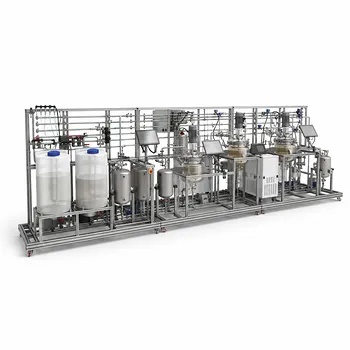
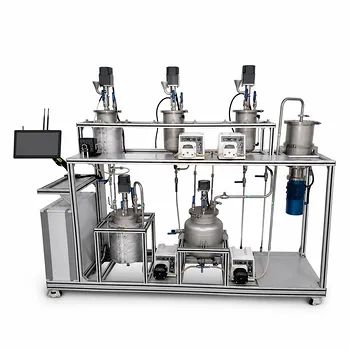
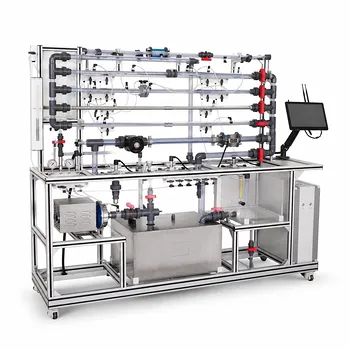
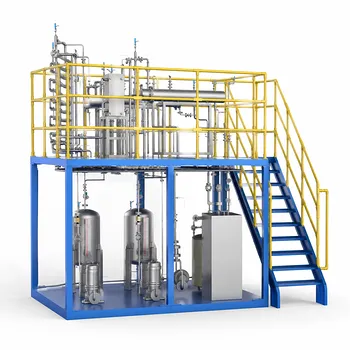
Mastering scale-up requires hands-on experience with real-world thermodynamic challenges. LABPARK designs and delivers high-quality Educational and Vocational Unit Operations Pilot Plants in chemical engineering, bioprocess & biotech, and environmental & water treatment. We empower universities, research institutes, and enterprises to bridge the gap between digital models and physical safety.
Ready to equip your facility with pilot plants that teach and validate critical scale-up principles? Contact LABPARK today to discuss your educational or research requirements.
Related Products
- Natural Product Extraction Unit Operations Training Pilot Plant
- Fixed-Bed Chemical Reaction and Gas Dust Tar Removal Unit Operations Pilot Plant
- Ethyl Acetate Synthesis Unit Operations Pilot Plant for Practical Training
- Methanol Synthesis and Catalyst Performance Evaluation Educational Unit Operations Pilot Plant
- Electrolytic Hydrogen Production Educational Unit Operations Pilot Plant
People Also Ask
- How to Demo Solubility Sensitivity in SFE Pilot Plants? Practical Thermodynamics
- How do pilot plants differentiate physical vs chemical extraction? Enhance Chemical Engineering Training
- How are HTU and NTU applied to determine extraction column height? Guide to Pilot Plant Scaling
- Why use split-plot designs in pilot plants instead of CRD? Optimize process parameters effectively.
- How do fluid transport principles apply to pilot plant configuration? Optimize your unit operations.