Yes, predicting three-phase (water-hydrocarbon-vapor) equilibrium with the Peng-Robinson equation of state is not just academic—it’s a frontline safeguard. Water is an almost universal companion in industrial hydrocarbon streams, and pilot plants handling distillation, gas processing, or separation see its effects daily. Using Peng-Robinson (PR) with a carefully fitted binary interaction parameter for water-hydrocarbon pairs lets students and engineers accurately calculate water content in both the vapor and liquid phases—directly influencing everything from dew point control to the prevention of liquid water dropout, corrosion, and hydrate plugs in pilot-scale piping.
Water may be the silent variable in every pilot plant stream, but its phase behavior is loud when things go wrong. A Peng-Robinson model tuned with water-hydrocarbon interaction parameters decodes that silence, converting it into clear operating limits that avoid costly failures and make experimental data trustworthy for scale-up.
Why Water Presents a Critical Operational Threat
The Hidden Impurity in Nearly Every Process Stream
Water enters pilot plants through feedstock, steam stripping, or as a lingering trace from upstream processing.
It is rarely a product—more often it is the unwanted third phase that can destabilize an entire separation train.
The Domino Effect: From Liquid Dropout to Hydrate Plugs
If the system temperature drops below the water dew point, liquid water condenses.
Once liquid water is present, it accelerates corrosion, especially when acid gases like CO₂ or H₂S are around.
At high pressures and low temperatures, this water can further form solid gas hydrates, physically blocking piping and instruments.
In a pilot plant, such events do more than ruin an experiment—they can destroy small-diameter tubing and compromise safety.
Predicting exactly when and where water will condense or form hydrates is therefore an operational necessity, not a luxury.
The Peng-Robinson EOS: A Practical Foundation for Three-Phase Calculations
One Equation to Rule Both Vapor and Liquid
Peng-Robinson is a two-constant cubic equation of state, simple enough to be solved analytically for density roots.
Unlike multi‑constant equations that demand heavy iteration, PR delivers vapor and liquid phase properties from a single consistent framework.
That self‑consistency is critical for three‑phase calculations, where you cannot afford contradictions between separate vapor and liquid models.
The Key to Accuracy: The Fitted Binary Interaction Parameter
A standard cubic EOS struggles with highly polar molecules like water.
The solution is to introduce a binary interaction parameter (kᵢⱼ) specifically tuned for each water‑hydrocarbon pair.
This parameter corrects the mixing rules, allowing the PR model to reproduce experimental water solubility in both the vapor and hydrocarbon liquid phases.
With that adjustment, you can reliably calculate water dew points, hydrate formation boundaries, and liquid‑liquid‑vapor equilibrium splits.
Proven Performance Near Critical Points
PR was originally designed to improve liquid density predictions near the critical region, outperforming its predecessor, the Soave‑Redlich‑Kwong equation.
For multicomponent systems—containing paraffins, nitrogen, CO₂, and H₂S—PR predicts critical temperatures within about 1.3% and pressures within 2.3% on average, making it highly trustworthy for mapping phase envelopes in pilot plants.
Bridging Theory and Pilot Plant Reality
Validating Models with Real Experimental Data
Pilot plants do not just rely on equations of state; they generate the data those equations need.
Industry surveys show that approximately 70% of engineering data requests focus on phase equilibrium, underscoring how central VLE data is to design.
By operating a pilot distillation column or phase separator, researchers measure actual compositions and temperatures—data that directly feed back to calibrate the binary interaction parameters in the PR model.
This loop transforms a generic prediction into a plant‑specific, accurate tool.
From Dew Point Prediction to Preventing Corrosion
When an engineer simulates a three‑phase separator, the PR EOS answers: “Will liquid water appear at this temperature?”
If the answer is yes, the operating envelope must be shifted—perhaps by raising temperature or adding a dehydration step.
That single prediction chain protects downstream equipment from corrosive attack and hydrate blockages, two of the most common causes of pilot plant downtime.
Understanding the Trade‑offs and Limitations
The Parameter Tuning Challenge
The Achilles’ heel of the PR EOS for water‑containing systems is its dependence on binary interaction parameters.
These values are not universal; they must be fitted against experimental data for each specific hydrocarbon family.
If the pilot plant processes a new crude assay or a synthetic mixture, the engineer must first obtain or measure VLE data to get the right kᵢⱼ—otherwise the predictions can be dangerously off.
When Polar Molecules Push Models to Their Limits
Even with a tuned parameter, a cubic equation of state can misbehave near critical regions of highly polar mixtures.
Water’s strong hydrogen bonding introduces non‑idealities that a simple cubic model cannot fully capture, especially for heavy hydrocarbons (C10+) or aqueous brines.
In such cases, the PR EOS serves as a practical first estimate, but pilot plant measurements remain the ultimate arbiter of accuracy.
The Imperative of Pilot Plant Data for Model Refinement
Because no equation of state is perfect, pilot plants become the calibration laboratory.
Accurate three‑phase VLE data gathered from an operating unit help refine the binary parameters and expose the model’s blind spots.
This is why students and engineers must see the PR EOS not as a black‑box answer generator, but as a framework that thrives on experimental feedback.
Making the Right Choice for Your Pilot Plant Operation
The Peng-Robinson EOS with water‑specific binary parameters is a cornerstone technique, but how you apply it depends on your primary goal.
- If your primary focus is safe and trouble‑free operation: Use PR predictions to map out water dew points and hydrate formation boundaries before each experimental run. Adjust operating temperatures or install guard beds to stay outside the danger zone.
- If your primary focus is model validation and scale‑up: Run parallel simulations at every data point, then use the measured three‑phase compositions to fine‑tune your binary interaction parameters. This ensures the model you hand over to the design team carries the fingerprint of real performance.
- If your primary focus is process efficiency: Combine PR‑based phase equilibrium with energy balance calculations to find the minimum reflux ratio and optimal column pressure—while still ensuring that water never condenses unexpectedly in the condenser or overhead line.
When you treat the Peng-Robinson equation not just as a set of equations but as a dialogue between prediction and pilot plant reality, you turn water from a hidden threat into a managed variable—and that is exactly what makes the difference between a struggling experiment and a successful scale‑up.
Summary Table:
| Aspect | Key Operational Impact | Role of Peng-Robinson (PR) EOS |
|---|---|---|
| Critical Risks | Corrosion, hydrate plugs, liquid water dropout | Safeguards pilot-scale piping & instruments |
| Model Benefits | Single consistent framework for VLE/VLLE | Predicts dew points & phase envelope boundaries |
| Calibration | Uses fitted binary interaction parameters ($k_{ij}$) | Corrects for polar water-hydrocarbon non-idealities |
| Scale-up Role | Generates experimental data to tune equations | Transforms theoretical models into plant-specific tools |
Bridge Theory and Reality with LABPARK Pilot Plants
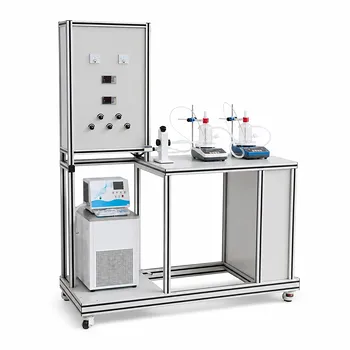
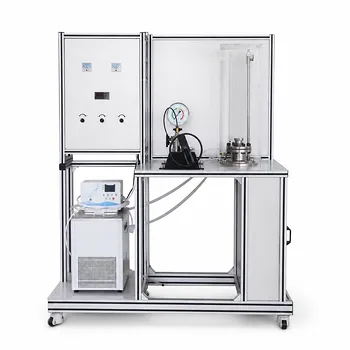
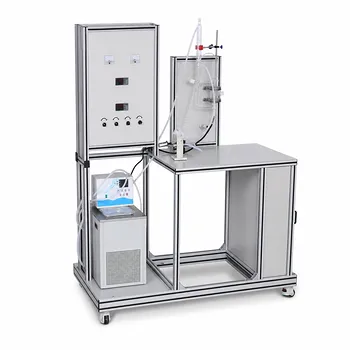
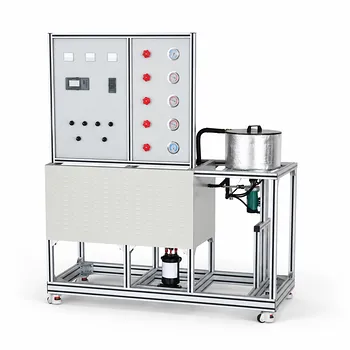
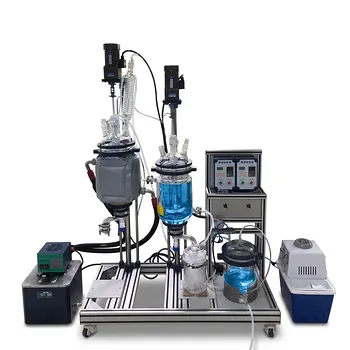
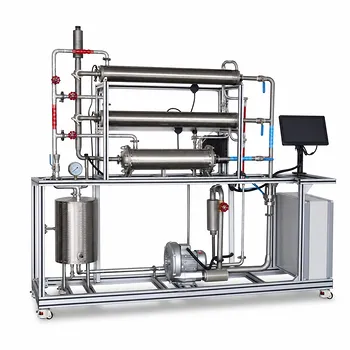
To safely master complex phase behavior like three-phase equilibrium, students and engineers need hands-on experience with reliable equipment. LABPARK provides premium Educational and Vocational Unit Operations Pilot Plants in chemical engineering, bioprocess & biotech, and environmental & water treatment for universities, research institutes, and enterprises.
Our pilot systems allow you to generate high-fidelity experimental data to validate thermodynamic models, refine binary interaction parameters, and prevent operational hazards.
Ready to elevate your training and research? Contact LABPARK today to request a quote!
Related Products
- Ternary Liquid-Liquid Equilibrium Educational Pilot Plant
- Carbon Dioxide PVT Curve Determination Educational Unit Operations Pilot Plant
- Binary System Vapor Liquid Equilibrium Data Determination Educational Unit Operations Pilot Plant
- Educational Compression Refrigeration Performance Determination Unit Operations Pilot Plant
- Two Phase Flow Pattern Velocity Resistance Measurement Educational Pilot Plant
People Also Ask
- Why is precise temperature control necessary in LLE experiments? Ensure accurate pilot plant data
- How do pilot plants explain ternary phase diagrams? Bridge thermodynamic theory and practice
- How do liquid-phase reactor pilot plants address mass transfer limitations like the 'cage effect'?
- What is the thermodynamic basis for phase equilibrium? How pilot plants validate Gibbs energy & fugacity.
- How to resolve emulsion in liquid-liquid extraction? 5 ways to ensure efficient phase separation