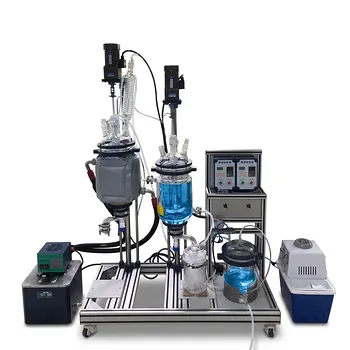
Predicting solubility ratios is not just an academic exercise—it is the central lever for controlling which crystal form emerges from your pilot-plant crystallizer.
In chemical and pharmaceutical engineering education, operating a crystallization pilot plant without first estimating the solubility ratio of different polymorphs is like navigating without a map. Because metastable polymorphs can be orders of magnitude more soluble than the stable form, a student who ignores this ratio will face inexplicable yield losses, sudden product transformations, and a complete breakdown of process reproducibility. The ability to calculate these ratios from thermal data—melting temperature and enthalpy of fusion—transforms crystallization from blind trial-and-error into a rational, predictable unit operation.
The core educational mission of a crystallization pilot plant is to teach that solid-state form directly dictates solubility, and solubility dictates everything else. Predicting the solubility ratio between polymorphs gives students a quantitative tool to define the safe operating window, prevent unwanted form conversion, and bridge the gap between thermodynamic theory and the industrial demand for a consistent crystalline product.
The Fundamental Link Between Polymorphs and Solubility
A single molecule can pack into multiple crystal lattices, each with a distinct internal energy. That energy difference is what makes one polymorph stable and another metastable under given conditions. Critically, that same energy difference also determines how much of each form can dissolve in a solvent.
Why Two Crystals of the Same Molecule Behave Like Different Materials
A metastable polymorph has a higher free energy than the stable form. This higher energy makes it easier for solvent molecules to pull the compound out of the lattice. Consequently, the metastable form is always more soluble than the stable form at the same temperature. Students often misunderstand this point, thinking that because the molecule is identical, the solubility should be the same. In reality, the solubility is a property of the solid phase, not just the molecule. The thermodynamic basis—captured through the melting point and heat of fusion—tells you exactly how much more soluble.
The Thermo-dynamic Basis You Can Measure at Pilot Scale
You don't need a full polymorph screen to estimate the solubility ratio. The primary reference makes it clear: gather the melting temperature (Tm) and enthalpy of fusion (ΔHfus) for each form using a differential scanning calorimeter. With these two numbers, the Hoffman equation—or simpler ideal-solubility approximations—directly predicts the solubility ratio x_metastable / x_stable. This means a student can take a sample of the unwanted polymorph that appeared in a failed run, run a quick DSC scan, and immediately understand why that form crystallized and what thermodynamic driving force must be overcome to avoid it.
How This Prediction Shapes the Entire Pilot Plant Curriculum
The value of predicting the solubility ratio goes far beyond a lecture slide. It is the thread that connects every operational decision in the pilot plant.
Defining the “Safe” Operating Window for Temperature and Concentration
Different polymorphs have different solubility curves. A metastable form might have a solubility curve that crosses that of the stable form at a specific transition temperature. By predicting the solubility ratio across the relevant temperature range, students can map the thermodynamic stability domains. This allows them to deliberately choose a temperature where the desired form is the only phase that can nucleate and grow. In a pilot-scale jacketed reactor, this calculation is what determines the cooling profile—and missing it means the vessel will inevitably produce a mixture of forms or the wrong form entirely.
Transforming Supersaturation from a Guess into a Controllable Variable
Supersaturation is the engine of crystallization, but it is form-dependent. If you calculate supersaturation based on the solubility of the stable form but actually generate a metastable zone for a different polymorph, your primary nucleation and growth kinetics will be wildly off. Predicting the solubility ratio allows students to express supersaturation with respect to the target polymorph. This turns a vague concept into a precise process control parameter, letting them link the cooling rate directly to the desired crystal size distribution and polymorphic purity.
Bridging the Gap Between DSC Data and Process Equipment Selection
The supplementary references rightly emphasize that pilot plants must demonstrate the link between material properties and equipment choice. When students see that the solubility ratio is small (e.g., less than 1.6-fold, as the 80% probability boundary from heat-of-fusion differences under 6.2 kJ/mol suggests), they realize that even mild temperature fluctuations or minor solvent compositional drifts can tip the system. This insight justifies the need for precise temperature control loops, carefully selected solvents that maximize the solubility difference, and the use of seeded crystallizations. It transforms the pilot plant from a piece of hardware into a thermodynamic argument made physical.
Understanding the Trade-offs and Limitations
Predictive thermodynamic models are powerful, but they are not a substitute for critical thinking. Teaching their proper place is essential to building competent engineers.
The Assumption You Are Making About the Solvent
The simplest models predict the ratio of ideal solubilities, which is a function only of the solid-state properties. In reality, the activity coefficient of the solute in the chosen solvent modifies this ratio. If the solvent interacts very differently with the two polymorphic surfaces, the real solubility ratio can deviate from the predicted value. A pilot plant curriculum must couple the thermal prediction with a discussion of solvent selection—specifically how a solvent can stabilize a particular molecular conformation in solution and preferentially accelerate the nucleation of one form, a point strongly supported by the supplementary references.
The Danger of Extrapolating Beyond Your Data
The primary reference highlights an 80% probability that the heat-of-fusion difference is below a certain threshold, leading to a relatively modest solubility ratio. This is an aggregate statistical insight, not a guarantee for any single compound. Students must learn that if a compound exhibits an exceptionally large heat-of-fusion difference, the solubility ratio can be enormous, making the metastable form practically impossible to isolate through conventional solution crystallization. Relying solely on statistical averages without measuring the specific compound’s properties is a recipe for process failure. The educational value lies in running the DSC measurement and then immediately testing the prediction with a small-scale solubility experiment in the pilot plant.
Making the Right Choice for Your Educational Goal
The way you integrate solubility ratio prediction into your pilot plant operations should depend on the primary learning objective you want to reinforce.
- If your primary focus is teaching fundamental thermodynamics: Have students measure Tm and ΔHfus for two lab-generated polymorphs. Then, task them with predicting the solubility ratio and designing a simple temperature-cycling experiment in the pilot plant to verify which form is more soluble. This creates a direct, unforgettable link between the DSC curve and what happens in the stirred vessel.
- If your primary focus is training for scalable pharmaceutical manufacturing: Use the predicted solubility ratio to define the design space for a seeded cooling crystallization. Show how a solubility ratio close to 1 demands razor-sharp temperature control and robust seeding protocols to avoid batch-to-batch form contamination, simulating the exact challenge faced during scale-up.
- If your primary focus is on solvent and process design: Couple the solid-state solubility ratio prediction with rational solvent selection. Have the class evaluate how different solvents change the real solubility difference and influence the conformation of the molecule in solution, directly tying material science to unit operations.
Predicting the solubility ratio is not a standalone calculation; it is the compass that allows a young engineer to navigate the complex landscape of polymorphism, ensuring that what begins as a theoretical number ends as the right crystal in the product drum.
Summary Table:
| Key Concept | Impact on Crystallization | Educational Value |
|---|---|---|
| Solubility Ratio | Prevents unexpected form conversion and yield loss | Teaches thermodynamic driving forces vs. trial-and-error |
| DSC Thermal Data | Predicts metastable/stable ratio ($x_{metastable}/x_{stable}$) | Connects material science properties to equipment choice |
| Operating Window | Defines temperature and concentration limits | Trains students in precise temperature control and seeding |
Bring Industrial-Grade Crystallization Training to Your Lab
Teaching complex thermodynamic concepts like polymorphism requires reliable, precise equipment. LABPARK provides state-of-the-art Educational and Vocational Unit Operations Pilot Plants in chemical engineering, bioprocess & biotech, and environmental & water treatment for universities, research institutes, and enterprises.
Equip your students with the tools to master crystallization, temperature control, and process scale-up. Contact LABPARK today to request a quote or customize your pilot plant!
Related Products
- Multi Functional Membrane Crystallization Educational Unit Operations Pilot Plant
- Potassium Salt Thermal Dissolution and Crystallization Separation Educational Unit Operations Pilot Plant
- Multi-Modal Distillation Unit Operations Training Pilot Plant
- Multi-Reactor Educational Pilot Plant for Reaction Engineering Unit Operations
- Dual-Mode Rectification Pilot Plant for Practical Training Unit Operations
People Also Ask
- Control Crystallization Pilot Plant Secondary Nucleation: 4 Key Adjustments
- Why is precise temperature control critical in crystallization pilot plants? Key to Scale-Up Success
- What key factors should be considered when configuring a crystallization unit operations pilot plant?
- How Crystal vs Amorphous Solids Guide Crystallization Pilot Plant Objectives
- What are the benefits of integrating online PAT tools like ATR-FTIR into crystallization unit operations pilot plants?