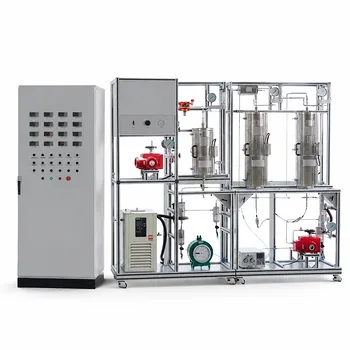
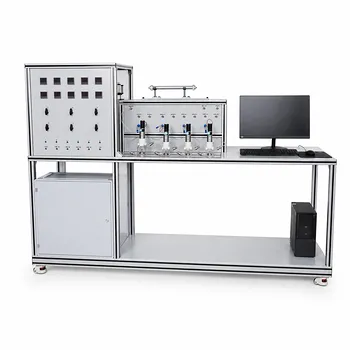
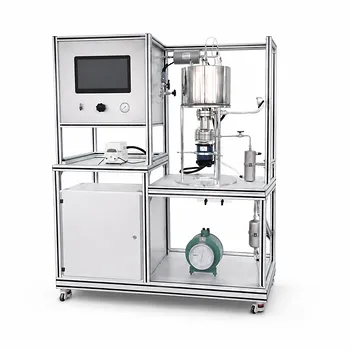
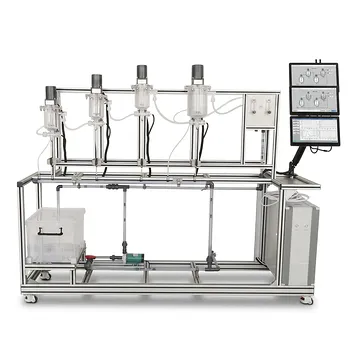
Because reaction rates are exponentially dependent on temperature, a 1°C drift can render an entire kinetics dataset useless. Precise thermal control is critical in educational reactor systems because it directly determines whether students obtain physically meaningful rate constants or dangerously uncontrolled reactions. In the persulfate-iodide reaction, even a slight overtemperature makes the clock reaction finish too quickly for accurate timing, introducing massive random errors. In hydrogen peroxide decomposition, the exothermic reaction can self-accelerate into a thermal runaway if heat removal lags, compromising both safety and kinetic modeling. Educational pilot plants mitigate these failure modes by embedding PID controllers, jacketed heating/cooling, and safety interlocks, turning an unpredictable system into a reproducible learning platform.
Measuring kinetics is not about “getting a reaction to happen”—it’s about measuring how fast it happens under precisely known conditions. Temperature is the single most sensitive variable in that equation. Without tight thermal control, your rate constants become noise, your activation energy plot loses linearity, and you subtly train students that bad data is normal.
The Temperature-Sensitivity Trap in Kinetics Experiments
Every rate constant follows the Arrhenius equation, where a linear change in temperature produces an exponential swing in reaction speed. In an educational setting, this sensitivity is not a minor inconvenience—it is the central reason why undergraduate labs often fail to reproduce textbook activation energies.
The Exponential Amplifier of Small Drifts
A 10°C increase can double or triple a reaction rate. In a manual experiment where a water bath fluctuates by ±2°C, the observed rate can easily wander by 20–40%. That variation buries the true kinetic signal under environmental noise.
When students try to plot ( \lg k ) versus ( 1/T ) to extract activation energy, thermal instability creates scatter that obscures the straight-line relationship. The slope becomes unreliable, and the calculated activation energy reflects the quality of the temperature controller, not the chemistry.
The Two Reactions That Betray Poor Control
The primary reference highlights two classic educational reactions that fail spectacularly without precision.
- Persulfate-iodide clock reaction: The appearance of the iodine‑starch color change is the measurement. If the reactor is too hot, the reaction finishes before the student can reliably start and stop a stopwatch. The dominant error shifts from chemistry to human reflex, and the “rate constant” becomes an artifact of timing delay.
- Hydrogen peroxide decomposition: This reaction produces heat as it goes. Without active cooling, the solution self‑heats, which raises the rate, which generates more heat. The result is an exothermic runaway where the temperature profile is a moving target, making any calculated rate constant meaningless and creating a safety hazard.
How Educational Reactors Turn Chaos into Curriculum
The solution is not more insulation or a better thermometer—it is an engineered thermal management strategy. Modern educational pilot plants embed three layers of defense that directly address the root causes of kinetic error.
Active Jacketing for Instantaneous Heat Exchange
A jacketed reactor surrounds the reaction vessel with a flowing heat-transfer fluid. This design eliminates “hot spots” near a heater or “cold spots” near an air interface. By circulating water or oil at a tightly controlled setpoint, the jacket can either supply heat for an endothermic sequence or rapidly remove heat from an exothermic reaction.
In hydrogen peroxide decomposition, the jacket becomes a heat sink that counterbalances the internal exotherm in real time. In the persulfate-iodide reaction, the jacket holds the mixture at a temperature slow enough to be measurable yet fast enough to complete within a lab period.
PID Controllers and Thermal Feedback Loops
A simple on/off thermostat would introduce temperature oscillations that wreak havoc on rate measurements. Educational reactors use PID (Proportional-Integral-Derivative) controllers to maintain a setpoint with minimal overshoot and rapid disturbance rejection. The controller continuously adjusts the jacket fluid temperature based on the reactor’s internal thermowell reading.
This closed-loop stability is what makes Arrhenius analysis feasible. When students change the setpoint from 25°C to 35°C, they can trust that the reaction actually occurred at 35°C, not at a drifting value that averaged 35°C over a fluctuating 5°C range.
Safety Interlocks as an Educational Mandate
Safety interlocks are not an add‑on; they are integral to the learning objective. They teach students that industrial kinetics always couples reaction engineering with process safety. If the thermocouple detects a temperature exceeding the safe operating limit—due to an exothermic excursion or a controller fault—the interlock can cut off heating, open emergency cooling valves, or trigger an alarm. This prevents the hydrogen peroxide decomposition from becoming a case study in runaway kinetics.
Why Thermal Stability Determines Activation Energy Accuracy
The determination of activation energy (( E_a )) is the capstone of most educational kinetics labs. That calculation rests entirely on maintaining a known, constant temperature for each run and achieving a true linear relationship in the Arrhenius plot.
The Geometry of the Arrhenius Plot
Plotting ( \lg k ) versus ( 1/T ) yields a straight line only if the temperature values are accurate and the rate constants are truly isothermal. Temperature uncertainties broaden each data point along the x‑axis; reaction rate uncertainties stretch it along the y‑axis. Combined, they rotate or flatten the linear fit, introducing systematic error into ( E_a ).
Pre‑Equilibration: The Silent Requirement
Even with a perfectly controlled jacket, if students inject cold reactants into a hot reactor, the first seconds of reaction occur at an unknown intermediate temperature. Educational reactor systems enforce thermal pre‑equilibration: reactants are held in a constant-temperature bath until they match the reactor setpoint before mixing. This eliminates the initial temperature drop that would otherwise corrupt the initial rate measurement.
External measurement cells (like polarimeter tubes for sucrose inversion) often feature water jackets for the same reason. The moment the sample leaves the controlled reactor, it begins to drift toward ambient temperature, so every analysis point must be thermally guarded.
Understanding the Trade-offs and Pitfalls
Precision thermal control introduces its own set of challenges that educators must acknowledge, not hide.
Cost and Complexity Versus Simplicity
A full jacketed reactor with a PID circulator is orders of magnitude more expensive than a beaker on a hotplate. For a teaching lab, this means fewer stations and longer rotation times. The educational value of accurate kinetics must be weighed against the throughput of hands‑on experience.
Thermal Lag and Over‑Correction
Even a PID controller has a finite response time. If a highly exothermic spike occurs faster than the jacket’s heat-transfer fluid can respond, the reactor temperature will temporarily overshoot. Advanced reactors mitigate this with feed‑forward control strategies that anticipate heat generation, but a standard educational unit may still exhibit a small transient. Students need to recognize this latency, not dismiss it as instrument drift.
The Illusion of Perfect Control
A stable digital readout can mask poor reactor design. If the thermowell is in a dead zone or the agitator does not ensure uniform mixing, a “constant” reading at the probe may conceal regional temperature gradients. The reactor must combine good thermal control with adequate mixing—otherwise students learn to trust a number that represents only a fraction of the reaction volume.
Making the Right Choice for Your Educational Goal
Your approach to thermal control should match the specific learning outcome you want to achieve from a kinetics experiment.
- If your primary focus is teaching the Arrhenius equation: Invest in a jacketed reactor with a high-precision circulator. Students need to see a perfectly linear ( \lg k ) vs ( 1/T ) plot to internalize the exponential relationship; anything less than ±0.1°C stability will dilute the lesson.
- If your primary focus is demonstrating industrial reactor safety: Choose a system with transparent safety interlocks and data‑logging of wall and bulk temperatures. Let students induce a mild runaway under controlled conditions to experience the consequences of thermal feedback.
- If your primary focus is maximizing hands‑on lab throughput: Consider simpler jacketed vessels with manual control but mandate a rigorous pre‑equilibration protocol. Document the residual temperature uncertainty and make error analysis part of the report so students learn how control limits affect their conclusions.
- If your primary focus is simulating scale‑up conditions: Use a reactor with programmable temperature ramps and profiles. Show how a reaction that works in a test tube can behave differently when internal mixing and heat transfer become limitations.
Precision thermal control is not a luxury in educational kinetics—it is the foundation that transforms a color-changing demonstration into a quantitative investigation of molecular energetics.
Summary Table:
| Thermal Control Component | Function in Kinetics | Educational & Safety Impact |
|---|---|---|
| Jacketed Reactor | Eliminates hot/cold spots & enables active heat exchange | Prevents thermal runaways & stabilizes reaction rates |
| PID Controller | Dynamically adjusts jacket fluid temperature | Maintains stable setpoints for reliable Arrhenius plots |
| Safety Interlocks | Monitors temperature limits & shuts down heating if exceeded | Teaches process safety & prevents hazardous runaways |
| Pre-equilibration | Pre-heats or cools reactants before mixing | Eliminates initial temperature drops in kinetic calculations |
Empower your students and researchers with industry-grade experimental precision. LABPARK provides premium Educational and Vocational Unit Operations Pilot Plants in chemical engineering, bioprocess & biotech, and environmental & water treatment. Tailored for universities, research institutes, and enterprises, our advanced systems integrate high-precision thermal control, PID feedback, and safety interlocks to deliver reliable, reproducible kinetic data.
Ready to upgrade your laboratory? Contact LABPARK today to find the ideal pilot plant solution for your educational and research goals.
Related Products
- Multi-Reactor Educational Pilot Plant for Reaction Engineering Unit Operations
- 100L Continuous Loop Hydrogenation Educational Unit Operations Pilot Plant
- Micro-Scale Gas-Solid Catalytic Reaction Educational Pilot Plant
- Crude Benzene Hydrogenation Educational Unit Operations Pilot Plant
- Gas Phase Mixing and Residence Time Distribution Determination Educational Unit Operations Pilot Plant
People Also Ask
- What role do educational pilot plants play in scaling green chemistry? Bridging the Lab-to-Industry Gap
- How do educational unit operations pilot plants address safety and waste management when scaling up?
- How do educational unit operations pilot plants bridge theory and design? Bridge the Engineering Gap
- Why Compare Predicted and Experimental Excess Enthalpy? Key to Accurate Pilot Plant Scale-up
- Why Use PTFE & Hastelloy in Chemical Pilot Plants? Prevent Corrosion & Ensure Safety