Knowledge Chemical Engineering Education Why is physical testing in solid-handling pilot plants critical? Get the data simulation software misses.
Author avatar

Tech Team · LABPARK

Updated 1 month ago

Why is physical testing in solid-handling pilot plants critical? Get the data simulation software misses.


Simulation alone can’t predict how a powder will flow, clump, or crumble under real conditions.

Physical testing in solid-handling pilot plants is critical because standard process simulation software was built for fluids and lacks comprehensive, built-in models for the complex behavior of particulate matter. Simulation platforms force engineers to rely on custom subroutines and unvalidated empirical correlations, making physical piloting the only way to directly observe particle attrition, clogging, bridging, and moisture-driven dynamics that software cannot forecast. The result is the reliable design data needed to de-risk scale‑up and ensure predictable operation.

Because commercial simulation tools lack robust thermodynamic and kinetic frameworks for solids, physical pilot plants provide the indispensable empirical data to validate models and observe the messy, real-world particle interactions that determine success or failure at an industrial scale.

The Simulation Gap in Solid-Handling Operations

A Legacy Built for Fluids

Standard commercial process simulation software was historically developed for petroleum and fluid-based processes. These platforms excel at vapor‑liquid equilibrium but treat solids with oversimplified models—or simply cannot handle them out‑of‑the‑box.

The missing thermodynamic and physical property frameworks force engineers to find workarounds that hide uncertainty rather than resolve it.

The Complexity of Particulate Matter

Processing solids in equipment like spray dryers, fluid beds, or rotary dryers involves characteristics that defy simple equations: particle size distribution, shape, moisture content, cohesion, static charge, and abrasiveness.

Unlike fluids, bulk solids can form arches, segregate, rat‑hole, and degrade. These behaviors are not cosmetic—they dictate operability, safety, and product quality.

The Role of Custom Subroutines and Their Limits

To compensate for missing built‑in models, users write custom subroutines or spreadsheet‑based empirical correlations. These models are only as good as the assumptions baked into them.

Without experimental validation, the subroutines remain a “black box.” A simulation may converge, but it cannot tell you if the predicted flow pattern or drying curve will ever happen in the real plant.

What Pilot Plants Unveil That Software Cannot

Observing Real Particle Behavior

In a physical pilot plant, you can see and measure particle attrition, dust generation, bridging in hoppers, and clogging in transfer lines. Software returns a number; a pilot plant returns a physical reality you can touch, photograph, and troubleshoot.

These phenomena drive unplanned downtime and off‑spec product—exactly the risks simulation fails to quantify.

Validating Custom Models and Empirical Correlations

Engineering methodology demands that model parameters be determined and validated through physical experimentation. A pilot plant provides actual mass and energy balances, residence time distributions, and separation efficiencies.

This turns a computational guess into a trusted design tool. When different thermodynamic or kinetic options give conflicting simulation results, only physical trials reveal which—if any—is accurate.

Capturing Process Interactions and Unforeseen Dynamics

Spray dryers and fluid beds involve simultaneous heat, mass, and momentum transfer with evolving particle properties. Simulation might approximate a drying curve, but only physical testing reveals sticky phases, uneven fluidization, or thermal degradation that emerge under real conditions.

These interaction effects routinely derail scale‑up when left unobserved.

Understanding the Trade‑offs

The Investment in Time and Resources

Running a pilot plant requires material, staffing, and facilities—it’s slower and costlier than iterating in software. The expense, however, is a fraction of the cost of a failed full‑scale installation. Piloting is an insurance premium on your process design.

Scale‑Up Is Not Linear

Even with pilot data, particle behavior can change with equipment size. A pilot plant reduces uncertainty but does not eliminate it entirely. Still, without a pilot baseline, you are scaling up from only unverified assumptions.

The Risk of Over‑Reliance on a Single Test

A single successful pilot run can create a false sense of security. True reliability emerges from testing across the range of expected raw materials, ambient conditions, and operating windows. Physical piloting must be systematic, not symbolic.

Making the Right Choice for Your Goal

  • If your primary focus is early‑stage conceptual design: Use simulation as a screening tool but map out the high‑uncertainty solids operations that will demand pilot verification before any capital commitment.
  • If your primary focus is detailed engineering and scale‑up: Mandate a physical pilot plant campaign. Use it to calibrate your custom subroutines and generate the empirical data that design calculations cannot live without.
  • If your primary focus is troubleshooting an existing solids process: A pilot plant lets you safely replicate and diagnose root causes of clogging, attrition, or quality drift without risking production.
  • If your primary focus is developing a new particulate product: Physical testing is non‑negotiable. Particle morphology, flowability, and stability emerge only under real processing stresses.

The most robust approach marries simulation’s speed with physical reality—letting pilot‑plant data build the foundation upon which a trustworthy digital twin can stand.

Summary Table:

Feature Process Simulation Software Physical Pilot Plants
Powder Behavior Cannot predict bridging or clumping Directly reveals flowability & sticking
Model Accuracy Relies on unvalidated assumptions Validates empirical correlations
Risk Mitigation High risk of scale-up failure Lowers risk with real process data

Bridge the Gap Between Simulation and Reality with LABPARK

Don't let software limitations compromise your process scale-up. LABPARK provides premium Educational and Vocational Unit Operations Pilot Plants in chemical engineering, bioprocess & biotech, and environmental & water treatment.

Designed specifically for universities, research institutes, and enterprises, our pilot plants deliver the vital empirical data needed to validate your models and observe real-world particle interactions.

Contact LABPARK today to find the perfect pilot plant solution for your lab or facility!

Related Products

People Also Ask

Related Products

Solid Waste Pyrolysis and Refining Educational Pilot Plant for Unit Operations

Solid Waste Pyrolysis and Refining Educational Pilot Plant for Unit Operations

This pilot plant for solid waste pyrolysis and refining integrates pyrolysis, separation, distillation, and catalytic hydrogenation into one educational unit. It provides visual process observation, smart data logging, and industrial safety for hands-on learning of engineering unit operations.

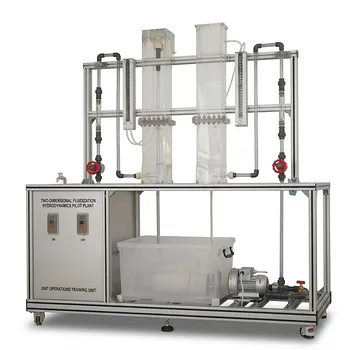
Two-Dimensional Fluidization Hydrodynamics Educational Pilot Plant for Unit Operations Training

Two-Dimensional Fluidization Hydrodynamics Educational Pilot Plant for Unit Operations Training

Explore gas-solid and liquid-solid fluidization hydrodynamics with our transparent 2D educational pilot plant. Ideal for chemical engineering unit operations labs, it demonstrates fixed to fluidized bed regimes, measures pressure drop, and integrates QR-code digital learning for enhanced student training.

Gas-Solid Heterogeneous Separation Demonstration Educational Unit Operations Pilot Plant

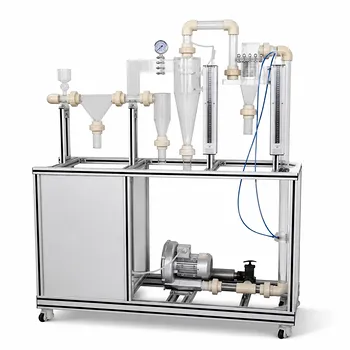
Gas-Solid Heterogeneous Separation Demonstration Educational Unit Operations Pilot Plant

Comprehensive visual transparent gas-solid separation pilot plant for chemical engineering labs. Demonstrates gravity settling inertial settling cyclone and bag filter technologies. Enables real-time analysis of fluid-particle mechanics pressure drop and collection efficiency. Ideal for undergraduate unit operations courses.

Educational Unit Operations Pilot Plant for Intraparticle Diffusion Effective Factor Measurement

Educational Unit Operations Pilot Plant for Intraparticle Diffusion Effective Factor Measurement

Designed for chemical engineering university labs, this pilot plant allows hands-on determination of catalyst particle intraparticle diffusion effective factors and gas-solid reaction kinetics using a fixed-bed tubular reactor with industrial touchscreen control, bridging theory and practical reactor design.

Hot Filtration Educational Unit Operations Pilot Plant Laboratory System

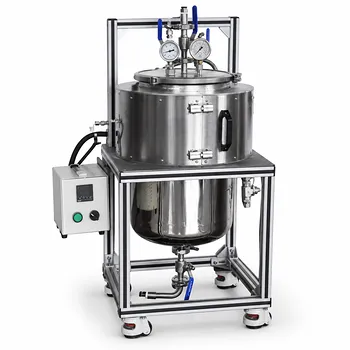
Hot Filtration Educational Unit Operations Pilot Plant Laboratory System

This integrated laboratory bench-scale hot filtration pilot plant enables students to study solid-liquid separation under thermal conditions, featuring a stainless steel vessel, removable heating jacket, and multi-layer filter plates for unit operations education, ideal for chemical engineering laboratory curriculum.

Fixed-Bed Chemical Reaction and Gas Dust Tar Removal Unit Operations Pilot Plant

Fixed-Bed Chemical Reaction and Gas Dust Tar Removal Unit Operations Pilot Plant

Integrated educational pilot plant for studying catalytic gas-solid reactions and downstream gas purification. Features dual fixed-bed reactor, three-stage heating, and touchscreen control for hands-on engineering training. Ideal for chemical and environmental engineering curricula.

Multi-Reactor Educational Pilot Plant for Reaction Engineering Unit Operations

Multi-Reactor Educational Pilot Plant for Reaction Engineering Unit Operations

Integrated bench-scale educational pilot plant for chemical engineering teaching featuring fixed bed fluidized bed and stirred tank reactors with web-based digital twin controls and safety interlocks for hands-on unit operations and reaction engineering comparative studies in one compact system.

Multimodal Absorption and Desorption Pilot Plant for Unit Operations Training

Multimodal Absorption and Desorption Pilot Plant for Unit Operations Training

Multimodal absorption and desorption pilot plant for higher education labs. Bridges theory and industrial practice with transparent packed columns, three operational modes (real-material, simulated, semi-physical), and SCADA control. Students explore mass transfer, column hydraulics, and process control. Customizable.

Multi-Functional Drying Educational Unit Operations Pilot Plant

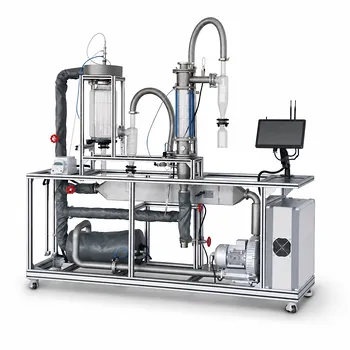
Multi-Functional Drying Educational Unit Operations Pilot Plant

Versatile multi-functional drying educational unit operations pilot plant integrating tunnel, fluidized bed, and spray drying. Enables hands-on study of drying curves, psychrometry, and gas-solid separation for chemical engineering curriculum in higher education labs.

Multi Pump Fluid Transport Process Piping Unit Operations Training Pilot Plant

Multi Pump Fluid Transport Process Piping Unit Operations Training Pilot Plant

Industrial-scale multi-pump pilot plant for unit operations training in fluid transport and process piping, featuring real-material and semi-physical simulation modes, comprehensive pump and flowmeter calibration, and safety-enhanced two-tier platform, bridging academic theory and industrial practice for chemical engineering education.

Three-Tube Heat Transfer Educational Pilot Plant for Unit Operations Training

Three-Tube Heat Transfer Educational Pilot Plant for Unit Operations Training

Three-tube heat transfer pilot plant for studying convective heat transfer enhancement and condensation. Allows comparison of smooth, corrugated, turbulent tubes, verifying empirical correlations. Ideal for chemical engineering education with safety and closed-loop steam recovery.

Natural Product Extraction Unit Operations Training Pilot Plant

Natural Product Extraction Unit Operations Training Pilot Plant

Integrated natural product extraction pilot plant for chemical engineering training bridges theory and industrial practice with modular extraction and evaporation/concentration units, hybrid touchscreen and manual control, realistic process simulation, and self-contained softened water and vacuum utilities.

Dual Mode Heat Transfer Pilot Plant for Unit Operations Training

Dual Mode Heat Transfer Pilot Plant for Unit Operations Training

Engineering-scale dual-mode heat transfer pilot plant for hands-on unit operations training in chemical engineering. Features real and simulated modes, multiple heat exchanger types, comprehensive coefficient determination, and advanced process control with data acquisition for engineering students and researchers.

Multi-Modal Distillation Unit Operations Training Pilot Plant

Multi-Modal Distillation Unit Operations Training Pilot Plant

Multi-modal distillation pilot plant for practical unit operations training in chemical engineering education. Features real, analog, and semi-physical simulation modes, industrial construction, customizable for university labs. Hands-on fractionation columns, SCADA control, safety systems. Includes sight glasses, sampling ports, closed-loop recycling.

Polymerization Granulation and Pellet Processing Educational Unit Operations Pilot Plant

Polymerization Granulation and Pellet Processing Educational Unit Operations Pilot Plant

Integrated pilot plant for teaching polymer processing from polymerization to pelletizing. Includes 30L reactor, hydrolyzer, extruder-granulator, vibration dryer, crusher, and sieve. Atmospheric pressure operation for safety, corrosion-resistant SS, customizable for chemical and polymer engineering education. Ideal for university labs.

Dual-Mode Rectification Pilot Plant for Practical Training Unit Operations

Dual-Mode Rectification Pilot Plant for Practical Training Unit Operations

Industrial-scale dual-mode rectification pilot plant for chemical engineering practical training. Features real-material and simulated-material operation modes, sieve-plate column with sight glasses for visual observation of hydrodynamics, and customizable SCADA control for safe, hands-on learning of unit operations and mass transfer.

Comprehensive Multi-Modal Heat Transfer Unit Operations Pilot Plant for Engineering Training

Comprehensive Multi-Modal Heat Transfer Unit Operations Pilot Plant for Engineering Training

Comprehensive multi-modal heat transfer unit operations pilot plant for engineering training. Features four heat exchanger types, multi-media switching, and three operating modes. Hands-on experience in safety, optimization, and process control. Industrial-grade design with real-time data acquisition for chemical engineering labs.

Ethyl Acetate Synthesis Unit Operations Pilot Plant for Practical Training

Ethyl Acetate Synthesis Unit Operations Pilot Plant for Practical Training

Modular and customizable pilot plant for ethyl acetate synthesis practical training. Integrates esterification reaction, liquid-liquid extraction, neutralization, and sieve-plate distillation unit operations. Bridging theory and real-world industrial processes. Designed for university chemical engineering labs

Supercritical High-Gravity Flash Evaporation Educational Unit Operations Pilot Plant

Supercritical High-Gravity Flash Evaporation Educational Unit Operations Pilot Plant

Bench-scale integrated teaching system for advanced separation and mass transfer, combining supercritical high-gravity flash evaporation with heating, chemical reaction, and material collection, featuring modular design, Stainless Steel 316L construction, transparent visualization, touchscreen control, and safety systems for chemical engineering education.

Fluidized Bed Gas Solid Catalytic Reaction Educational Pilot Plant

Fluidized Bed Gas Solid Catalytic Reaction Educational Pilot Plant

Our educational fluidized bed gas-solid catalytic reaction pilot plant is ideal for chemical engineering labs. Students study fluidization dynamics, catalyst evaluation, and process control hands-on. Features include a customizable reactor, touchscreen HMI, and safety interlocks for safe, curriculum-aligned experiments.


Leave Your Message