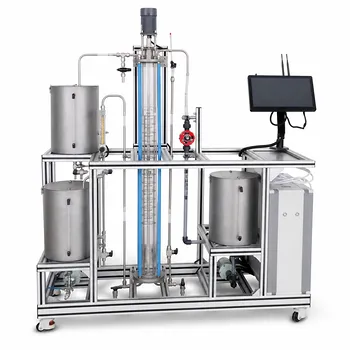
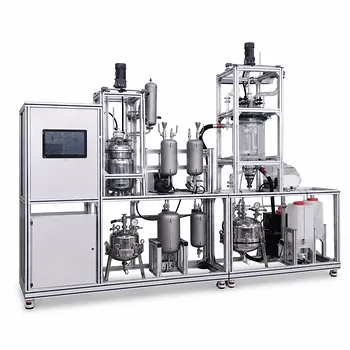
Azeotropes create an impossible distillation problem—liquid-liquid extraction directly solves it. In unit operations labs, LLE is the preferred teaching method because it exploits solubility differences to separate compounds that azeotropic distillation cannot touch. After extraction, the solute–solvent mixture is then fed to a standard distillation column, where the now non‑azeotropic system can be fractionated using normal boiling‑point differences. This integrated sequence embodies the core lesson: complex separations demand hybrid, multi‑unit strategies.
Azeotropes lock mixtures into a constant‑boiling trap that simple distillation cannot break. Teaching liquid–liquid extraction first removes that lock without relying on vapor–liquid equilibrium, then hands a clean, non‑azeotropic stream to distillation for final polishing—making the combined process a perfect educational model for hybrid industrial separations.
Why Azeotropes Defeat Simple Distillation
An azeotrope is a mixture where the vapor and liquid phases have identical compositions. At that point, the bubble‑point and dew‑point lines cross, and boiling no longer enriches either component. Pouring more heat in just makes more of the same equilibrium mixture. Standard distillation hits a thermodynamic wall.
The Educational Blind Spot
Students quickly learn that a single distillation column cannot break an azeotrope. The lesson sticks because the limitation is absolute, not just inconvenient. This creates the ideal scenario to introduce a different driving force: solubility.
The Case for Liquid–Liquid Extraction in the Teaching Lab
LLE separates based on partition coefficients, not volatility. It introduces a selective solvent that preferentially dissolves one component from the feed mixture. Because the driving force is chemical affinity, not boiling point, azeotropes become irrelevant. This makes LLE the perfect tool to demonstrate a workaround for a fundamental thermodynamic barrier.
Solubility Differences Overcome Boiling‑Point Constraints
The solvent “pulls” the target solute into a new liquid phase while leaving the other components behind. Even when the original mixture boils as a single azeotrope, the solute’s solubility in the solvent can be high enough to achieve a clean split. The process operates at mild temperatures, often at room temperature, and involves no phase change—just liquid‑liquid contacting.
Key Industrial Scenarios That LLE Teaches
Pilot‑scale LLE labs expose students to the three classic situations where extraction is favored over distillation:
- Azeotropic or close‑boiling mixtures: When relative volatility is near 1, distillation becomes excruciatingly energy‑intensive. LLE side‑steps the equilibrium entirely.
- Low‑concentration, high‑boiling solutes: Recovering a tiny amount of acetic acid from water by distilling off all the water wastes enormous energy. Extraction concentrates the acid efficiently.
- Heat‑sensitive materials: Antibiotics, organic acids, or natural products degrade at distillation temperatures. LLE preserves them by working at ambient conditions.
These scenarios reinforce when and why an engineer reaches for extraction first.
Integrating Extraction with Distillation: A Complete Separation Sequence
The real mastery comes from sequencing unit operations. A liquid–liquid extraction pilot plant rarely stands alone; it feeds a downstream distillation column. This integration is the core of the lab exercise.
Breaking the Azeotrope with Solvent
In the extraction step, the solute transfers from the feed into the solvent phase. The resulting extract is now a mixture of solute and solvent. Critically, this new binary system usually does not form an azeotrope and often exhibits large boiling‑point differences. The solvent is chosen deliberately to create this favorable separation profile.
Distillation as the Final Polishing Step
With the azeotrope broken, the extract can be routed to a simple distillation column. The column then separates the solute from the solvent by straightforward fractionation. The solvent is typically recycled back to the extractor, closing the loop. Students witness how a process that was impossible in one unit becomes trivial in the next, purely because the feed composition was reshaped by extraction.
The Pedagogical Fuel of Integration
Working through the LLE‑to‑distillation handshake teaches:
- Mass transfer fundamentals in two distinct modes (diffusion‑limited extraction vs. vapor‑liquid equilibrium).
- Solvent selection criteria—not just for solubility but for easy downstream recovery.
- Material and energy balances across linked pieces of equipment.
- The concept of hybrid separations, where each unit handles what it does best.
This layered insight is far more valuable than any single‑unit demonstration.
Understanding the Trade‑offs and Limitations
No unit operation is universally superior. Teaching LLE also means confronting its practical complexities.
Solvent Selection Is a Multi‑Objective Puzzle
The solvent must offer high selectivity and capacity, be non‑toxic, chemically stable, easily recovered, and have negligible miscibility with the raffinate. Finding one chemical that ticks all boxes is rare. The lab highlights how solvent screening becomes its own research problem.
Adding a Second Liquid Phase Brings New Handling Challenges
Emulsion formation, slow settling, and density‑difference constraints can delay phase separation. Students learn to evaluate mixer‑settler designs and extraction columns not just in theory but under real hydraulic behavior. These operational headaches are the price of bypassing an azeotrope.
Energy Savings Are Context‑Dependent
While extraction avoids boiling the entire feed, solvent regeneration in the downstream distillation still consumes energy. For very dilute feeds, LLE cuts total energy use dramatically. For more concentrated streams, the advantage can shrink. The lab’s data force students to calculate the total energy budget across both steps, building a genuine cost/benefit mindset.
Making the Right Choice for Your Educational Objectives
If you’re designing or selecting a unit‑ops experiment, let the learning outcome guide the configuration.
- If your primary focus is teaching how to overcome a thermodynamic limitation: Choose an azeotropic feed and an LLE‑plus‑distillation sequence. The visual contrast between a failed distillation and a clean extract is unforgettable.
- If your primary focus is energy efficiency and green processing goals: Pair the LLE pilot plant with a low‑temperature distillation step, and highlight the energy saved by not boiling the entire azeotropic mixture.
- If your primary focus is industrial realism for bioprocesses: Use a heat‑sensitive surrogate compound and emphasize that LLE preserves product quality while distillation would destroy it.
- If your primary focus is process integration and solvent recovery: Run the full closed‑loop extraction–distillation pilot plant and let students optimize solvent recycle ratios and purity targets.
Mastering azeotrope challenges with a hybrid LLE‑distillation sequence transforms a theoretical impossibility into a tangible, scalable engineering solution.
Summary Table:
| Separation Step | Primary Driving Force | Role in Azeotrope Breaking | Key Educational Value |
|---|---|---|---|
| 1. Liquid-Liquid Extraction | Solubility / Partition Coefficient | Bypasses vapor-liquid equilibrium barriers | Teaches chemical affinity & solvent selection |
| 2. Downstream Distillation | Volatility / Boiling Point | Separates solute from solvent (non-azeotropic) | Teaches energy balances & closed-loop recycle |
Bring Advanced Separation Technology to Your Lab
Equip your students and researchers with the tools to master complex hybrid separations. LABPARK provides state-of-the-art Educational and Vocational Unit Operations Pilot Plants in chemical engineering, bioprocess & biotech, and environmental & water treatment. Designed specifically for universities, research institutes, and enterprises, our systems offer hands-on experience with LLE and distillation integration.
Contact LABPARK Today to customize your pilot plant and elevate your practical training!
Related Products
- Comprehensive Liquid-Liquid Extraction Pilot Plant for Engineering Education
- Educational Rotary Disc Liquid-Liquid Extraction Pilot Plant
- Gallium and Indium Selective Extraction Educational Pilot Plant
- Liquid-Liquid Mass Transfer Coefficient Determination Educational Pilot Plant
- Two-Dimensional Fluidization Hydrodynamics Educational Pilot Plant for Unit Operations Training
People Also Ask
- How do pilot plants differentiate physical vs chemical extraction? Enhance Chemical Engineering Training
- How to Estimate KD for Liquid-Liquid Extraction Pilot Plants Using Henry's Law when Lab Data is Limited
- Why is the plait point a critical limit in liquid-liquid extraction pilot plants? Safe LLE Operation
- In a liquid-liquid extraction pilot plant, how is a ternary-phase diagram utilized to determine solvent feed requirements?
- How to resolve emulsion in liquid-liquid extraction? 5 ways to ensure efficient phase separation