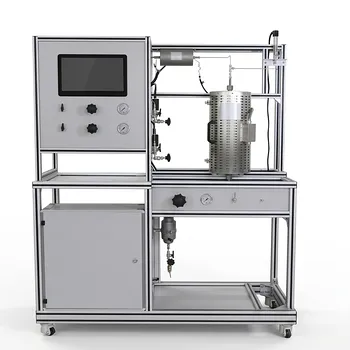
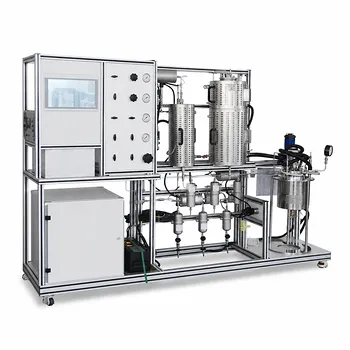
The modern chemical plant is a hybrid of proven foundations and cutting-edge innovation. A vocational unit operations pilot plant must include both conventional equipment like stirred tank reactors and distillation columns alongside novel micro-reactors because this dual-platform approach transforms the facility from a simple demonstration rig into a strategic benchmarking tool. It allows engineers and students to directly compare mass and heat transport, reaction kinetics, and energy efficiency side-by-side, building the critical skill of selecting the right technology for the right process rather than blindly favoring one paradigm.
A pilot plant equipped with both conventional and intensified technologies solves the deep need of developing judgment. It doesn’t just teach how each system works—it reveals when and why one outperforms the other, producing engineers who can design optimal, future-proof chemical manufacturing processes instead of merely operating legacy equipment.
The Core Purpose: Benchmarking for Informed Decisions
The primary reference frames dual-system pilot plants as essential for comparative evaluation. Without a side-by-side benchmark, learners only see isolated performance. With both, they can measure the true trade-offs in heat transfer efficiency, reaction selectivity, and operational simplicity.
Comparing Reaction Kinetics and Transport Phenomena
Micro-reactors achieve volume reductions of 10 to 1,000 times by shrinking diffusion distances to micrometers. A student observing a conventional stirred reactor next to a microchannel reactor can directly measure how this geometric shift eliminates heat transfer limitations.
In one demonstration, steam methane reforming reaches contact times under 10 milliseconds in the microreactor while the conventional system struggles with slow heat transfer. This direct observation cements the link between surface-to-volume ratio and kinetic limit operation far more powerfully than any textbook.
Evaluating Energy Efficiency and Process Integration
Process intensification often combines multiple steps, like reaction and separation, into a single unit. A pilot plant with both approaches lets users quantify energy savings by directly comparing a conventional sequence (reactor → separator → reboiler) against a heat-integrated, multifunctional reactor.
The heat-integrated reactor decouples reaction energy from external utilities, converting high-temperature heat directly into chemical energy. Measuring the reduced carbon footprint and lower operating costs side-by-side with conventional setups transforms abstract sustainability goals into concrete, measurable outcomes.
Understanding When to Scale Up—or Number Up
Conventional scale-up relies on increasing vessel size, which alters mixing, heat transfer, and fluid dynamics. Micro-reactors scale via numbering up: replicating identical microchannel plates in parallel without changing reaction dynamics. Pilot plants that house both reveal this fundamental difference.
A student can take a reaction from a 1 kg batch to a 10 kg batch and observe efficiency drops. Then they can run the same reaction in a microreactor stack, holding performance constant. This hands-on experience builds deep intuition about scale-up risks and the potential for modular, distributed manufacturing.
Beyond the Classroom: Bridging Lab and Commercial Reality
Vocational training aims to produce engineers who can step into real plants. Modern pharmaceutical and chemical companies increasingly adopt continuous manufacturing to reduce inventory, cycle times, and cleaning downtime. A pilot plant lacking both batch and continuous modules leaves graduates unprepared for this industry shift.
Batch vs. Continuous: Comparative Operational Dynamics
Residence time distribution, flow control, and startup/shutdown dynamics differ fundamentally between batch and continuous systems. A dual-mode pilot plant lets trainees run the same reaction in both modes, measuring yield consistency and waste generation.
This direct comparison reveals why continuous manufacturing delivers leaner operations, but also exposes its vulnerabilities—like handling solids. Without seeing both, an engineer might naively assume continuous is always superior, a costly misunderstanding in a real plant.
Validating Economics and Risk at Intermediate Scale
A unit operations pilot plant exists to de-risk commercial scale-up. It validates raw material utilization, by-product handling, and equipment integrity before committing millions. Using only micro-reactors would hide the challenges of large-volume mixing and heat removal. Using only conventional equipment would mask opportunities for dramatic footprint and cost reduction.
Thus, the dual system provides a complete risk-assessment sandbox. It answers questions like: “What is the true minimum reactor volume for this endothermic reaction?” and “At what production volume does numbering up become uneconomical compared to a single large batch reactor?”
Understanding the Trade-offs
While process intensification brings thermal control and safety, it’s not a universal solution. A discerning engineer must know its hard limits.
The Solids Problem and Channel Blocking
Microchannel reactors typically have channel dimensions near 1 mm. Any solids formation or particulate contamination can block these channels instantly, halting production. Conventional reactors handle slurries and precipitates with robust impellers and wider passages. A pilot plant that only boasts microreactors would give a dangerously incomplete picture of real chemical manufacturing constraints.
Corrosion Sensitivity and Material Compatibility
Intensified systems often use thin metal plates with precisely etched features. They exhibit heightened susceptibility to corrosion compared to thick-walled bulk reactors, restricting the range of possible reaction fluids. Benchmarked against a conventional glass-lined or stainless steel vessel, the trade-off between compactness and durability becomes tangible. This teaches engineers to evaluate life-cycle costs, not just initial performance gains.
Training for Real-World Operations
From an educational standpoint, if a pilot plant skips conventional equipment, the learner may never develop troubleshooting skills for fouling, hot spots, or mixing dead zones. If it skips micro-reactors, the learner misses process intensification entirely. The fusion ensures comprehensive competence, producing a professional who can adapt to any plant environment, legacy or greenfield.
Making the Right Choice for Your Training Goal
If your primary focus is foundational education: Ensure the pilot plant includes classic unit operations like distillation, extraction, and stirred reactors. Use micro-reactors as advanced modules to illustrate intensification principles after core concepts are mastered.
If your primary focus is industry-relevant research: Prioritize a setup where the same reaction can be routed through conventional and microreactor streams with in-line analytics. This enables apples-to-apples performance benchmarking, directly supporting process development and scale-up studies.
If your primary focus is cultivating innovation and entrepreneurship: Lean heavily on the microreactor train to demonstrate how small hold-ups (under 150 ml) enable safe, rapid experimentation with hazardous chemistries. Pair it with conventional systems to show where the business case for continuous manufacturing clearly breaks even.
The most powerful vocational pilot plant is not a museum of either old or new technology—it is a deliberate comparative arena where the engineer learns to choose, not just to operate.
Summary Table:
| Feature | Conventional Equipment | Micro-reactors (Process Intensification) |
|---|---|---|
| Scale-up Method | Increasing vessel size (complex fluid dynamics) | Numbering up parallel channels (predictable) |
| Heat & Mass Transfer | Limited by surface-to-volume ratio | Extremely high (micrometer diffusion) |
| Solids Handling | Excellent (handles slurries and precipitates) | High risk of channel blocking/clogging |
| Primary Application | Training on legacy/standard industrial setups | Safe, rapid experimentation & continuous flow |
Future-Proof Your Engineering and Research Programs with LABPARK
At LABPARK, we empower universities, research institutes, and enterprises by delivering state-of-the-art Educational and Vocational Unit Operations Pilot Plants in chemical engineering, bioprocess & biotech, and environmental & water treatment. By integrating conventional chemical equipment with cutting-edge process intensification technologies like micro-reactors, our systems provide the hands-on benchmarking tools needed to train top-tier engineers and de-risk commercial scale-ups.
Ready to transform your training facility or laboratory? Contact LABPARK today to discuss your project requirements and receive a customized solution!
Related Products
- Three-Tube Heat Transfer Educational Pilot Plant for Unit Operations Training
- Multimodal Absorption and Desorption Pilot Plant for Unit Operations Training
- Carbon Dioxide Hydrogen Methanol Synthesis Educational Unit Operations Pilot Plant
- Multi-Reactor Educational Pilot Plant for Reaction Engineering Unit Operations
- Multi Pump Fluid Transport Process Piping Unit Operations Training Pilot Plant
People Also Ask
- When is ε-NTU preferred over LMTD in pilot plants? Predict heat exchanger performance without iteration.
- How does transitioning to a multi-shell heat exchanger affect required area? Optimize pilot plant design.
- How to configure heat transfer pilot plants for pinch analysis? Teach energy recovery.
- What engineering trade-offs must students analyze in a heat transfer pilot plant? Balance performance & cost.
- How does cascade control achieve superior disturbance rejection in heat transfer pilot plants?