If you’re wondering why a reducing agent is added right before ion-exchange, the direct answer is deceptively simple. Hydroxylamine hydrochloride is added to chemically convert all dissolved iron from its ferric (Fe³⁺) state to the ferrous (Fe²⁺) state. This single transformation prevents the metal from interfering with the resin’s ability to cleanly separate anions like phosphate and sulfate in one streamlined pass.
The true purpose of hydroxylamine hydrochloride goes beyond sample prep—it fundamentally alters iron’s charge and chemistry to enable a faster, cleaner, and visually diagnostic separation. Without it, ferric ions form complexes that foul the resin, contaminate your silica residue, and make a single-pass anion isolation impossible.
Why Oxidation State Dictates Separation Success
The performance of your ion-exchange column hinges entirely on the charge of the species in solution. Ferric and ferrous ions behave very differently, and that difference can determine the accuracy of your whole analysis.
The Ferric Interference Problem
In a digested scale sample, iron originating from corroded steel exists as Fe³⁺. Unlike simple cations, ferric ions readily form chloride complexes like FeCl₆³⁻ in the concentrated hydrochloric acid environment used for digestion. This complex carries a negative charge, allowing it to stick to the anion-exchange resin.
That co-adsorption contaminates the anion fraction you are trying to isolate. Your phosphate and sulfate levels will be inaccurate, and the separation becomes messy.
The Ferrous Solution
Reducing Fe³⁺ to Fe²⁺ strips away that complex-forming ability. Ferrous ions remain simple, positively charged cations. When passed through an anion-exchange column, they pass straight through while negatively charged phosphate and sulfate ions are retained.
This lets you achieve complete separation of all target anions from iron in a single, rapid step. No re-precipitation, no secondary columns needed.
The Dual Purpose: A Built-in Diagnostic Tool
Beyond the chemical separation, hydroxylamine hydrochloride acts as a colorimetric indicator that gives you immediate, qualitative information about your sample's composition.
Recognizing Iron Visually
When you add the reagent to a solution containing iron, you will see a distinct yellow color. This is the formation of the ferric chloride complex during the early stages of mixing. It confirms the presence of iron before any instrumental analysis.
Detecting Chromium
An even more useful cue appears if chromium is present. The solution will shift from an orange or yellow hue to a vivid green. This specific color change signals chromium reduction and alerts you to an element that might otherwise be overlooked in routine scale analysis.
Impact on Silica Residue Purity
The benefits extend to gravimetric steps downstream. After the ion-exchange separation, silica is often recovered as a residue.
Without reduction, ferric ions can co-precipitate or adsorb onto the silica particles, weighing them down with contamination. By reducing the iron to Fe²⁺ and ensuring it passes the column cleanly, you get a silica residue that is significantly less contaminated, improving the accuracy of your final silica quantification.
Understanding the Trade-offs and Critical Control Points
While the addition is beneficial, neglecting the procedural details will compromise your data. Objectively, the reagent’s effectiveness is conditional.
Incomplete Reduction
The biggest pitfall is insufficient reaction time. The reference procedure explicitly requires boiling the solution for at least five minutes after adding hydroxylamine hydrochloride. Cutting this short leaves residual Fe³⁺, which defeats the purpose and still fouls the column.
Reagent Purity and Age
Hydroxylamine hydrochloride itself is a reducing agent that can slowly degrade. Using an old or impure batch introduces unknown variables. Always consider the reagent's condition; a weak reducing solution won't drive the reaction to completion, leading to the same ferric interference you were trying to avoid.
Not a Universal Reductant
This step specifically targets iron. It will not mask or alter other potential interferences that may be present in complex scale matrices. You must ensure your analytical method accounts for other metals through separate quality control steps, not rely on hydroxylamine hydrochloride to fix everything.
How to Apply This to Your Analytical Procedure
Your decision to use—and how to monitor—this step should align with the quality objectives of your water chemistry program.
- If your primary focus is high-throughput sample processing: The single-pass separation enabled by the reduction is non-negotiable. It saves hours compared to multi-step precipitations, but you must strictly enforce the five-minute boiling rule to guarantee complete conversion.
- If your primary focus is trace-level silica accuracy: Pay close attention to the color change. A yellow solution confirms you have reduced the iron that would otherwise contaminate your gravimetric result, giving you confidence in a purer silica yield.
- If your primary focus is troubleshooting an unfamiliar scale: Use the visual diagnostic cues deliberately. A green hue after addition is a red flag for chromium, directing you to further investigation you might otherwise have missed.
Ultimately, hydroxylamine hydrochloride is the switch that turns a stubborn, complex iron contaminant into a cooperative, transparent cation, clearing the path for a single-pass analysis that is both rapid and reliably accurate.
Summary Table:
| Process / Parameter | Ferric Iron (Fe³⁺) | Ferrous Iron (Fe²⁺) (Post-Reduction) |
|---|---|---|
| Resin Behavior | Forms anionic complexes; fouls the resin | Remains a simple cation; passes through |
| Anion Separation | Contaminates target phosphate & sulfate | Enables clean, single-pass anion isolation |
| Visual Cues | Yellow color indicating iron presence | Green color if chromium is reduced |
| Silica Purity | Contaminates silica residue during recovery | Passes cleanly; improves gravimetric accuracy |
Optimize Your Water Chemistry and Separation Process Training
Are you looking to bridge the gap between classroom theory and real-world water treatment applications?
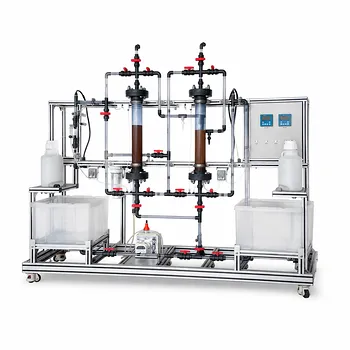
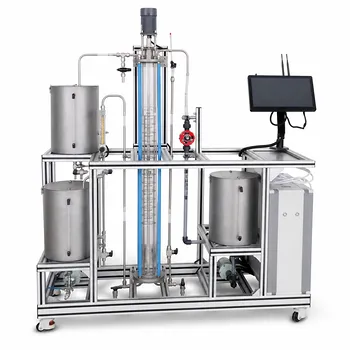
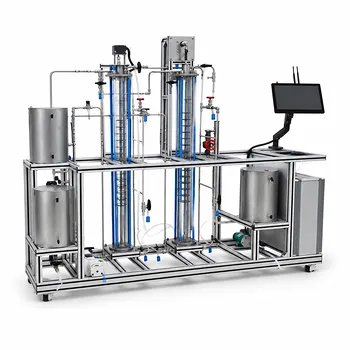
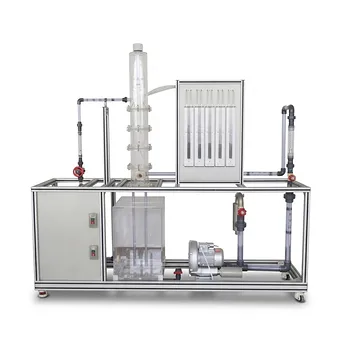
LABPARK provides state-of-the-art Educational and Vocational Unit Operations Pilot Plants in:
- Environmental & Water Treatment (including ion-exchange technology)
- Chemical Engineering
- Bioprocess & Biotech
Designed specifically for universities, research institutes, and enterprises, our pilot plants empower students and researchers to master practical process controls and analytical techniques.
Ready to upgrade your laboratory training capabilities? Contact us today to find the ideal pilot plant solution for your institution!
Related Products
- Ion Exchange Water Purification Educational Pilot Plant for Engineering Unit Operations
- Educational Rotary Disc Liquid-Liquid Extraction Pilot Plant
- Multi-Modal Distillation Unit Operations Training Pilot Plant
- Comprehensive Liquid-Liquid Extraction Pilot Plant for Engineering Education
- Plate Column Hydrodynamics Tray Demonstration Educational Pilot Plant
People Also Ask
- How to Prevent Ion Exchange Channeling? Expert Solutions for Pilot Plants
- What operational precautions should lab operators take for resin volume changes and air pockets? Key Guide
- How does ion exchange work in water treatment pilot plants? Cost & process guide.
- How to use ion exchange pilot plants to verify alkalinity? A hands-on guide for engineering students.
- Why does iron degrade cation resin & how to demonstrate capacity recovery? Step-by-Step Lab Guide