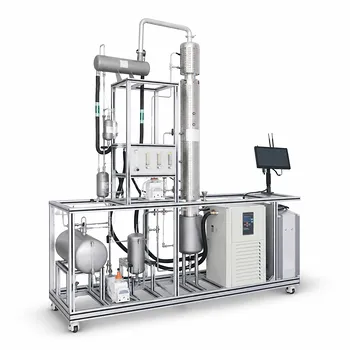
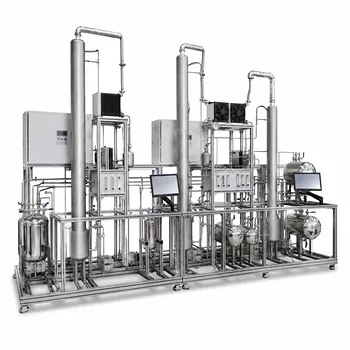
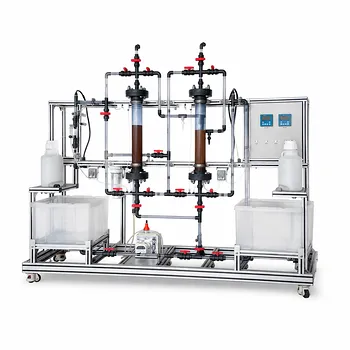
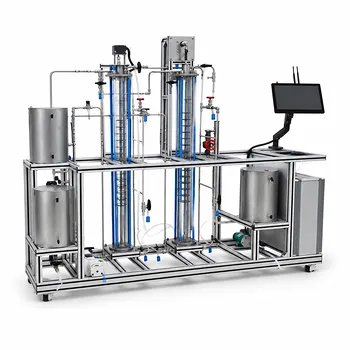
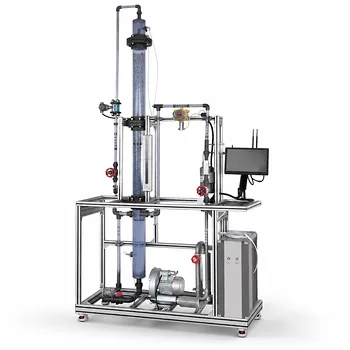
In a distillation pilot plant, getting thermodynamics ‘almost right’ near an azeotrope can still cost you the entire column.
This is not about academic precision—it is about financial survival. The capital cost of a separation process scales roughly as (ln α)⁻¹, where α is the relative volatility. When a mixture approaches an azeotrope, α drifts dangerously close to 1, and the logarithm plunges towards zero. Even a minuscule error in predicting α at that edge can explode into a staggering over- or underestimation of required stages, reflux ratio, and column diameter, turning a viable design into an uneconomical monster—or a physical impossibility.
Near an azeotrope, distillation economics and operability become hypersensitive to thermodynamic fidelity. A 1% misprediction in relative volatility can double your capital cost estimate, making pilot-plant validation and high-accuracy phase-equilibrium models the only credible foundation for scale-up.
The Hypersensitivity of Separation to Relative Volatility
How a Tiny Drift in α Warps Column Design
The workhorse relationship in distillation design is the number of stages, which depends on α through a function that explodes as α → 1. The cost term (ln α)⁻¹ acts like a megaphone for errors.
Imagine an α of 1.05 for a close-boiling mixture. If your thermodynamic model underestimates α by just 2%—bringing it to 1.029—the resulting column may require twice the number of trays. That misjudgment not only inflates the tower height and capital cost but can also demand a reflux ratio that makes energy consumption unworkable.
The Azeotropic Cliff: Where Even Smart Models Stumble
At an azeotrope, α identically equals 1. In the immediate surroundings, the volatility ratio flattens, and the gradient of separation efficiency collapses.
Because α is calculated from vapor pressures and activity coefficients, any inaccuracy in the underlying model—especially for non-ideal liquid-phase interactions—directly distorts the azeotropic composition, temperature, and the entire VLE envelope. A pilot plant that relies on a generic model might predict a feasible separation where none exists, or worse, miss a narrow window where pressure-swing distillation could break the azeotrope.
From Classroom Theory to Pilot Plant Reality
Why the Pilot Plant Demands More Than a Textbook
A pilot column is not just a scaled-down production unit; it is a truth-telling instrument. It exposes the gap between idealized equations of state and the messy reality of heat losses, liquid maldistribution, and tray inefficiencies.
When you operate near an azeotrope, the pilot plant’s role shifts from demonstration to validation under stress. Every temperature profile deviation and composition mismatch becomes magnified. High thermodynamic accuracy ensures that the discrepancies you observe are due to real hydraulic or kinetic effects—not errors in the fundamental assumption of the phase split.
Regressed VLE Data as the Anchor for Simulation
Blind simulation is dangerous. To get accuracy near azeotropes, you must regress binary interaction parameters (like those in NRTL or UNIQUAC) against actual experimental data across the boiling-point range at the pilot plant’s operating pressure.
This approach aligns the simulator’s thermodynamic engine with the column’s real behavior. When researchers substitute estimated activity coefficients into a rigorous regression, the resulting NRTL parameters become the fingerprint of that specific mixture. Only then can the simulation reliably predict whether the column can pull components apart—or whether you need an entrainer, a pressure swing, or a membrane-assisted process like pervaporation.
Why Generic Models Fail Near Azeotropes
Non-Ideality Is the Norm, Not the Exception
Azeotropic systems are defined by strong molecular interactions—hydrogen bonding, dipole–dipole forces, or quadrupole effects. Ideal-solution assumptions (Raoult’s law) break down completely.
Take a mixture of carbon dioxide and ethane, which forms a positive azeotrope. An activity coefficient model that treats the liquid phase as a simple regular solution will misplace the azeotropic point and misjudge the concentration where distillation stalls. The pilot plant then teaches a false lesson, leading to flawed scale-up strategies.
The Master Variable: How Accuracy in Activity Coefficients Feeds Through
Relative volatility is the ratio of vapor pressures times activity coefficients. Even if your vapor-pressure correlation is perfect, a small error in the activity coefficient ratio near the azeotrope can skew α by orders of magnitude.
For heterogeneous azeotropes, where a second liquid phase appears, the challenge doubles. The model must solve Vapor-Liquid-Liquid Equilibrium (VLLE) correctly. An inaccurate thermodynamic prediction might suggest a homogeneous liquid when phase splitting is already occurring, causing the pilot column to flood or show unexpected composition profiles.
Understanding the Trade-offs: Accuracy, Cost, and Educational Goals
The Real Cost of Over‑Precision
Not every pilot-plant task demands 0.1% accuracy. A preliminary feasibility study can often tolerate ~10% error, because the goal is simply to see if a separation is plausible. For detailed vessel sizing, 5% is acceptable and 1% is desirable.
However, near an azeotrope, the economic gradient is so steep that even a 5% error in α can render the design useless. This is not the place to save time with quick-and-dirty predictive models. The trade-off is clear: invest in high-fidelity VLE data and regressed parameters now, or pay orders of magnitude more later in oversized equipment, excessive energy bills, or a column that fails to start up.
The Risk of Experimental Overconfidence
Pilot-plant runs generate beautiful data, but they too can mislead if thermodynamic accuracy is neglected. Researchers might observe a sharp composition change and misinterpret it as a viable separation, when in truth the column is operating so close to α = 1 that a slight pressure fluctuation would collapse performance.
The safety net is a synergistic loop: use accurate predictions to design the experiments, then use the pilot data to refine the thermodynamic model. This iterative marriage prevents both overdesign and under-design, and teaches students that thermodynamics is not a solved book problem but a living tool.
Making the Right Choice for Your Pilot Plant Goal
How tight must your thermodynamic calculations be? It depends entirely on what you are trying to achieve.
-
If your primary focus is preliminary process screening or classroom demonstration: A fast, approximate model (like regular solution theory) may suffice. Accept ~10% error to quickly map out possible separation sequences, but never use these results to order a column.
-
If your primary focus is detailed column design for an industrial pilot plant: Accuracy must tighten to at least 1–5%. Regress NRTL or UNIQUAC parameters against experimental VLE data, and explicitly verify the azeotropic composition and temperature under the column’s planned pressure.
-
If your primary focus is optimizing an azeotropic or extractive distillation scheme: Demand accuracy of 1% or better on the activity coefficient ratios near the azeotrope. Integrate pilot-plant runs with rigorous parameter estimation to confirm entrainer selection and feed location before spending capital on a full-scale unit.
-
If your primary focus is training students to think like engineers: Use the azeotrope as a ‘stress test.’ Require them to compare low-accuracy predictions with high-accuracy regressions, and to measure how the column’s performance degrades when α is off by just a few percent. That single lesson anchors a lifetime of respect for thermodynamic data.
One fact remains unshakable: near an azeotrope, thermodynamics is not a supporting detail—it is the pilot plant. Get it wrong, and your column becomes an expensive monument to a misplaced decimal.
Summary Table:
| Pilot Plant Goal | Target Accuracy | Recommended Thermodynamic Model/Action |
|---|---|---|
| Classroom / Screening | ~10% error | Use fast, approximate models (e.g., regular solution theory) |
| Detailed Column Design | 1% – 5% error | Regress NRTL or UNIQUAC parameters against experimental VLE data |
| Azeotropic Optimization | < 1% error | Focus on high-fidelity activity coefficient ratios near the azeotrope |
Bring Precision to Your Separation Processes with LABPARK
Accurate thermodynamics is the foundation of successful pilot plant scale-up. LABPARK provides state-of-the-art Educational and Vocational Unit Operations Pilot Plants in chemical engineering, bioprocess & biotech, and environmental & water treatment.
Specifically designed for universities, research institutes, and enterprises, our high-fidelity systems help you validate complex thermodynamic models, mitigate risks near azeotropic points, and ensure seamless scale-up.
Ready to elevate your engineering lab's capabilities? Contact us today to discuss your pilot plant needs!
Related Products
- Continuous Sieve-Plate Distillation Pilot Plant for Unit Operations Laboratory Education
- Multi-Modal Distillation Unit Operations Training Pilot Plant
- Dual-Mode Rectification Pilot Plant for Practical Training Unit Operations
- Multi-Functional Special Distillation Educational Pilot Plant
- Green Anhydrous Ethanol Purification Extractive Distillation Unit Operations Training Pilot Plant
People Also Ask
- How can real-time carbon number prediction improve distillation pilot plants? Optimize control.
- Why is vacuum operation capability an essential feature for a distillation unit operations pilot plant? Unlock Efficiency
- How to select the right activity coefficient model (Wilson, NRTL, UNIQUAC) for distillation pilot plants?
- What are the primary reflux ratio control strategies? Master Distillation Unit Operations
- How does catalyst water concentration affect distillation pilot plant design? Key separation train choices.