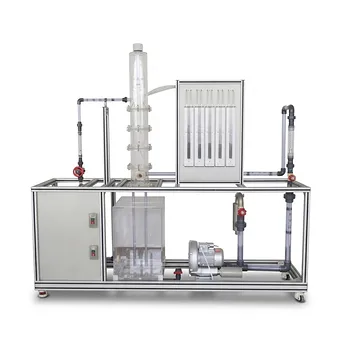
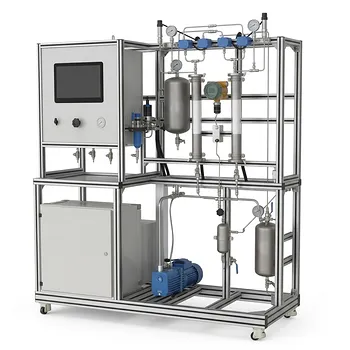
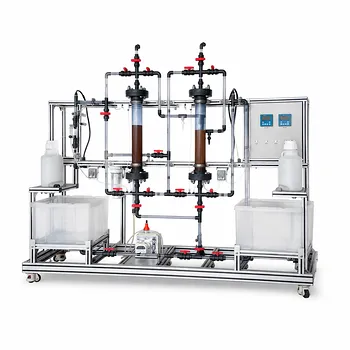
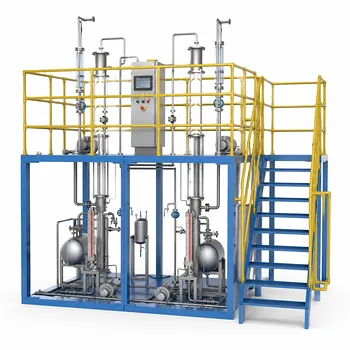
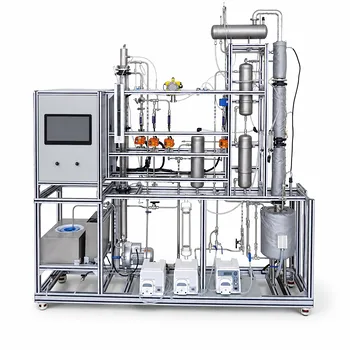
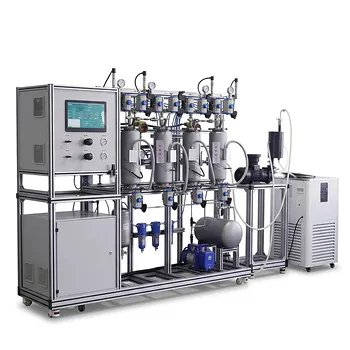
Let’s start with the most direct answer: Borosilicate glass is the material of choice for educational distillation and absorption pilot plants because it provides unmatched visual transparency—allowing students to observe the real-time fluid dynamics that define mass transfer operations—while also delivering exceptional thermal shock resistance and broad chemical inertness. The critical safety precautions center on containing glass fragments with protective wrapping and preventing catastrophic pressure buildup through reliable atmospheric venting.
Educational pilot plants are not just scaled-down industrial units; they are live demonstrations of hydrodynamic and thermodynamic theory. Borosilicate glass turns an opaque industrial process into a transparent learning tool, but its brittleness and low-pressure limits demand that every system be wrapped, vented, and operated with a deep respect for its physical boundaries.
Why Visibility is a Foundational Need in Education
From Theory to Tangible Observation
In a textbook, flooding, weeping, and phase separation are abstract concepts. In a borosilicate glass column, they become immediate, visible events. This direct observation bridges the gap between mathematical models and physical reality, a learning outcome that stainless steel could never provide.
Decoding Mass Transfer in Real Time
For absorption studies involving gases like SO₂ or chlorine, a transparent column lets students and researchers see the onset of emulsion formation, interfacial rag layers, and phase boundary shifts. In liquid-liquid extraction pilot plants, glass-walled columns are indispensable for accurately estimating phase separation times and gathering the high-quality data needed to scale up to industrial opaque vessels.
Building an Intuitive Understanding of Hydrodynamics
Watching liquid hold-up, bubble behavior, and froth entrainment creates an intuitive understanding of column operation that no simulation can replicate. This visual feedback loop is what cements core chemical engineering principles during vocational training.
The Material Science That Makes It Possible
Exceptional Thermal Shock Resistance
Borosilicate glass, with its high silica content (typically 60–80% SiO₂) and critical boron trioxide (>8% B₂O₃), has an extremely low coefficient of thermal expansion. This means it can endure rapid temperature swings—such as a sudden startup of a steam-heated reboiler or a chilled condenser—without cracking, a crucial safety advantage over ordinary soda-lime glass.
Broad Chemical Durability (With Crucial Boundaries)
The glass resists corrosion from most acids and organic solvents, making it ideal for handling the wide range of chemicals encountered in a teaching curriculum. However, it is not inert to everything. Hydrofluoric acid and prolonged contact with strong alkaline solutions will etch and structurally weaken the glass network. This chemical boundary must be a cornerstone of any standard operating procedure.
A Safer Fracture Pattern
When borosilicate glass fails under extreme thermal or mechanical stress, it tends to crack rather than shatter into a hail of sharp shards like soda-lime glass. This controlled failure mode minimizes the risk of laceration, but it does not eliminate the hazard of flying fragments, which leads directly to the essential safety practices.
Core Safety Precautions for Operating Glass Pilot Plants
Containment Through Protective Wrapping
All glass columns, pipes, and sight glasses must be wrapped with heavy-duty plastic tape. This is not a maintenance afterthought; it is a primary engineered control. In the event of a break, the adhesive tape holds the pieces together, preventing glass fragments from scattering into the workspace and onto operators.
Pressure Management: The Absolute Rule of Venting
Borosilicate glass is inherently brittle and has a very low pressure tolerance. It is generally unsuitable for any operating pressure significantly above atmospheric. The most dangerous scenario is an accidental pressure surge. Therefore, every glass system must incorporate unrestricted atmospheric venting as a passive safeguard. Pressure relief valves alone are insufficient—the system must have a continuously open vent path to preclude any chance of a buildup.
Sealing Integrity in a Glass System
Glass flanges can easily be over-tightened and cracked. Seals must be made with chemically resistant, mechanically forgiving gaskets—typically PTFE (polytetrafluoroethylene). PTFE offers the chemical inertness needed without the stiffness that would stress the glass during assembly and thermal cycling.
The Special Perils of Vacuum Operations
When a distillation pilot plant is run under vacuum, the risk profile inverts from overpressure to implosion. Safety here requires three non-negotiable steps:
- Pre-operation inspection: Every glass component must be meticulously checked for microscopic stars or cracks before applying vacuum; a single flaw can cause a violent implosion.
- Pump protection: A sequence of absorption traps (containing desiccants like anhydrous calcium chloride, followed by sodium hydroxide and paraffin wax) must be installed before the vacuum pump to scrub water, acid gases, and organic vapors, preventing contamination and pump failure.
- Controlled shutdown: At the end of a run, the vacuum must be released slowly only after the system has fully cooled. Rapid air ingress can cause both thermal shock and oil backflow from the pump into the glass receiver.
Handling Hazardous Gases
In absorption trials with toxic or corrosive gases (H₂S, chlorine, SO₂), the material resistance of glass is just one layer of safety. The fume hood or enclosure must include dedicated gas sensors, emergency shutdown valves, and exhaust scrubbing systems to treat effluent before it reaches the atmosphere. Personal protective equipment, including face shields, is mandatory even with taped glass.
Understanding the Trade-offs
Brittleness vs. Visual Value
The very property that makes glass transparent also makes it unforgiving of mechanical impact or internal overstress. Every glass pilot plant is a fragile instrument, not a rugged piece of process equipment. The payback is in knowledge transfer; the cost is a perpetual commitment to gentle operation and rigorous protection.
Chemical Limits
While borosilicate glass replaces an opaque metal column with a window, it narrows the chemical range. Any experiment involving hot, strong caustic solutions or fluoride-containing media must either be redesigned with alternative materials or kept to very short, carefully monitored durations. This limitation must be explicitly taught to students as part of the materials selection curriculum.
Making the Right Choice for Your Goal
Your approach to a borosilicate glass pilot plant should be dictated by your primary objective—education, research, or demonstration.
- If your primary focus is deep conceptual learning: Exploit the visual transparency fully. Build experimental protocols around observing flooding points, weeping limits, and the sharpness of phase boundaries, then link those observations directly to the underlying mass transfer equations.
- If your primary focus is generating scalable data: Use the glass column to validate fluid dynamic models, but recognize that the smooth glass surface and atmospheric limits differ from industrial rough-pipe hydraulics. Document every visual observation (rag layer thickness, dispersion band height) as a critical variable for scale-up.
- If your primary focus is maximum operational safety: Treat the system not as a pressure vessel but as a large, evacuated glass apparatus. Institutionalize the double-check: tape condition, vent path freedom, and flange seal integrity become a pre-startup checklist, never a suggestion.
Every borosilicate glass column in an educational lab is a pedagogical statement: seeing the process transforms understanding. But that window into the physics must be wrapped, vented, and respected as the precise, fragile instrument it is.
Summary Table:
| Aspect | Key Details | Practical Value / Safety Action |
|---|---|---|
| Transparency | Visualizes fluid dynamics & mass transfer | Connects textbook theory to real-world observation |
| Thermal Shock | High silica & boron trioxide content | Withstands rapid temperature swings without cracking |
| Containment | Heavy-duty plastic protective wrapping | Holds fragments together to prevent laceration hazards |
| Venting | Continuous, unrestricted atmospheric vent | Essential to prevent brittle glass overpressurization |
| Vacuum Safety | Pre-op inspection & absorption traps | Eliminates implosion risks and protects vacuum pumps |
Bring Industrial-Scale Learning to Your Lab with LABPARK
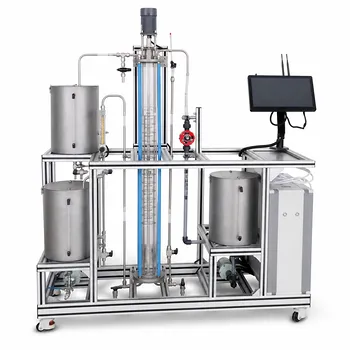
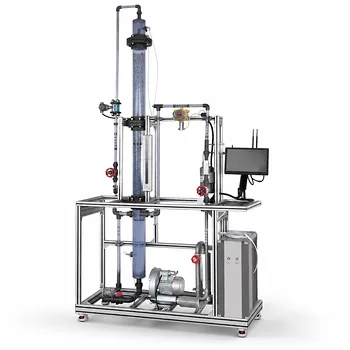
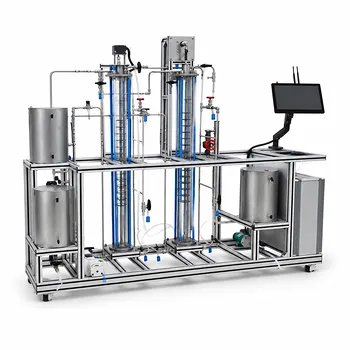
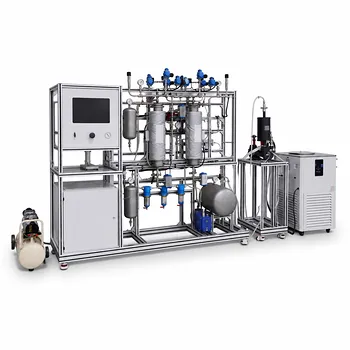
LABPARK provides premium Educational and Vocational Unit Operations Pilot Plants in chemical engineering, bioprocess & biotech, and environmental & water treatment. Designed to meet the rigorous safety and educational standards of universities, research institutes, and enterprises, our pilot plants turn complex thermodynamic theory into hands-on practice.
Looking to upgrade your department's educational capabilities? Contact LABPARK today for tailored pilot plant solutions!
Related Products
- Multi-Functional Special Distillation Educational Pilot Plant
- Continuous Sieve-Plate Distillation Pilot Plant for Unit Operations Laboratory Education
- Continuous Batch Extractive Distillation Educational Pilot Plant
- Educational Rotary Disc Liquid-Liquid Extraction Pilot Plant
- Absorption and Desorption Educational Unit Operations Pilot Plant
People Also Ask
- Why does simple distillation yield higher efficiency than flash distillation? Key thermodynamic differences.
- Why is the acentric factor important in pilot plants? Fluid property prediction.
- How to Estimate Distillation Pilot Plant Tray Efficiency? O'Connell's Correlation Guide
- How to Verify Distillation Boundary Lines & Composition Regions with Pilot Plants
- How Batch vs Continuous Configuration Affects Distillation Pilot Plant Versatility & Footprint