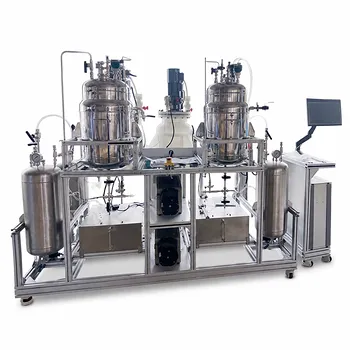
Real-time online spectroscopy directly enables advanced control by replacing slow laboratory assays with instantaneous predictions of critical properties—like boiling points or component concentrations—that automatically adjust column parameters. In a distillation pilot plant, an in-line NIR or Raman probe can measure stream composition every few seconds. A chemometric model translates that spectrum into a predicted ASTM-D86 T90 or TBP cut point. That predicted value becomes the process variable for a feed‑forward or feedback controller that manipulates reflux ratio, reboiler duty, or product draw‑off, demonstrating the closed‑loop optimization strategies used in modern refineries.
The core challenge is closing the gap between slow, manual lab data and the fast dynamics of a distillation column. The solution is to install a spectroscopic sensor directly in the process line, use multivariate models to predict the quality attribute that matters most, and feed that real‑time prediction to the process control system. This transforms a pilot plant from a simple operation exercise into a true testbed for advanced process control and industrial Process Analytical Technology (PAT).
The Technology Behind the Transformation
Which Online Spectroscopic Techniques Work Best for Distillation?
The primary reference centers on NIR spectroscopy and process NMR to predict ASTM-D86 distillation points (T10, T50, T90, FBP) and True Boiling Point (TBP) profiles in real time. NIR is exceptionally practical in pilot plants because it can measure through standard fiber‑optic probes and does not require expensive consumables.
Raman spectroscopy brings unique advantages. It can monitor multiple chemical species simultaneously, even those that are difficult to distinguish with NIR. In a distillation column handling corrosive or complex mixtures, Raman offers near‑instantaneous response—avoiding the 20‑ to 60‑minute lag of traditional on‑line gas chromatography—making it ideal for studying transient column behavior.
For a narrower quality goal, a simple diode array spectrometer with a transmission probe at the column top can track solvent purity. The instrument extracts a single quality parameter and signals the control system to switch from waste to product collection when purity crosses a threshold.
From Spectra to a Meaningful Process Variable
Raw absorbance or intensity data are useless without a translation layer. The pilot plant must integrate a chemometric model—typically built with partial least‑squares (PLS) regression or self‑modeling curve resolution—that converts the optical spectrum into a predicted physical property such as a distillation cut point or a concentration. These models are developed off‑line using a calibration set of samples and then uploaded into the analyzer or the overarching process control system. The model then runs continuously, enabling the real‑time prediction that fuels advanced control.
Architecting the Integration for Advanced Control
In‑Line vs. Bypass Probe Installation
The simplest integration puts a transmission or fiber‑optic probe directly into the column overhead line or the feed pipe. For distillation, a common arrangement is a transmission probe at the top of the column to monitor distillate purity, or a Raman probe immersed in a side‑stream to track multiple components. A bypass loop can also be used, pulling a small slipstream through a flow cell where the optical measurement occurs. The key is that the measurement cycle is seconds, not minutes, giving the control system the speed it needs.
Demonstrating Feed‑Forward Control
The primary reference highlights the value of using online spectral predictions to implement feed‑forward control. Instead of waiting for a change in feed composition to upset the column, the sensor immediately detects the shift and predicts its impact on boiling point range. The controller then pre‑emptively adjusts the reflux ratio and reboiler duty to hold the product specification steady. This is a textbook advanced control strategy and a powerful learning experience for students who otherwise only see lab‑based manual sampling.
Real‑Time Optimization and Automated Quality‑Based Switching
Once a quality prediction is streamed to the process control system, you can move beyond simple feedback loops. The control system can automatically switch exit streams from waste to product collection the moment the predicted purity drops below a predefined setpoint—eliminating manual intervention and product loss. On a broader level, the system can perform real‑time economic optimization: continuously adjusting setpoints for reflux and heat input to minimize energy use while meeting all purity constraints, just as a refinery does.
Capturing Column Dynamics That Gas Chromatography Misses
Traditional on‑line GC systems, with their 20‑ to 60‑minute cycle times, act as a low‑pass filter on the process. Students and researchers see only a smoothed, delayed picture. By integrating in‑line Raman or NIR, the pilot plant reveals true transient dynamics—for example, how the column profile shifts seconds after a feed rate disturbance or a reflux change. This immediate feedback turns the pilot plant into a hands‑on laboratory for understanding process dynamics and tuning advanced controllers.
Understanding the Trade‑offs and Potential Pitfalls
Online spectroscopy is not a plug‑and‑play magic bullet. Chemometric models require significant upfront calibration work and may need updating if the feedstock or operating region changes. The probe’s optical window must remain clean in dirty process streams. While NIR and Raman are robust, they are indirect techniques; a poorly maintained or transferred model will give wrong predictions, which an automatic controller will then act on with real consequences. Process NMR offers exquisite detail but comes at high cost and complexity, limiting its use in most educational pilot plants. Therefore, the choice of technology must balance speed, robustness, and the specific property that will drive the control strategy. A simple purity monitor with a diode array may be a far better teaching tool for some curriculums than a complex NIR system that tries to predict an entire boiling point curve.
Making the Right Choice for Your Educational or Research Goal
Define what you want to demonstrate, then let that drive your sensor and integration architecture.
- If your primary focus is on refinery‑style product property control: Use an NIR or NMR system to predict ASTM-D86 points or TBP in the feed stream and implement a feed‑forward controller on reflux ratio and reboiler duty.
- If your primary focus is on multi‑component separation dynamics or fast transients: Integrate in‑line Raman spectroscopy to monitor multiple chemical species simultaneously and replace slow GC with a data stream fast enough to reveal true column dynamics.
- If your primary focus is on basic automated quality assurance and product cut switching: Install a diode array spectrometer at the column top to track a single purity metric and trigger automatic valve switching—simple, robust, and highly visual.
- If your primary focus is on holistic PAT training: Combine a fast online spectroscopic sensor with a chemometrics lab exercise; have students build a PLS model on offline samples and then deploy it online to close a feedback loop, directly experiencing the shift from manual assay to automated analysis.
Transforming a distillation pilot plant with real‑time spectroscopy turns it from a steady‑state demonstration into a dynamic learning platform where advanced process control is not a theoretical concept but a visible, interactive reality.
Summary Table:
| Spectroscopy Tech | Key Distillation Application | Primary Advantage | Best For |
|---|---|---|---|
| NIR | ASTM-D86 / TBP profiles | No consumables, fiber-optic probes | Refinery-style control training |
| Raman | Multi-component tracking | Fast response (< minutes) vs GC | Fast dynamic/transient study |
| Diode Array | Single component purity | Simple, highly cost-effective | Auto-switching waste/product |
Elevate Your Engineering Lab with LABPARK Pilot Plants
Are you looking to bridge the gap between process theory and industrial practice? LABPARK designs and manufactures high-quality Educational and Vocational Unit Operations Pilot Plants in chemical engineering, bioprocess & biotech, and environmental & water treatment.
Whether you are a university, research institute, or enterprise, our pilot plants are engineered to integrate advanced sensors like online spectroscopy, enabling hands-on training in Advanced Process Control (APC) and Process Analytical Technology (PAT).
Ready to upgrade your lab's capabilities? Contact LABPARK today to discuss your custom pilot plant requirements with our specialists!
Related Products
- Continuous Sieve-Plate Distillation Pilot Plant for Unit Operations Laboratory Education
- Continuous Batch Extractive Distillation Educational Pilot Plant
- Multi-Functional Special Distillation Educational Pilot Plant
- Electrolyte Distillation Purification and Formulation Educational Pilot Plant
- Multi-Modal Distillation Unit Operations Training Pilot Plant
People Also Ask
- How to select the right activity coefficient model (Wilson, NRTL, UNIQUAC) for distillation pilot plants?
- How does catalyst water concentration affect distillation pilot plant design? Key separation train choices.
- What are the primary reflux ratio control strategies? Master Distillation Unit Operations
- Why is vacuum operation capability an essential feature for a distillation unit operations pilot plant? Unlock Efficiency
- How can real-time carbon number prediction improve distillation pilot plants? Optimize control.